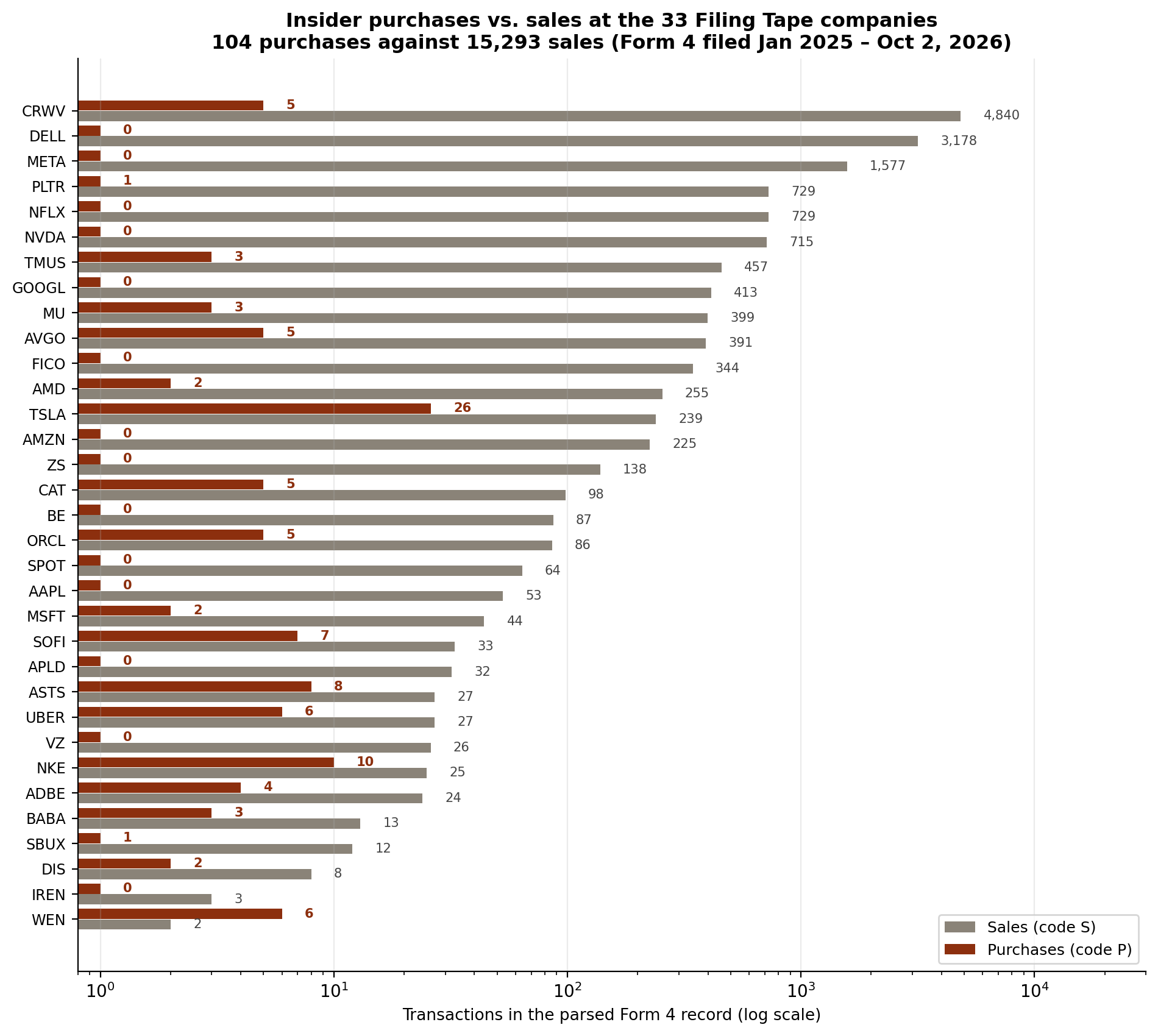
Across the first 33 Filing Tape audits, insiders filed 104 open-market purchases against 15,293 sales. At 14 of the 33 companies the purchase column is exactly zero — while insiders there sold $22.35 billion of stock in the same record.
Why this series keeps landing on the same blank cell
Every Filing Tape audit reads a company through the same filing lenses: who among 83 tracked superinvestors holds it, what the full 13F register looks like, what Congress reported, what the 13D/G register shows, how much stock is sold short — and what insiders themselves have done on Form 4. One cell of that grid came back empty so often that it stopped looking like a coincidence and started looking like the story. "Its insiders have never bought a share" ended up in headline after headline — for NVIDIA, for Amazon, for Meta — not because we went looking for it, but because the purchase column kept printing zero.
So after 33 audits we stopped treating it as a per-company quirk and counted it as a series. How rare is an insider open-market purchase, really, at the most searched, most covered companies in the market? And when purchases do happen, who is doing them?
What we counted
The count covers every Form 4 transaction in GetCoattail's parsed record: 316,796 filings across all issuers, filed between January 2025 and October 2, 2026, of which 5,450 filings belong to the 33 series companies. A purchase is a non-derivative row with transaction code P — an open-market or private purchase, the SEC's code for an insider choosing to buy. A sale is code S. Everything else is excluded by construction: equity awards (code A), option exercises (code M), gifts, tax withholding, and all derivative rows. An officer is a reporting person flagged as an officer or carrying an officer title in the filing. Dollar values are shares multiplied by the reported price, summed. The full 33-company table is published as a CSV with this article, and every figure below is recomputed from it.
Two limits belong up front. The parsed record begins in January 2025 — "never" in this article means "never in this record," a window of just under two years, not never in a company's history. And the window is a filing-date window: Form 4 is due within two business days of a trade, so filing and transaction dates sit close together — though in a sample of the record about 1% of the rows are older trades reported late or by amendment.
The zero column
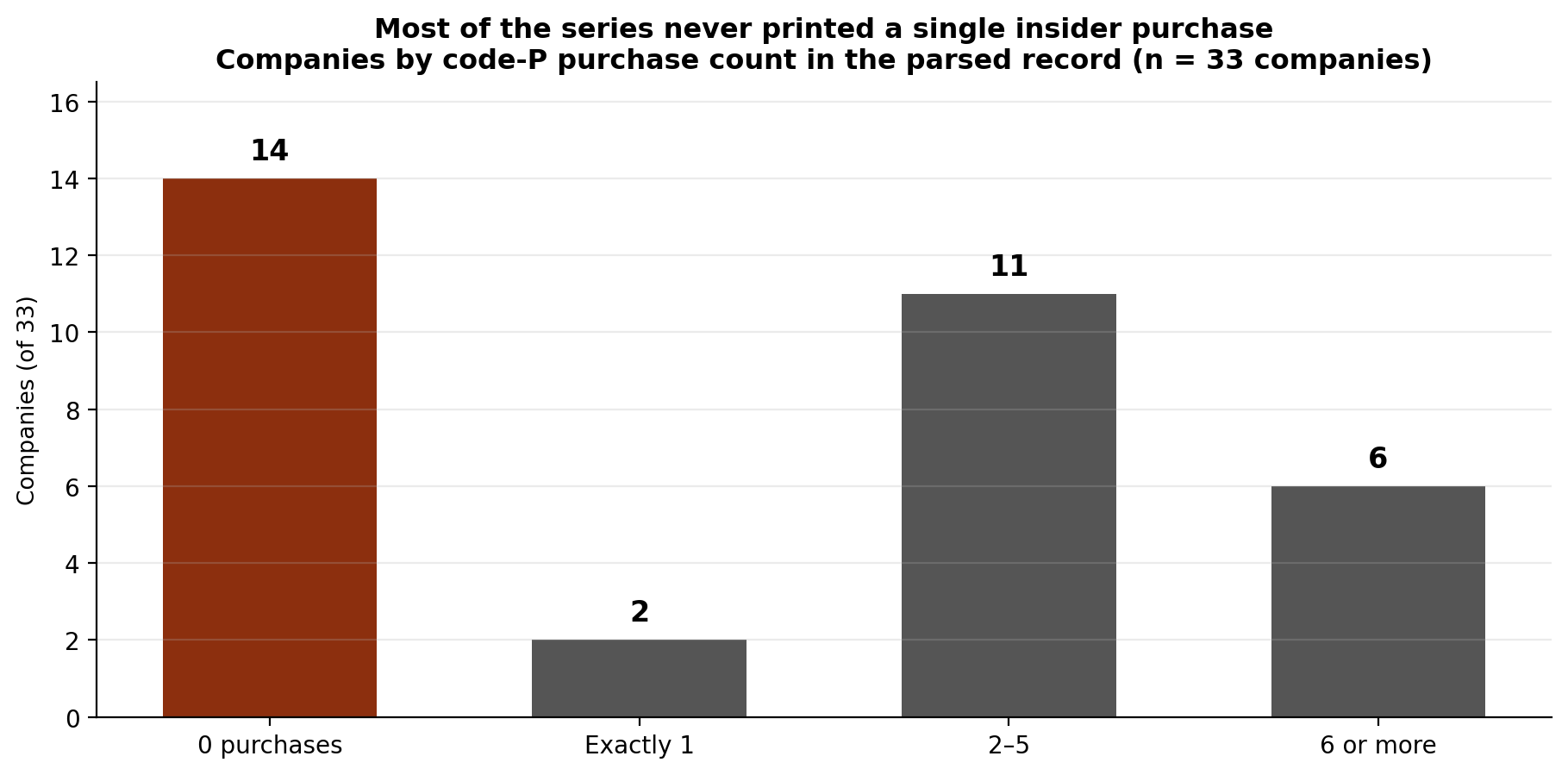
At 14 of the 33 companies — IREN, NVIDIA, Apple, Amazon, Meta, Dell, Bloom Energy, Netflix, Verizon, Fair Isaac, Alphabet, Spotify, Applied Digital and Zscaler — the parsed record contains not one code-P purchase. Zero transactions, zero shares, zero dollars, zero buyers.
These are not companies where insiders are inactive. The same 14 registers show 7,584 sale transactions totalling $22,350,128,401. Dell's insiders filed 3,178 sales worth $8.06 billion and no purchases. Amazon's filed 225 sales worth $6.18 billion and no purchases. NVIDIA's filed 715 sales worth $3.80 billion and no purchases. Meta's filed 1,577 sales and no purchases. The door, in this record, only swings one way.
The distribution across all 33 companies makes the shape clear. Fourteen companies sit at zero purchases. Two — Palantir and Starbucks — have exactly one purchase each. Eleven have between two and five. Only six have six or more.
All 33 companies, counted the same way
The complete recount behind every figure in this article. The same table is downloadable as filing-tape-33-insider-cohort.csv.
| # | Ticker | Form 4 filings | Buys (P) | Buy $ | Officer buys | Sells (S) | Sell $ | Buyers | Sellers | Holders (of 83) | Top holder % | Cohort Δ Q1→Q2 | Price Δ 2026Q2 |
|---|---|---|---|---|---|---|---|---|---|---|---|---|---|
| 1 | IREN | 18 | 0 | $0 | 0 | 3 | $66.7M | 0 | 3 | 0 | 0.0% | — | +33.4% |
| 2 | CRWV | 479 | 5 | $20.5M | 0 | 4,840 | $10.38B | 2 | 11 | 1 | 100.0% | -22.8% | +28.5% |
| 3 | MU | 134 | 3 | $7.8M | 0 | 399 | $435.6M | 1 | 14 | 5 | 99.5% | -41.3% | +241.7% |
| 4 | NVDA | 178 | 0 | $0 | 0 | 715 | $3.80B | 0 | 16 | 19 | 30.9% | -18.9% | +14.7% |
| 5 | TSLA | 51 | 26 | $1.00B | 25 | 239 | $610.5M | 2 | 7 | 6 | 84.8% | -33.2% | +13.1% |
| 6 | AMD | 128 | 2 | $1.5M | 2 | 255 | $443.8M | 1 | 7 | 6 | 52.7% | +105.7% | +185.6% |
| 7 | AAPL | 79 | 0 | $0 | 0 | 53 | $246.4M | 0 | 9 | 22 | 88.0% | -2.1% | +14.0% |
| 8 | AMZN | 124 | 0 | $0 | 0 | 225 | $6.18B | 0 | 10 | 35 | 19.2% | +14.1% | +14.4% |
| 9 | META | 391 | 0 | $0 | 0 | 1,577 | $1.41B | 0 | 11 | 31 | 24.7% | +27.1% | -1.5% |
| 10 | ORCL | 103 | 5 | $4.7M | 0 | 86 | $2.77B | 4 | 13 | 14 | 62.6% | -14.0% | -0.4% |
| 11 | DELL | 311 | 0 | $0 | 0 | 3,178 | $8.06B | 0 | 25 | 3 | 75.5% | -82.8% | +162.9% |
| 12 | BE | 123 | 0 | $0 | 0 | 87 | $462.7M | 0 | 12 | 2 | 56.3% | -26.6% | +123.4% |
| 13 | PLTR | 120 | 1 | $1.2M | 0 | 729 | $1.89B | 1 | 12 | 2 | 96.7% | -0.4% | -20.2% |
| 14 | NFLX | 389 | 0 | $0 | 0 | 729 | $1.42B | 0 | 14 | 11 | 35.0% | +104.1% | -25.7% |
| 15 | SBUX | 60 | 1 | $994,500 | 0 | 12 | $2.0M | 1 | 2 | 5 | 79.7% | -27.8% | +14.1% |
| 16 | AVGO | 96 | 5 | $1.9M | 0 | 391 | $1.83B | 1 | 10 | 13 | 42.2% | -57.9% | +22.0% |
| 17 | VZ | 467 | 0 | $0 | 0 | 26 | $20.8M | 0 | 6 | 7 | 92.2% | -0.9% | -15.7% |
| 18 | NKE | 107 | 10 | $9.7M | 3 | 25 | $46.2M | 5 | 9 | 7 | 94.1% | -1.8% | -22.3% |
| 19 | FICO | 76 | 0 | $0 | 0 | 344 | $117.4M | 0 | 6 | 8 | 48.4% | -8.5% | +11.9% |
| 20 | ASTS | 111 | 8 | $806,436 | 0 | 27 | $469.5M | 2 | 9 | 1 | 100.0% | +0.0% | +7.2% |
| 21 | MSFT | 225 | 2 | $3.4M | 1 | 44 | $254.4M | 2 | 7 | 37 | 32.6% | +3.2% | +0.8% |
| 22 | ADBE | 129 | 4 | $3.5M | 2 | 24 | $53.1M | 2 | 4 | 10 | 48.4% | +3.5% | -15.7% |
| 23 | GOOGL | 306 | 0 | $0 | 0 | 413 | $276.5M | 0 | 9 | 36 | 64.4% | +7.3% | +24.3% |
| 24 | SOFI | 158 | 7 | $2.5M | 7 | 33 | $20.5M | 3 | 6 | 2 | 95.8% | +9.9% | +12.9% |
| 25 | UBER | 211 | 6 | $16.9M | 6 | 27 | $75.5M | 4 | 5 | 12 | 54.8% | +133.6% | +0.3% |
| 26 | BABA | 36 | 3 | $25.7M | 1 | 13 | $85.8M | 2 | 5 | 9 | 72.4% | -7.3% | -23.5% |
| 27 | DIS | 130 | 2 | $2.1M | 0 | 8 | $2.5M | 2 | 3 | 20 | 28.4% | -20.0% | -0.1% |
| 28 | SPOT | 49 | 0 | $0 | 0 | 64 | $98.9M | 0 | 6 | 7 | 62.8% | -27.8% | -5.3% |
| 29 | TMUS | 140 | 3 | $3.9M | 2 | 457 | $1.76B | 2 | 15 | 1 | 100.0% | -30.6% | -20.1% |
| 30 | WEN | 185 | 6 | $126,135 | 6 | 2 | $1.8M | 5 | 2 | 4 | 68.6% | +12.0% | +19.3% |
| 31 | APLD | 66 | 0 | $0 | 0 | 32 | $34.7M | 0 | 7 | 3 | 88.0% | — | +57.1% |
| 32 | CAT | 187 | 5 | $578,536 | 0 | 98 | $274.6M | 2 | 10 | 6 | 94.2% | -0.0% | +50.3% |
| 33 | ZS | 83 | 0 | $0 | 0 | 138 | $160.1M | 0 | 12 | 1 | 100.0% | -90.6% | +0.6% |
| Total (33) | 5,450 | 104 | $1.11B | 55 | 15,293 | $43.76B |
Insider columns: parsed Form 4 record, filings through October 2, 2026. Cohort columns: 83 tracked superinvestors, 2026Q2 13F. Cohort change is undefined for IREN (no holder in either quarter) and Applied Digital (zero-share base in Q1).
The asymmetry, in totals
Add the whole series up and the imbalance is not subtle: 104 purchases totalling $1,108,681,887, against 15,293 sales totalling $43,764,195,849. That is 147 sales for every purchase by count, and $39.50 of sales for every $1 of purchases by value. The median company in the series has 2 purchases and 87 sales.
The flow is not picking up, either. Narrow the window to Form 4s filed in the last year and only 15 of the 33 companies show any purchase at all — 51 purchases in total. Narrow it to the last 90 filing days and the count falls to four companies (Alibaba, AST SpaceMobile, Uber and Oracle) and 10 purchases.
One name is doing most of the buying — and it isn't officers
The $1.11 billion purchase total sounds less one-sided than the count — until it is decomposed. Tesla alone accounts for $1,000,984,274 of it, 90.3% of every purchase dollar in the series, from two distinct buyers. Remove Tesla and the remaining 32 companies bought $107.7 million against $43.15 billion of sales: 193 sales per purchase, and roughly $401 of sales for every $1 of purchases.
Narrow the lens to officers — the people running the companies — and the column empties further. At 23 of the 33 companies, no officer has made a single open-market purchase in the record. Officer purchases exist at only 10 companies, 55 transactions in all, and 25 of those 55 are Tesla's. Excluding Tesla, officers across 32 of the most followed companies in the market bought 30 times in just under two years, for $33.9 million combined. And at 9 of the 19 companies where anyone bought at all — including CoreWeave, Micron, Oracle and Palantir — not one purchase came from an officer; directors and 10% owners did all of it.
The exceptions are real, and they are small
Two companies break the pattern outright, and both breaks are worth stating precisely. Wendy's is the only company in the series where purchases outnumber sales — 6 against 2 — though the amounts are small: $126,135 of purchases against $1.81 million of sales. Tesla is the only company where purchase dollars exceed sale dollars. Nike has the second-most purchases, 10 transactions worth $9.7 million, and Uber's register includes the September chief-executive purchase its audit flagged. These exceptions matter because they prove the column is not broken — the filing system records purchases fine when they happen. They just barely happen.
What this does not mean
Three caveats keep this count honest. First, insiders receive stock without buying it: grants and option exercises are how most insider shareholdings are built, and both are excluded here by design — this article measures discretionary purchases only, not total insider ownership, which is large at many of these companies. Second, selling is not the mirror image of buying. A sale can be diversification, tax planning, or a pre-arranged trading plan executing on a schedule set months earlier; the dataset does not flag plan sales, so the 15,293 should not be read as 15,293 bearish decisions. A purchase has no equivalent ambiguity — nobody buys on a pre-arranged plan to diversify away from cash — which is exactly why its absence is the cleaner signal. Third, the window is short. Twenty-one months that included long rising stretches for many of these names is not the whole of market history, and a different window would print a different count; the claim here is about this record, stated with its dates attached.
Two supporting patterns from the same recount
The insider lens was not the only one re-aggregated. Of the 31 companies where a first-to-second-quarter 2026 cohort change can be defined, 12 rose in price during the quarter while the 83 superinvestors cut their share count — price and the tracked register moved in opposite directions. And the register itself is often a single name wearing a crowd's clothes: among the 28 companies with two or more cohort holders, 16 have one holder at 60% or more of the cohort's shares, peaking at Micron, where one manager is 99.5% of the position. Both patterns get a short section here rather than their own piece for one reason: they describe positioning, while the purchase column describes a decision — and the decision is the rarer document.
How to read the next 33 audits
Treat the purchase column as the loudest cell in the grid precisely because it is usually silent. When a Filing Tape audit prints zero purchases, that is the base rate, not a warning — 14 of 33 household names sit there today, alongside $22.35 billion of sales. The event worth noticing is the opposite print: a first code-P purchase at one of the 14 zero companies, above all a first purchase by an officer. It is the one insider flow that is always a choice, it has happened at barely half the series even once, and it is the trigger the next audits in this series will report first.
Methodology and data
Sources: SEC Form 4 filings as parsed by GetCoattail (316,796 filings across all issuers, filed January 2025 through October 2, 2026; 5,450 filings for the 33 series companies); superinvestor holdings from Form 13F for 2026Q2 (83 tracked managers); prices from GetCoattail daily closes. A purchase is a non-derivative Form 4 row with transaction code P; a sale is code S; awards, option exercises, gifts and derivative rows are excluded. Values are shares times the reported price, summed without adjustment. "Never" is scoped to this parsed record throughout. This article measures filing counts, not returns; no trading costs or taxes arise in any figure. Episode-level detail for each company is in its Filing Tape audit, linked from the research index.
Past patterns are not a promise of future results. For education only — not investment advice.