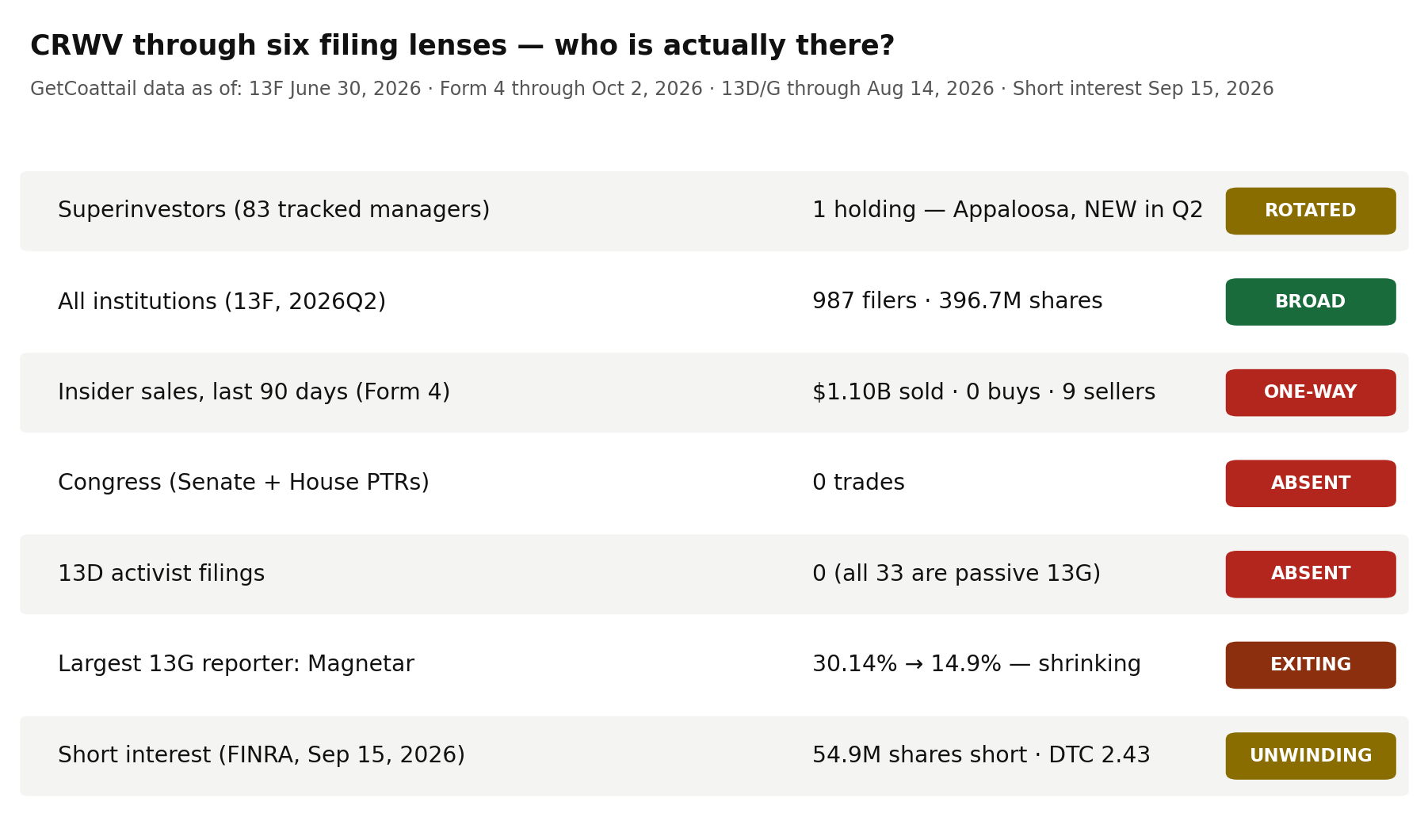
GetCoattail Research — CoreWeave is the AI cloud's defining public debut: revenue doubling, a $104 billion backlog, a JPMorgan upgrade, analyst targets more than 50% above the price. We ran it through every filing lens we maintain. The record shows one superinvestor — a new one — and $1.1 billion of insider selling in ninety days.
Start with the narrative, because it is a strong one. CoreWeave, the GPU cloud built for AI workloads, went public in March 2025 and has become the purest listed bet on AI infrastructure demand. On August 11, 2026 it reported second-quarter revenue of $2.575 billion, up 112% year over year, with a revenue backlog of $104 billion, up 246% — plus more than $25 billion of new commitments signed in the early weeks of the third quarter. The stock rose 19% in the session after the report. Management raised full-year 2026 revenue guidance to $12.4–13.2 billion. JPMorgan upgraded the shares to overweight on September 24, 2026, raising its target to $125; the published consensus average target is $138.78 across 35 firms. The stock trades around $88–90 in early October 2026, down from a 52-week high of $153.20.
Now the filings. GetCoattail tracks the portfolios, trades and disclosures of the investors with the most information about any given company: concentrated superinvestors, institutions as a whole, corporate insiders, members of Congress, and 5% holders. For CoreWeave, those lenses return a pattern that rhymes with IREN, our first Filing Tape audit — breadth without sponsorship — with one twist: the selling is coming from inside the building.
Lens 1: the superinvestors — one, and it just changed
We track 83 large, mostly long-only managers whose 13F portfolios we collect directly from SEC EDGAR. As of June 30, 2026, the number holding CoreWeave was one: Appaloosa Management, with a new position of 1,078,248 shares worth $107,328,806 — 1.39% of Appaloosa's portfolio. One quarter earlier the count was also one, but it was a different fund: Viking Global Investors held 1,397,438 shares, worth $108,259,522, at March 31, 2026, and appears nowhere in the June 30 record. The superinvestor lens did not grow. It rotated, completely, and stayed at one.
Context matters here. This cohort holds AI infrastructure when it wants to: 19 of the 83 hold NVIDIA. A one-holder reading for the sector's flagship IPO, fifteen months after its listing, is not a data gap — the filing is complete. It is a measured absence. One plausible reading is valuation discipline: CoreWeave is not yet profitable, reporting a net loss of $1,167,000,000 for fiscal 2025 on revenue of $5,131,000,000, and the cohort we track leans toward proven compounders. Whatever the reason, the re-rating narrative has so far run with a single tracked sponsor — and that sponsor arrived only last quarter.
Lens 2: institutions — breadth, arriving fast
Zoom out to the whole 13F market and the picture flips, exactly as it did for IREN. At June 30, 2026, 987 institutions reported positions in CoreWeave, up from 786 at March 31 — a 26% jump in one quarter — and 961 of them reported long positions. Reported share counts rose 35%, from 293,061,798 to 396,743,705 shares, and the dataset's reported aggregate value rose from $33.63 billion to $51.70 billion (+54%). By filer count, CoreWeave went from a new listing finding its register to a standard institutional holding in five quarters.
Breadth like this is real demand — but, again, it is not the same animal as conviction buying. A filer count approaching one thousand for a Nasdaq-100-scale name is what index baskets, ETF flows and market-making inventory produce mechanically. Which kind of holder sits at the top of the register is the next lens.
Lens 3: the 5% register — early money heading down, a partner heading up
Thirty-three SC 13D/G filings cover CoreWeave, and all thirty-three are 13G — the passive form. There is not one 13D. What the register actually shows is a changing of the guard among the pre-IPO holders. The largest reporter in the record is Magnetar Financial, an early backer, at 30.14% (107,962,916 shares, as of March 31, 2025). Magnetar has since reported 23.3% at September 30, 2025 and 14.9% (67,972,524 shares) at April 30, 2026 — the biggest name on the register has been shrinking at every step. CEO Michael Intrator's reported stake has eased from 14.0% to 10.1%. Goldman Sachs reported 8.1% at March 31, 2026 and 4.3% at June 30, 2026; Jane Street, a market-making firm, reported 6.2% at June 30, 2026.
The one large holder moving the other way is a partner, not a fund. NVIDIA reported 7.0% (24,182,460 shares) at March 31, 2025 and 11.5% (47,213,353 shares) as of January 23, 2026. NVIDIA is CoreWeave's chip supplier and a strategic shareholder; its growing stake is evidence of a commercial relationship deepening, filed in the same passive form as everything else on this register.
Lens 4: insiders — $1.1 billion sold in 90 days, zero bought
The Form 4 record is the loudest lens in this audit. In the 90 days through October 2, 2026, CoreWeave insiders filed 81 reports covering 724 sale transactions totalling $1,097,314,668 — 11,521,830 shares sold by nine insiders, 625 of the transactions by officers. Open-market purchases in the same window: zero. Not one insider bought a single share at market price.
Widen the window and the shape does not change. Over the full year through October 2, 2026, insiders recorded zero open-market purchases against 4,069 sale transactions totalling $7,199,199,365. Across the entire parsed Form 4 record — 479 filings — there are exactly five purchase transactions, worth $20,500,010.86 combined, against 4,840 sale transactions worth $10,379,797,419.85. Some of this selling is mechanical — vesting schedules and tax withholding generate filings regardless of anyone's view — and we do not assign motives to any of it. But the purchase side has no mechanical explanation. In twelve months, at prices between the $60.82 closing low of July 29, 2026 and the autumn recovery, no insider chose to buy.
Lens 5: Congress — zero
Across the full Senate and House transaction record we maintain, members of Congress have reported no trades in CoreWeave — no buys, no sells. As with IREN, the political-money lens is dark for one of the market's most debated AI names.
Lens 6: short interest — built up, then unwound by a third
As of September 15, 2026 — the most recent FINRA settlement date — 54,939,326 CoreWeave shares were sold short, roughly 10% of the 551 million weighted-average basic shares the company reported for the second quarter of 2026, with days-to-cover of 2.43.
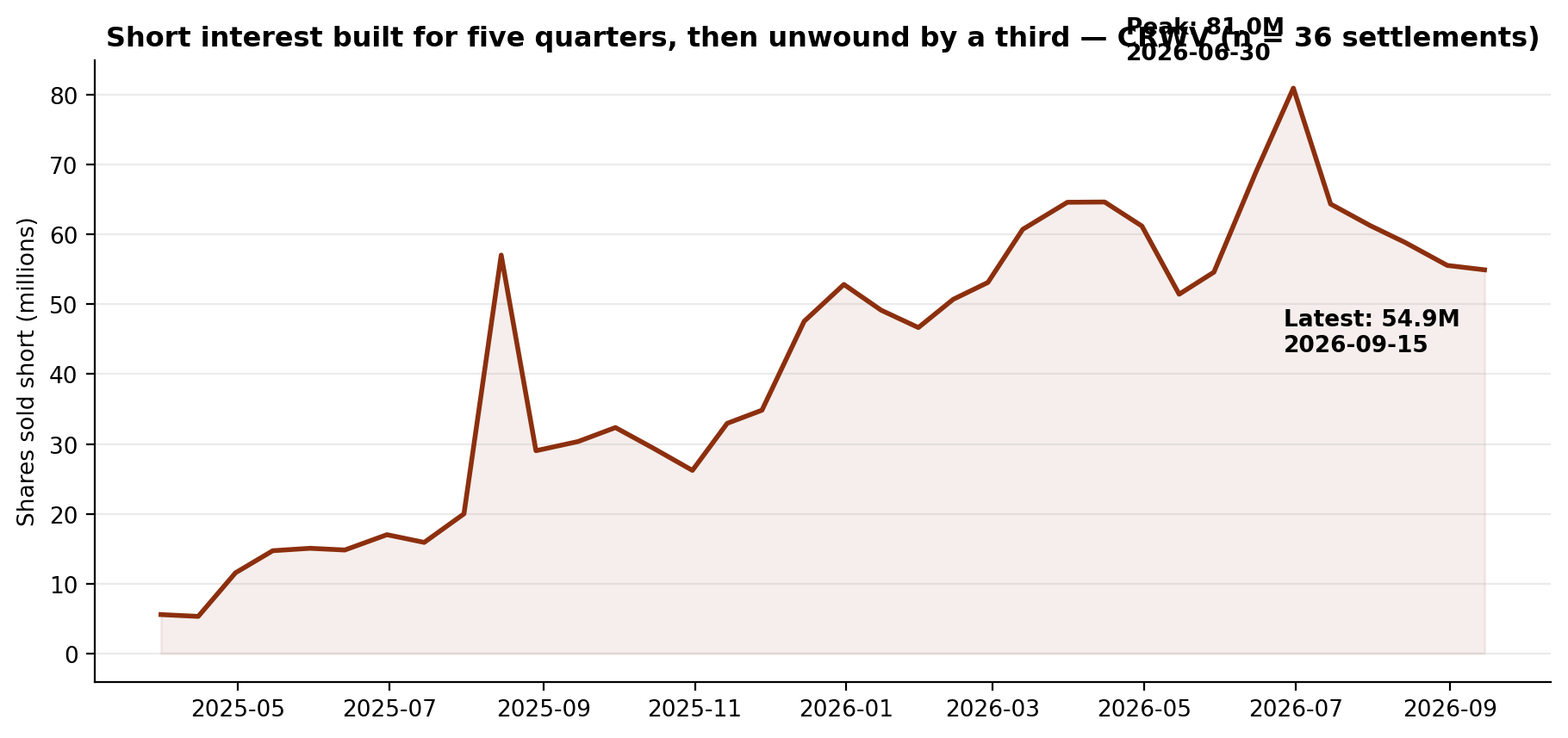
The arc is the story. Short interest was just 5,556,786 shares at the first settlement after the IPO, on March 31, 2025, and climbed almost without interruption for five quarters, peaking at 80,963,200 shares on June 30, 2026. Since that peak it has fallen at five consecutive settlements, down 32.1% — even though it remains 81.0% above its level of a year earlier (30,347,531 shares at September 15, 2025). Set against Lens 4, the balance of this audit is complete: the largest deliberate bearish position has been shrinking since June, while the insider selling has not paused at all.
What would change the picture
Nothing above is a recommendation. It is a record. These are the filings that would change the description, in the order the data will arrive:
- 1. The 2026Q3 13Fs (filing window closing mid-November 2026). A second tracked manager ends the one-holder era. So does Appaloosa adding to — or exiting — its new position, and any return by Viking. Breadth holding above 987 filers matters too: a stall would mark Q2's sponsorship as flow, not sponsorship.
- 2. The first insider open-market purchase in over a year. A single Form 4 purchase code, at any size, would break a streak that currently runs through 479 filings with five purchases in total. Watch also whether the pace of sales — $1.10 billion in the last 90 days — slows after the autumn vesting cycle.
- 3. Magnetar's next 13G amendment, and NVIDIA's. Magnetar has stepped down from 30.14% to 14.9% across three reports; whether that descent flattens or continues toward zero defines the register. A 13D from anyone converts the register from passive to intent.
- 4. Delivery against the backlog. The company guided third-quarter revenue to $3.45–3.6 billion and full-year capital spending to $35–39 billion. The share count in future 13Fs and 13G percentages is where the financing behind that spending becomes visible.
- 5. The short-interest series from its June peak. Short interest has fallen at five consecutive settlements from 80,963,200 shares (June 30, 2026). Whether it rebuilds toward that peak or keeps unwinding is the fastest-updating series in this audit: FINRA publishes it every two weeks.
Until one of those prints, the filing record describes a company whose growth numbers belong to the whole market's story — and whose own insiders and early backers are, on the record, net sellers of it.
Related reading: Zero of 83: The Superinvestors Aren't in IREN — Filing Tape #1, the same six lenses on CoreWeave's AI-cloud peer; 80% Overlap, No Copycat Signal: Congress vs. the Superinvestors — how we test whether two filing sets really move together. CoreWeave's own page: CoreWeave (CRWV) on GetCoattail.
Methodology and data notes
- Superinvestor lens: 83 managers collected directly from SEC EDGAR Form 13F (managers_13f collection), positions as of June 30, 2026 and March 31, 2026; CoreWeave identified by CUSIP 21873S108. The Q1 holder (Viking Global, CIK 0001103804) and Q2 holder (Appaloosa) were cross-checked between the EDGAR collection and the site pipeline; share counts and values match exactly in both.
- Full-market lens: SEC Form 13F Data Sets full-market aggregation (the fixtures underlying our 2026Q1–Q2 market tables). Holders = distinct filers reporting the CUSIP; 961 of the 987 reported long positions. Reported-value caution: the aggregate value ($51,700,261,278 over 396,743,705 shares) implies ≈$130.31 per share against a June 30, 2026 close of $99.54 in our price file. The gap is definitional, not a filer error: the aggregate sums the VALUE of every information-table row — including put and call option rows — while the share count covers long common-stock rows only. We therefore headline filer and share counts and label dollar values "reported."
- Insider lens: full-parse Form 4 aggregation (agg_by_ticker), record as of October 2, 2026. Sale and purchase counts are transaction-code counts (S and P) in non-derivative rows; grants and exercises are not counted as purchases. The site's 90-day insider aggregate, compiled on a different as-of date, shows the same shape (0 buys; 633 sales; $993,973,953.24).
- 13D/G lens: full-parse SC 13D/G aggregation and parsed filings (33 filings, 18 of them amendments, 56 reporters in aggregate), filings through August 14, 2026. Reporter percentages are as reported in each filing for its event date; the same holder can appear in several filings.
- Congress lens: Senate PTR archive and House PTR archive as maintained on this site; zero CRWV rows in either, checked against the raw files.
- Short interest lens: FINRA Equity Short Interest files (biweekly settlement dates), collected directly from FINRA's public distribution; the CRWV series covers 36 settlements from March 31, 2025 to September 15, 2026. FINRA publishes each settlement about two weeks after the fact. The share-count ratio uses the company's reported weighted-average basic shares for Q2 2026 — 551,000,000 (Form 10-Q filed August 12, 2026). That count combines share classes while the FINRA series covers the listed Class A line, so the ratio is approximate.
- Prices: our own daily-close file for CRWV through October 2, 2026 ($89.62 close; 252-session closing high $143.08 on October 9, 2025; closing low $60.82 on July 29, 2026). The $88.45 close for October 7, 2026 is the quote figure carried on our CRWV stock page and by Finnhub. The 52-week intraday range of $60.55–$153.20 and market-value range are quote-provider figures (Finnhub; MarketBeat via Daily Political, checked October 8, 2026) — providers differ on share count, putting market value between roughly $41 billion and $48 billion.
- Market context sources: Q2 2026 revenue, backlog and guidance — company results (August 11, 2026) as reported by Barchart, TS2 and Gate; JPMorgan target change (September 24, 2026) and consensus average ($138.78, 35 firms) — MarketBeat via The Lincolnian and TradingView. Figures we could not confirm against two sources were left out.
- Data files: CRWV lens summary — every figure in this audit by lens and as-of date (CSV) · CRWV short interest at all 36 FINRA biweekly settlements, Mar 31, 2025 – Sep 15, 2026 (CSV).
This article describes public filings as of the dates stated. It is not investment advice and makes no recommendation. Filings lag reality: 13F positions are as of June 30, 2026, and later trading is not yet public.
Revision history
- v1.0 — October 8, 2026: first publication.