GetCoattail Research — IREN is the market's loudest AI-infrastructure story: a $9.7 billion Microsoft contract, an NVIDIA partnership, analyst targets near twice the price. We ran it through every filing lens we maintain. The cohorts whose buying usually validates a story like this are not there — and that absence, measured precisely, is the story.
Start with the narrative, because it is a good one. IREN, the former bitcoin miner Iris Energy, is rebuilding itself as an AI cloud. It signed a five-year, $9.7 billion GPU cloud contract with Microsoft in November 2025, deploying NVIDIA GPUs at its Childress, Texas campus — and a $3.4 billion AI cloud agreement with NVIDIA itself. Management targets more than $4 billion of contracted annual recurring revenue operational by the end of December 2026, against roughly $1 billion operating in late August. JPMorgan flipped from underweight to overweight in September 2026 and raised its target to $65; published consensus averages sit between roughly $78 and $81. The stock trades around $40 in early October 2026, with a market value near $16.4 billion.
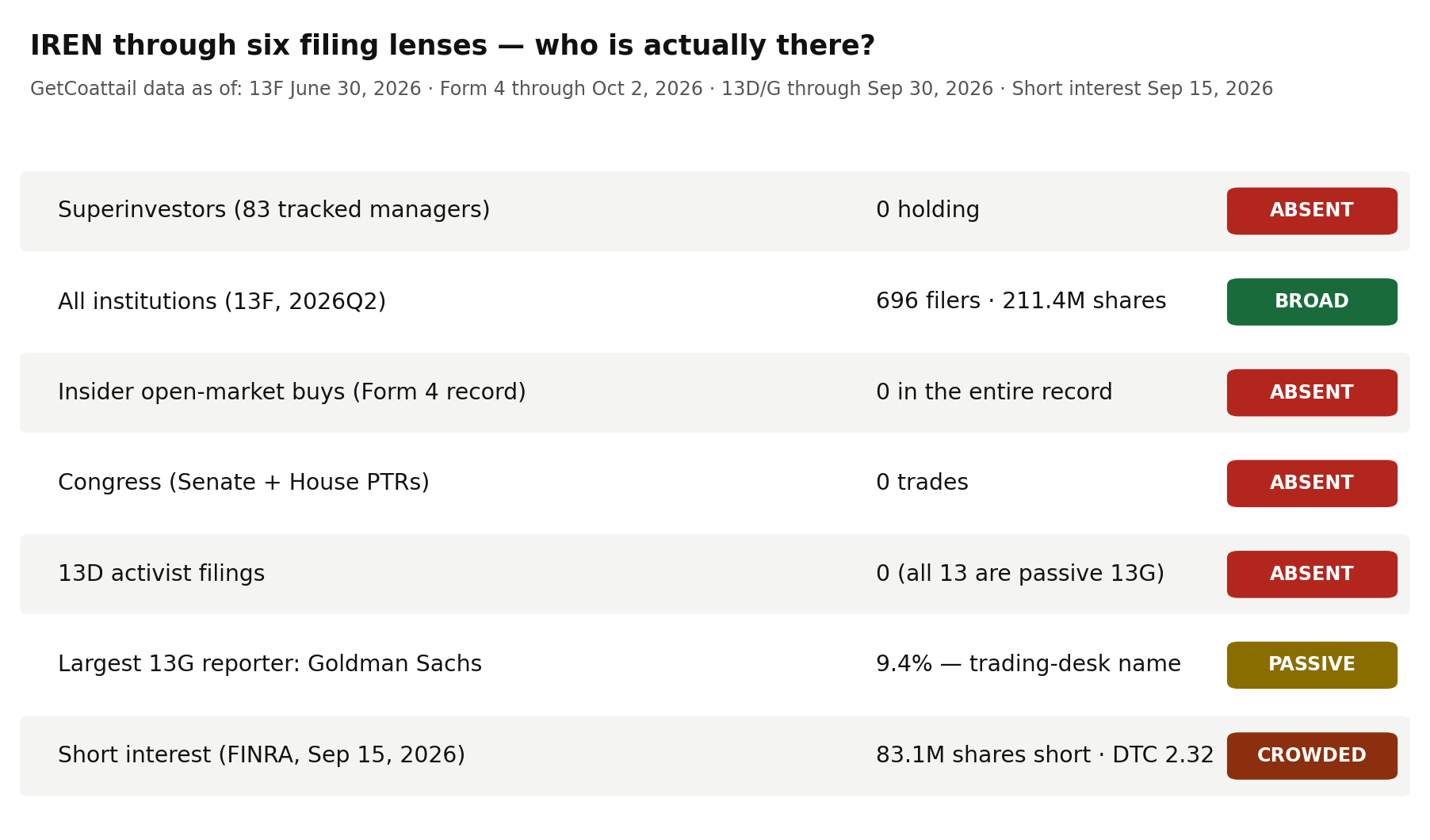
Now the filings. GetCoattail tracks the portfolios, trades and disclosures of the investors with the most information about any given company: concentrated superinvestors, institutions as a whole, corporate insiders, members of Congress, and 5% holders. For IREN, those lenses return an unusual pattern — breadth without conviction.
Lens 1: the superinvestors — zero
We track 83 large, mostly long-only managers whose 13F portfolios we collect directly from SEC EDGAR — the concentrated, long-horizon cohort this site is built around. As of June 30, 2026, the number holding IREN was zero. It was also zero at March 31, 2026. This is not a small-sample quirk: across the same managers' portfolios, a $16 billion company with a contracted-revenue story is exactly the kind of name that shows up somewhere. It shows up nowhere.
Absence is not a verdict, and we do not present it as one. This cohort leans toward profitable compounders, and IREN is not one yet: for the fiscal year ended June 30, 2026, it reported revenue of $707.0 million and a net loss of $702.6 million — most of it $638.8 million of non-cash impairments on retired bitcoin-mining equipment — while AI cloud revenue grew from $16.4 million to $128.8 million. A manager can admire the contracts and still wait for the income statement. What the zero establishes is narrower and still useful: the re-rating so far has happened without a single one of the 83.
Lens 2: institutions — breadth, arriving fast
Zoom out to the whole 13F market and the picture flips. At June 30, 2026, 696 institutions reported long positions in IREN, up from 499 at March 31 — a 39% jump in one quarter. Reported positions totalled 211,372,822 shares, and the dataset's reported aggregate value rose from $9.98 billion to $17.70 billion (+77%). By filer count, IREN went from a niche holding to a standard one in a single quarter.
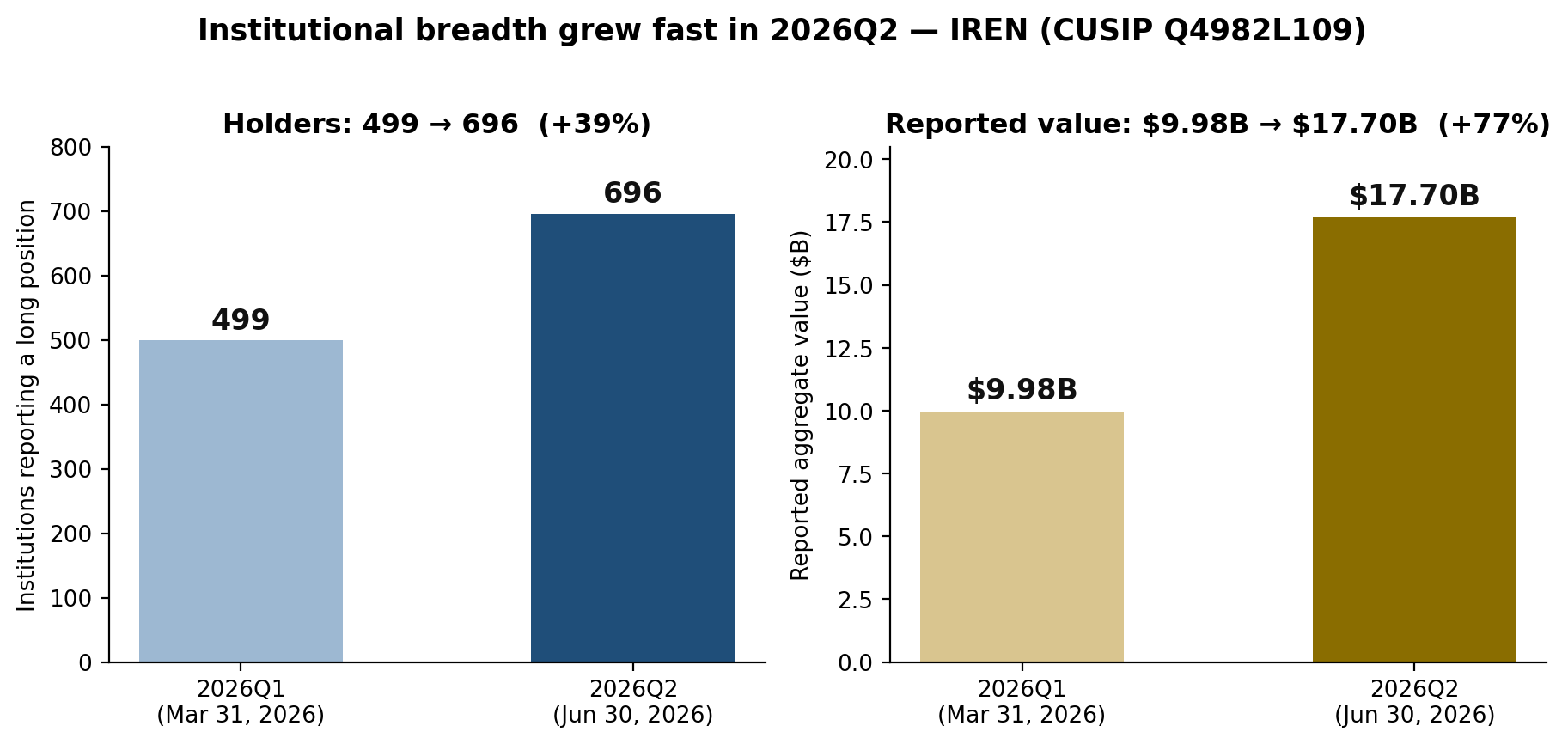
Breadth like this is real demand — but it is not the same animal as conviction buying. A filer count in the high hundreds for a stock of IREN's size is what index inclusion, ETF baskets and market-making inventory produce mechanically. The next lens shows which kind of holder sits at the top of the register.
Lens 3: the 5% register — desks, not activists
Thirteen SC 13D/G filings cover IREN, and all thirteen are 13G — the passive form. There is not one 13D, the filing an investor uses when it wants something from management. The largest reporter is the Goldman Sachs Group at 9.4% (33,642,054 shares, as of June 30, 2026), followed by Bank of America at 5.8% (21,027,180 shares). The most recent filing, on September 30, 2026, is Citadel Securities at 4.5%. The other large names are of the same type — Susquehanna and Jane Street are market-making firms — and their recent direction is down: Susquehanna reported 7.0% at September 30, 2025 and 4.2% at December 31, 2025; Jane Street went from 6.4% to 4.7% over the same dates. Banks and trading desks hold inventory for many reasons, client facilitation among them; a 13G from a desk is evidence of activity, not of a view.
Lens 4: insiders — grants in, nothing bought
The Form 4 record is the cleanest lens of the six, because insiders are the people who know. Across IREN's entire parsed Form 4 record — 18 filings, with coverage reaching back to 2021 — there is not one open-market purchase by any insider, at any price, including the $29.31 closing low of July 29, 2026. What the record contains instead is selling and granting. In September 2025 the two co-CEOs, Daniel and William Roberts, each reported the sale of 1,000,000 shares at $33.131 — the same jointly held position reported by both, so counted once it is roughly $33.1 million — alongside derivative sales over 500,000 underlying shares on each of September 3 and 4, 2025. Director Christopher Guzowski sold 11,958 shares at $36.32 on September 16, 2025. On July 1, 2026, each co-CEO received grants totalling 9,651,525 shares at $0, the CFO received 26,968, and four directors received between 6,657 and 8,369 each. Grants are compensation, not purchases; they cost the insider nothing and say nothing about what insiders would pay. In the 90 days through October 2, 2026, insiders filed nothing at all.
Lens 5: Congress — zero
Across the full Senate and House transaction record we maintain, members of Congress have reported no trades in IREN — no buys, no sells. For a stock at the centre of the AI-infrastructure debate, the political-money lens is simply dark.
Lens 6: short interest — the one crowded position
The last lens now has its number. As of September 15, 2026 — the most recent FINRA settlement date — 83,089,334 IREN shares were sold short: roughly 23% of the 357,378,674 shares IREN has most recently reported outstanding to the SEC.
The build was steep. Short interest stood at 20,586,418 shares on January 31, 2025 and has roughly quadrupled since, up 168% in the twelve months to September 15, 2026. It peaked on July 31, 2026 at 98,219,154 shares, and has since fallen at three consecutive settlements — 94,246,133, then 93,610,835, then 83,089,334 — down 11.2% in the latest period and 15.4% from the peak.
One calibration: days-to-cover is 2.32. IREN trades tens of millions of shares a day, so a short equal to nearly a quarter of the reported share count is still only about 2.3 days of average volume — the crowding is in the share count, not in the exit. Set against the long side, the balance of this audit is complete: breadth without a single conviction buyer in the filing record, and a large, deliberate position on the short side — one that has been shrinking since July.
What would change the picture
We do not issue a view on IREN. We publish the checklist that would change the description above, in the order the data will arrive:
- 1. The 2026Q3 13Fs (filing window closing mid-November 2026). A first position by any of the 83 tracked managers ends the zero. So does breadth holding up: if the filer count stalls or reverses from 696 — with the stock sitting 45% below its closing high of $76.41 (November 5, 2025) — the Q2 breadth was momentum, not sponsorship.
- 2. The first insider open-market purchase, ever. A single Form 4 purchase code — at any size, at any price — would be the first time someone inside IREN paid market price for its future. Watch also for selling resuming after the July 2026 grants.
- 3. A 13D. One activist filing converts the 5% register from inventory to intent.
- 4. Delivery against the December 2026 ARR target, and the financing behind the $25–30 billion of guided fiscal-2027 capital spending. New share issuance shows up in future 13F share counts and 13G percentages; the December-quarter ARR figure shows up in results expected in early November and in the fiscal second quarter that follows.
- 5. The short-interest series from its July peak. Short interest has fallen at three consecutive settlements from 98,219,154 shares (July 31, 2026). Whether it rebuilds toward that peak into the December ARR delivery — or keeps unwinding — is the fastest-updating series in this audit: FINRA publishes it every two weeks.
Until one of those prints, the filing record describes a stock owned by almost everybody's index and almost nobody's conviction.
Related reading: 80% Overlap, No Copycat Signal: Congress vs. the Superinvestors — how we test whether two filing sets really move together; 866 Senate Stock Trades vs. $55 Million in One Stock — who trades, who holds, and why the two leaderboards disagree.
Methodology and data notes
- Superinvestor lens: 83 managers collected directly from SEC EDGAR Form 13F (managers_13f collection), positions as of June 30, 2026 and March 31, 2026; IREN identified by CUSIP Q4982L109 (foreign CUSIP — IREN is Australian-domiciled). Zero hits in both the EDGAR collection and the site pipeline, cross-checked.
- Full-market lens: SEC Form 13F Data Sets full-market aggregation (the fixtures underlying our 2026Q1–Q2 market tables). Holders = distinct filers reporting the CUSIP; 672 of the 696 reported long positions. Reported-value caution: the aggregate value ($17,699,394,940 over 211,372,822 shares) implies ≈$83.74 per share against a June 30, 2026 close of $45.73 in our price file. The gap is definitional, not a filer error: the aggregate sums the VALUE of every information-table row — including put and call option rows ($8.03 billion for IREN) — while the share count covers long common-stock rows only. On long rows alone, reported value is $9,655,496,647 (≈$45.68 per share, matching the close). We therefore headline filer and share counts and label dollar values "reported."
- Insider lens: full-parse Form 4 aggregation (agg_by_ticker), record as of October 2, 2026; 2021–2024 coverage cross-checked against the acquisition archive (zero IREN filings). The published aggregate counts the Roberts brothers' joint sale twice (2,011,958 shares, $66,696,314.56); the article counts the shared position once.
- 13D/G lens: full-parse SC 13D/G aggregation, filings through September 30, 2026 (13 filings, 4 of them amendments, 21 reporters).
- Congress lens: Senate PTR archive and House PTR archive as maintained on this site; zero IREN rows in either, checked against the raw files.
- Short interest lens: FINRA Equity Short Interest files (biweekly settlement dates), collected directly from FINRA's public distribution; the IREN series covers 116 settlements from November 30, 2021 to September 15, 2026. FINRA publishes each settlement about two weeks after the fact, so this lens is backward-looking too. The share-count ratio uses IREN's dei reported shares outstanding — 357,378,674 shares as of April 30, 2026 (Form 10-Q filed May 8, 2026); SEC data carries no newer company-reported count, and issuance since that date would lower the ratio. Days-to-cover as reported by FINRA (2.32 at September 15, 2026).
- Prices: our own daily-close file for IREN through October 6, 2026 ($41.745 close; 252-session closing high $76.41 on November 5, 2025; closing low $29.31 on July 29, 2026). The 52-week intraday range of $28.93–$76.87 and the ≈$16.4 billion market value are quote-provider figures (Yahoo Finance / Finnhub, checked October 7, 2026).
- Market context sources: Microsoft contract (five-year, $9.7B, announced November 3, 2025) and NVIDIA agreement ($3.4B cloud contract, $2.1B equity warrant) — company announcements as reported by Barchart and ConvergeDigest; ARR and capital-spending guidance — company fiscal-2026 reporting (August 27, 2026) as reported by Barchart and ConvergeDigest; fiscal-2026 revenue and net loss — company results as reported by Yahoo Finance; JPMorgan target change (September 14, 2026) and consensus averages — MarketBeat via American Banking News and MEXC. Figures we could not confirm against two sources were left out.
- IREN is not currently in the GetCoattail stock-page universe; this audit was run from the underlying collections directly.
This article describes public filings as of the dates stated. It is not investment advice and makes no recommendation. Filings lag reality: 13F positions are as of June 30, 2026, and later trading is not yet public.
Revision history
- v1.0 — October 8, 2026: first publication.