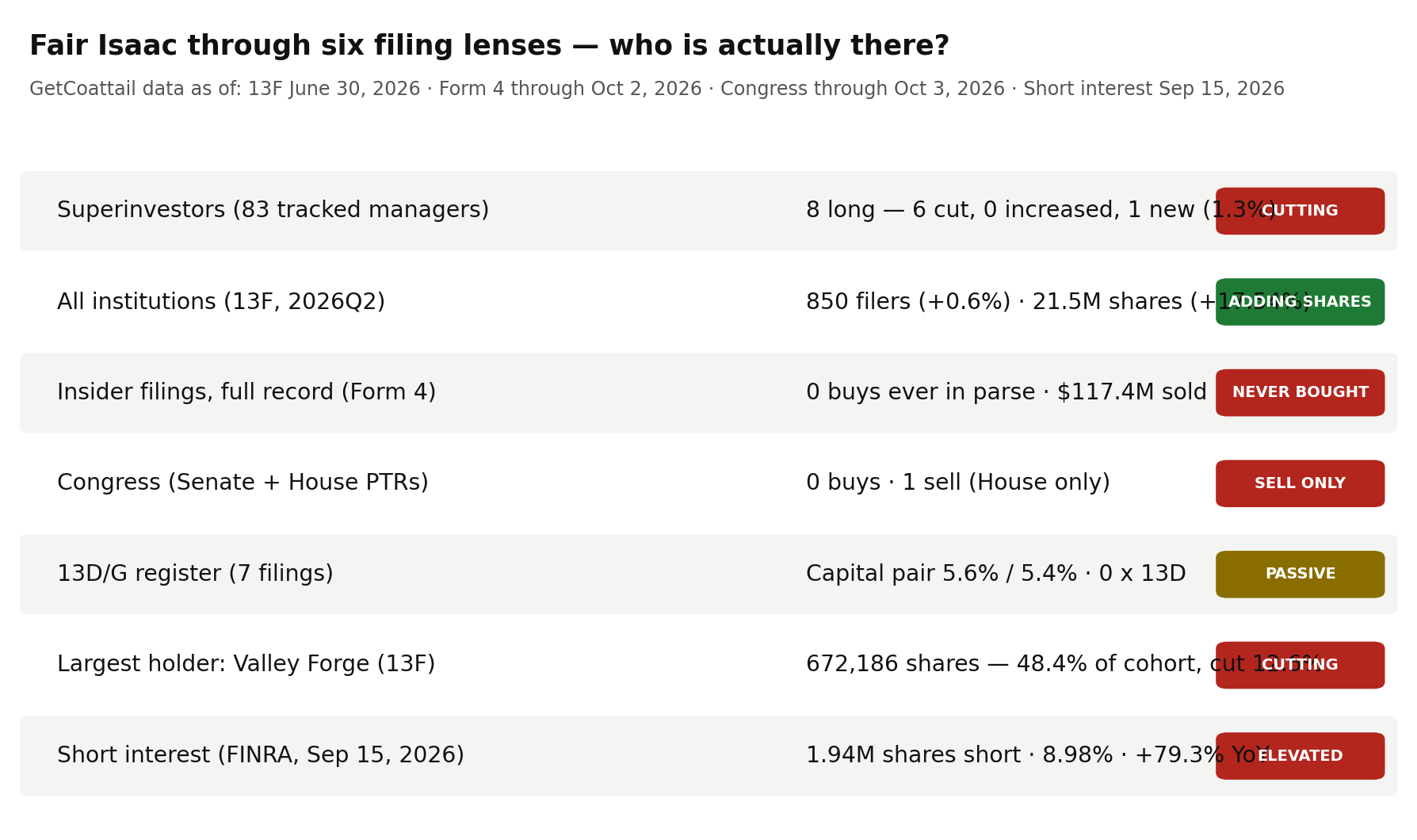
GetCoattail Research — The Filing Tape #19. Fair Isaac is the market's broken moat story: a federal mortgage-pricing change that put a rival score on equal footing, a September collapse that included a 26.5% single-day fall in our price file, and a stock down 60.9% this year — even as its latest quarter grew revenue 25.7% and raised full-year guidance. We ran it through every filing lens we maintain. Eight of our 83 tracked superinvestors hold it at all — six of them cut in the second quarter, none increased — and its insiders have recorded no open-market purchase anywhere in the parsed Form 4 record.
Start with the narrative, because at the moment it is a regulation story, not an earnings story. Through 2026 the Federal Housing Finance Agency opened Fannie Mae and Freddie Mac underwriting to VantageScore 4.0, a direct rival to the FICO Score: a limited rollout began April 22, access expanded to all approved lenders September 9, and on September 30 upfront fees were aligned across Classic FICO and VantageScore 4.0. Classic FICO remains eligible; FICO 10T is not yet eligible for loan delivery. Our price file shows the result: $1,118.93 on September 3, $932.26 on September 4, $840.89 on September 28 and $617.87 on September 29 — down 26.5% in one session — before a 252-session closing low of $592.47 on September 30. Coverage described September as the stock's worst month on record. Operating results pointed the other way: third-quarter revenue, reported July 29, reached $674.2 million, up 25.7%, with Scores revenue of $458.9 million, up 41%, Software revenue of $215.3 million, up 2%, EPS of $12.18 against an $11.76 consensus, and fiscal 2026 revenue guidance raised to $2.53 billion. The balance sheet added debate: $3.1 billion of buybacks in the first nine months of fiscal 2026, about 4.0 times operating cash flow of $777.9 million, took total debt to $5.58 billion. On October 7 the company disclosed a workforce reduction of about 15% ($27 million of expected pretax charges), and shares fell 3.9% that day in press reports. MarketBeat's consensus is Moderate Buy with an average target of $1,210.38 — ten Buy, six Hold and one Sell — but the weeks around the break brought a run of cuts: Bank of America from $1,400 to $700 with a downgrade to Neutral, Barclays from $1,700 to $935 then $875, Wells Fargo from $1,350 to $950 then $800, BMO Capital from $1,550 to $1,150, Baird from $1,549 to $1,070, and a Zacks cut to Strong Sell. AltIndex counted 50 Reddit mentions in the 24 hours to October 9, up 455.6%.
Now the filings. GetCoattail tracks the investors best placed to know any company: superinvestors, institutions, insiders, Congress, and 5% holders. For Fair Isaac — the nineteenth Filing Tape audit, after IREN, CoreWeave, Micron, NVIDIA, Tesla, AMD, Apple, Amazon, Meta, Oracle, Dell, Bloom Energy, Palantir, Netflix, Starbucks, Broadcom, Verizon and Nike — the story is a tracked cohort stepping back before the break, a broad register adding shares in the same quarter, and an insider register that has only ever sold.
Lens 1: the superinvestors — eight holders, six cuts, zero increases
We track 83 large, mostly long-only managers whose 13F portfolios we collect directly from SEC EDGAR. As of June 30, 2026, eight held Fair Isaac in long common-stock positions — every reported row is a long position, with no option rows in the count. Their combined position is 1,388,870 shares worth $1,659,394,188. On a like-for-like pipeline basis the cohort shrank in the second quarter, falling from 1,517,352 shares across seven holders at March 31 to 1,388,870 shares across eight holders at June 30 — down 8.5% — in a quarter when the share price rose from $1,067.54 to $1,194.78 in our price file, up 11.9%. The pipeline and EDGAR-collection second-quarter share totals agree exactly, at 1,388,870 shares.
Of the eight holders, one was new, none increased, one was unchanged and six decreased. The single new position is also the smallest story in the register: Terry Smith's Fundsmith opened with 17,953 shares worth $21,449,885, a 0.16% portfolio weight — 1.3% of the entire cohort. The largest holder, Valley Forge Capital Management, reported 672,186 shares worth $803,114,389, a 25.77% portfolio weight — 48.4% of the entire cohort — and decreased its position 12.6% in the quarter. Chuck Akre at Akre Capital Management decreased 0.5% to 361,826 shares, Lindsell Train decreased 9.3% to 226,186 shares, AKO Capital decreased 18.5% to 103,619 shares, Jensen Investment Management decreased 40.8% to 740 shares, and John Rogers at Ariel Investments decreased 0.5% to 203 shares. Yacktman Asset Management was unchanged at 6,157 shares. The top two together are 74.4% of the cohort. This register did not wait for September: six of eight holders trimmed in a rising quarter, and the only arrival was worth 1.3% of the cohort.
Lens 2: institutions — flat filer count, 17.54% more shares
Zoom out to the whole 13F market and the register moved the other way. At June 30, 2026, 850 institutions reported positions in Fair Isaac, up from 845 at March 31 — a 0.6% rise — and 843 of them reported long positions. Reported share counts rose 17.54%, from 18,264,736 to 21,467,505 shares, with 760 filers entering and 755 exiting. The dataset's reported aggregate value rose 31.0% to $26,138,716,180; the aggregate includes option rows, so we treat filer and share counts as the reliable series and the dollar figure as reported (see methodology). The implied value per share, $1,217.59, sits just 1.9% above the June 30 close of $1,194.78 — among the smallest gaps this series has recorded on this check. Almost the same filers held materially more shares in the quarter the tracked cohort cut 8.5%.
Lens 3: the 5% register — seven filings, all passive, newest from two Capital arms
Seven SC 13D/G filings cover Fair Isaac — zero 13D filings and seven 13G filings, three of them amendments, from six reporting names, the most recent filed August 12, 2026. The newest rows belong to two Capital Group arms: Capital Research Global Investors reported 1,296,893 shares (5.6%) as of June 30, 2026, and Capital International Investors reported 1,257,692 shares (5.4%) as of June 30, 2026, both filed August 12. Vanguard Capital Management reported 1,735,904 shares (7.31%) as of March 31, 2026, and Vanguard Portfolio Management reported 1,260,989 shares (5.31%) as of March 31, 2026, both in filings dated April 29. BlackRock reported 2,101,659 shares (8.6%) as of March 31, 2025. The Vanguard Group reported 0 shares (0.0%) as of March 13, 2026, after 3,069,749 shares (12.78%) as of September 30, 2025 — the same reporting-name sequence that appeared in our Broadcom, Palantir, Netflix, Starbucks, Verizon and Nike audits; we report the rows as filed, without summing them or calling the zero an exit. No 13D — the filing an investor uses when it wants something from management — has appeared at all.
Lens 4: insiders — no purchases anywhere in the parsed record
The insider lens is the starkest in this audit. Across the parsed Form 4 record for Fair Isaac (76 filings through October 2, 2026), there are zero open-market purchase transactions — no purchase shares, no purchase dollars, no buyers — against 344 sale transactions totalling 67,540 shares and $117,444,350.04, by six sellers. Nearly all of the selling is officer selling: 338 of the 344 sale transactions are recorded as officer sales. The pattern holds in every window: in the most recent year, insiders filed 46 reports covering zero purchases and 56 sale transactions totalling $20,430,669.57, by five sellers; in the 90 days through October 2, 2026, they filed five reports covering zero purchases and one sale transaction of 967 shares for $1,353,800.00, by one seller — a trade that matches press reports of a director sale at an average price of $1,400.00 on July 29. Our site's insider aggregate, compiled as of October 9, 2026, matches the full-parse 90-day figures exactly — zero purchases, one sale, $1,353,800.00, one seller — so there is no discrepancy to disclose on this lens. Some selling is mechanical — vesting, tax withholding and pre-arranged plans generate filings regardless of anyone's view — and we assign no motives. What the record establishes is narrower: across 76 filings and $117,444,350.04 of sales, the purchase column is empty in every period we can parse.
Lens 5: Congress — no buys, one sell, House only
Across the Senate and House record we maintain (as of October 3, 2026), Fair Isaac shows zero purchase transactions and one sale transaction, with no most-recent purchase recorded. The House aggregate carries the sale; the Senate aggregate has no Fair Isaac row at all. The combined record's member-count field is zero, so we report transaction counts only. Congressional disclosures report value ranges, so we record direction only. The sample is one transaction, and it is a sale.
Lens 6: short interest — 8.98% of the share count, built before the break
As of September 15, 2026 — the most recent FINRA settlement date — 1,939,188 Fair Isaac shares were sold short, with days-to-cover of 4.03. That is 8.98% of the 21,597,635 shares outstanding in our fundamentals file (a share count as of July 17, 2026) — among the highest ratios this series has recorded. The series peak is close behind the latest reading: 2,233,857 shares on July 15, 2026, with days-to-cover of 9.30, and the latest reading sits 13.2% below that peak. Year over year the borrow has grown sharply: the September 15, 2025 settlement recorded 1,081,239 shares, so the latest reading is up 79.3%.
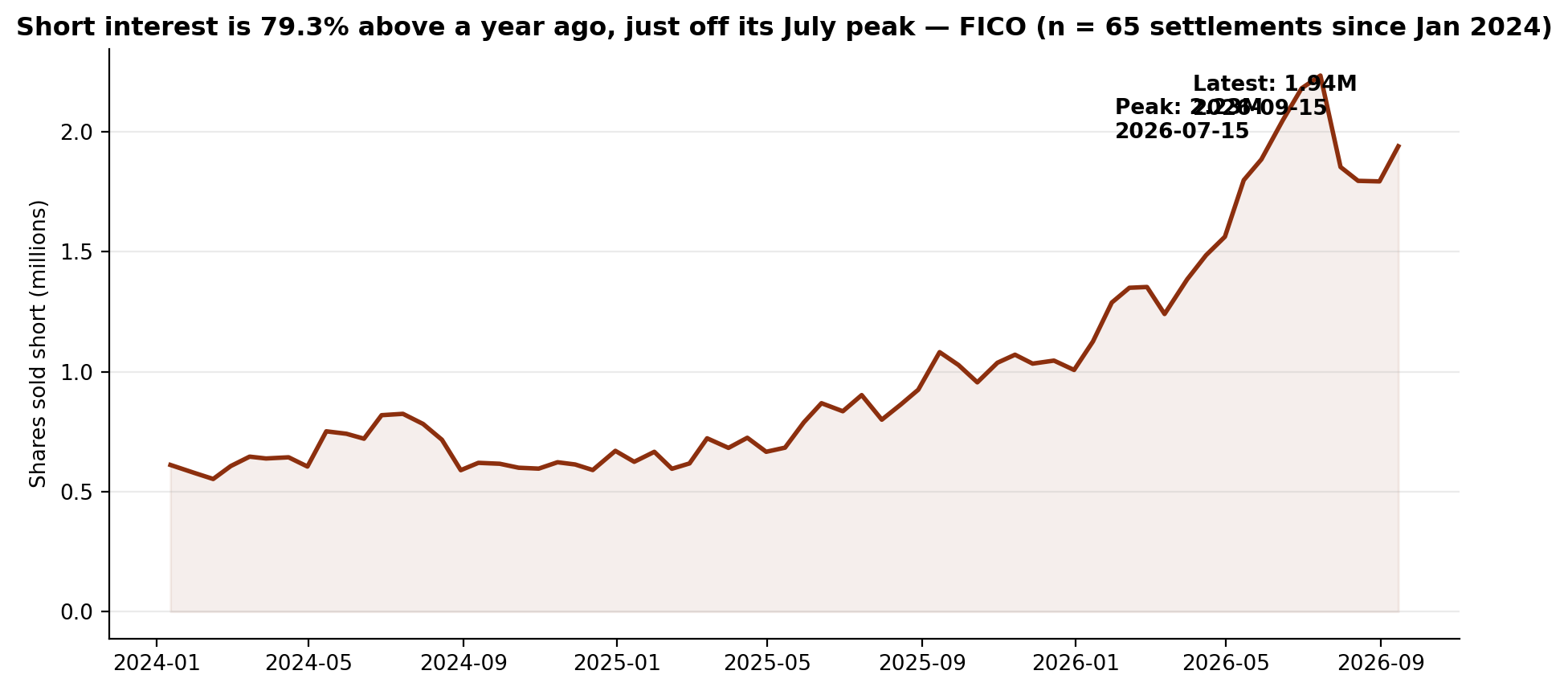
The recent settlements run 2,233,857 on July 15, then 1,852,790, 1,795,062, 1,792,796 and 1,939,188. One timing fact matters: the September 15 settlement predates the September 29 collapse by two weeks. The borrow did not react to the break; at 79.3% above its year-ago level, it was already built.
The gap, stated plainly
Fair Isaac's filing record is a study in who moved early and who has never moved at all. The tracked superinvestors hold 1,388,870 shares across eight managers, and they cut 8.5% in a quarter when the price rose 11.9% — six decreases, no increases, one unchanged register, and one new position worth 1.3% of the cohort. The full market moved the other way on shares: 850 filers, up 0.6%, holding 21,467,505 shares, up 17.54%. Insiders have recorded zero purchases across the entire parsed record — 76 filings, $117,444,350.04 of sales, $20,430,669.57 of it inside the last year, and $1,353,800.00 in the last 90 days. Congress is one House sale and no buys. And the short side was positioned before the event: 1,939,188 shares sold short at September 15, 8.98% of the share count, up 79.3% year over year, two weeks before a 26.5% single-day fall took the price to a 252-session low. One plausible reading is that the second-quarter registers already reflected a moat being repriced — named holders trimming into strength, borrowers building, insiders selling as they have throughout the parsed record — while the broad register's added shares were the other side of those trades. The record supports each clause separately; it does not say which register is right.
What would change the picture
Nothing above is a recommendation. It is a record. These are the filings that would change the description:
- 1. The 2026Q3 13Fs (filing window closing mid-November 2026). The third quarter contains the collapse — the price fell 44.7% from June 30 to October 2 in our file. Whether Valley Forge's 672,186 shares (48.4% of the cohort after a 12.6% trim), Akre's 361,826 and Lindsell Train's 226,186 survived is the whole superinvestor lens: the Q2 register cut into strength; Q3 shows whether it kept cutting into weakness.
- 2. A first insider purchase — anywhere, at any size. The parsed record holds zero purchases against $117,444,350.04 of sales. A single open-market purchase after a 60.9% year-to-date fall would be the first entry in a column that has been empty for the entire parsed record; continued silence extends a one-directional lens into the drawdown itself.
- 3. The short-interest settlements that cover September 29. The borrow stood at 1,939,188 shares on September 15, up 79.3% year over year and 13.2% off its July peak, before the collapse. Settlements published after September 29 will show whether borrowers treated the break as confirmation or as a covering opportunity: FINRA publishes every two weeks, the fastest series in this audit.
- 4. Fiscal fourth-quarter results and the first numbers after the workforce reduction. The next print tests both sides of the current argument at once: fiscal 2026 guidance of $2.53 billion of revenue against a $27 million restructuring charge, a roughly 15% workforce reduction, and a consensus target of $1,210.38 sitting above a $661.25 close in our price file.
- 5. A first congressional purchase, or a first Senate row. The record is one House sale, no buys, and no Senate row at all. Any purchase — from either chamber — changes a one-directional lens; continued sales-only prints extend it.
Until one of those prints, the record describes a stock whose broad register added 17.54% more shares in Q2 while its tracked superinvestors cut 8.5% — six decreasing, none increasing — whose insiders sold $117,444,350.04 across the parsed record without a single purchase, and whose borrow stood 79.3% above its year-ago level two weeks before the collapse.
Related reading: Seven of 83: One Holder Is 94.1% of the Superinvestors' Nike Stake. Short Interest Just Hit a Record. — Filing Tape #18; Seven of 83: One Holder Is 92.2% of the Superinvestors' Verizon Stake. Its Insiders Have Never Bought a Share. — Filing Tape #17; Zero of 83: The Superinvestors Aren't in IREN — Filing Tape #1. Fair Isaac's own page: Fair Isaac (FICO) on GetCoattail.
Methodology and data notes
- Superinvestor lens: 83 managers collected directly from SEC EDGAR Form 13F (managers_13f collection), positions as of June 30, 2026; Fair Isaac identified by CUSIP 303250104. Eight distinct managers hold long positions totalling 1,388,870 shares; all eight reported rows are long (no put or call rows). Quarter-to-quarter cohort totals (1,517,352 shares across 7 pipeline rows at March 31; 1,388,870 across 8 pipeline rows at June 30) are from the site pipeline's holdings files on the same CUSIP basis in both quarters; the change is −8.5% ((1,388,870 / 1,517,352) − 1), and the pipeline's second-quarter share total agrees exactly with the EDGAR collection's long total (difference: 0 shares). The pipeline's second-quarter value total ($1,535,715,990) is below the EDGAR collection's dollar total ($1,659,394,188) because the pipeline file carries AKO Capital's row in thousands ($123,802 for 103,619 shares); the article uses the EDGAR dollar figure for the cohort value and share counts for the quarter comparison. Valley Forge's share of the cohort is 672,186 / 1,388,870 = 48.4%; the top two holders total 74.4%; the new Fundsmith position is 17,953 / 1,388,870 = 1.3%. Direction counts across the eight long holders: 1 new, 0 increased, 1 unchanged, 6 decreased.
- Full-market lens: SEC Form 13F Data Sets full-market aggregation (the fixtures underlying our 2026Q1–Q2 market tables). Holders = distinct filers reporting the CUSIP; 843 of the 850 reported long positions. Reported-value caution: the aggregate value ($26,138,716,180 over 21,467,505 shares) implies ≈$1,217.59 per share against a June 30, 2026 close of $1,194.78 in our price file, a gap of 1.9%. The aggregate sums the VALUE of every information-table row — including put and call option rows — while the share count covers long common-stock rows only, so we headline filer and share counts and label dollar values "reported."
- Insider lens: full-parse Form 4 aggregation (agg_by_ticker), record as of October 2, 2026 (76 filings). Sale and purchase counts are transaction-code counts (S and P) in non-derivative rows; grants and exercises are not counted as purchases, and one filing can contain many transaction rows. Purchase transactions total zero across the full record (0 shares, $0, zero buyers); officer purchases also total zero. Sale transactions total 344 across the full record (67,540 shares, $117,444,350.04, six sellers), of which 338 are recorded as officer sales. In the most recent year: zero purchases, 56 sale transactions, $20,430,669.57, five sellers. In the 90 days through October 2, 2026: zero purchases, one sale transaction, $1,353,800.00, one seller. The site's insider aggregate (compiled as of October 9, 2026) matches the full-parse 90-day figures exactly.
- 13D/G lens: full-parse SC 13D/G aggregation and parsed filings (7 filings matching CUSIP 303250104, 6 reporting names), filings through August 12, 2026. The Vanguard Group's 3,069,749-share row (event date September 30, 2025, 12.78%) and its 0-share row (event date March 13, 2026) are reported as separate rows, as are the Vanguard Capital Management (1,735,904 shares, 7.31%) and Vanguard Portfolio Management (1,260,989 shares, 5.31%) rows with event date March 31, 2026; they are not summed. The aggregation's totalSharesReported field sums overlapping reporters and successive amendments and is not used. Percentages are quoted exactly as reported in the respective filings.
- Congress lens: Senate PTR archive and House PTR archive as maintained on this site, combined record as of October 3, 2026. Counts are transaction counts in the aggregated member record; congressional disclosures report value ranges, so no dollar figures are used for this lens. The combined record shows zero buys and one sell, with the member-count field at zero and no last-buy date recorded; the House aggregate (as of October 3, 2026) shows the same zero buys and one sell, and the Senate aggregate (as of October 1, 2026) has no Fair Isaac row. Because the member-count field is zero, the article reports transaction counts only.
- Short interest lens: FINRA Equity Short Interest files (biweekly settlement dates), collected directly from FINRA's public distribution; the Fair Isaac series covers 137 settlements from January 15, 2021 to September 15, 2026. The peak of 2,233,857 shares on July 15, 2026 is the peak of the full collected series; the latest reading of 1,939,188 shares sits 13.2% below it ((1,939,188 / 2,233,857) − 1). FINRA publishes each settlement about two weeks after the fact. The share-count ratio uses the fundamentals file's share count of 21,597,635 — a shares-outstanding count as of July 17, 2026.
- Fundamentals note: our fundamentals collection carries Fair Isaac's fiscal-2025 revenue of $1,990,869,000, net income of $651,946,000 and assets of $1,868,133,000 (fiscal year ended September 30, 2025). The market value of about $15.0 billion uses that file's October 6, 2026 price ($695.46) and reported share count.
- Prices: our own daily-close file for Fair Isaac through October 2, 2026 ($661.25 close, −60.9% year to date on that file; 252-session closing high $1,879.55 on October 7, 2025; 252-session closing low $592.47 on September 30, 2026; closes of $1,067.54 at March 31, 2026 and $1,194.78 at June 30, 2026, a second-quarter change of +11.9%; change from June 30 to October 2 of −44.7% ((661.25 / 1,194.78) − 1); September closes of $1,118.93 on September 3, $932.26 on September 4, $840.89 on September 28 and $617.87 on September 29, the last a one-day change of −26.5% ((617.87 / 840.89) − 1); October 1, 2026 close of $661.75). The drawdown from the 252-session closing high is −64.8% ((661.25 / 1,879.55) − 1), and the gain from the 252-session closing low is +11.6%.
- Market context sources: FHFA VantageScore 4.0 timeline (limited rollout April 22; access for all approved enterprise lenders September 9; upfront fees aligned across Classic FICO and VantageScore 4.0 on September 30; Classic FICO still eligible, FICO 10T not yet eligible for loan delivery) and September described as the stock's worst month on record — Watchlist News / The Cerbat Gem analysis and Tickeron coverage, checked October 9, 2026; fiscal third-quarter results (revenue $674.2 million, up 25.7% year over year; Scores $458.9 million, up 41%; Software $215.3 million, up 2%; EPS $12.18 against an $11.76 consensus; fiscal 2026 guidance of $2.53 billion of revenue and $42.43 of EPS) — MarketBeat coverage as carried in its July 29 earnings report and Tickeron coverage, checked October 9, 2026; buybacks and leverage ($3.1 billion repurchased in the first nine months of fiscal 2026 against $777.9 million of operating cash flow; total debt $5.58 billion, up 82.7% from $3.06 billion at September 2025; $1.5 billion term loan funding an accelerated repurchase) — Watchlist News / The Cerbat Gem analysis, checked October 9, 2026; workforce reduction (about 15% of positions, $27 million of pretax charges expected in fiscal Q4 2026, AI-driven product development framing; shares down 3.9% to $668.05 on October 7) — Barron's coverage, checked October 9, 2026; MarketBeat consensus target of $1,210.38 (Moderate Buy consensus; ten Buy, six Hold and one Sell ratings) and the September 30 – October 5 target cuts (Bank of America $1,400 to $700 with a downgrade to Neutral; Barclays $1,700 to $935 then $935 to $875; Wells Fargo $1,350 to $950 then $950 to $800; BMO Capital $1,550 to $1,150; Robert W. Baird $1,549 to $1,070) — MarketBeat coverage as carried by The Markets Daily, Defense World, American Banking News and DailyIQ's analyst-action table, checked October 9, 2026; Zacks cut to Strong Sell — MarketBeat instant alert, checked October 9, 2026; director sale matching the 90-day Form 4 row (967 shares at an average $1,400.00 on July 29, under a pre-arranged Rule 10b5-1 plan) — MarketBeat insider coverage, checked October 9, 2026; social-media attention ranking (Fair Isaac seventh among meme-stock mentions in the source ranking used for this series, 50 in 24 hours, up 455.6%, updated October 9, 2026) — AltIndex, checked October 9, 2026. Figures we could not confirm against two sources were left out.
- Fair Isaac is in the GetCoattail stock-page universe: Fair Isaac (FICO) stock page. Series data: fico_lens_data.csv · fico_short_interest_series.csv. Earlier audits: Nike · Verizon · IREN.
This article describes public filings as of the dates stated. It is not investment advice and makes no recommendation. Filings lag reality: 13F positions are as of June 30, 2026, and later trading is not yet public.
Revision history
- v1.0 — October 9, 2026: first publication.