Every week, financial feeds light up with some version of the same headline: an insider has "filed to sell" millions of dollars of stock. The filing behind the headline is Form 144, and the headline almost always overstates what the document is. A Form 144 is not a trade. It is a notice of proposed sale, filed under SEC Rule 144 when an affiliate of a company — an officer, a director, a large holder, anyone in a control relationship with the issuer — intends to sell more than 5,000 shares or $50,000 worth of stock in a three-month period. Nothing in the form guarantees the shares will actually be sold.
That gap between intention and execution is exactly what makes the form hard to use. Treat every notice as a completed sale and you will overstate insider selling. Dismiss notices as paperwork and you will miss real distribution. So we measured the gap directly: for every Form 144 filed in a window where the follow-up record is complete, we looked for the actual sale in the seller's subsequent Form 4 reports.
What we measured
Form 144 has been filed electronically on EDGAR since April 13, 2023, which makes a full census possible for the first time. Our collection holds 63,013 notices filed between April 13, 2023 and October 9, 2026, covering 1,455 tickers. To score follow-through, a notice needs a full 90 days of observable Form 4 data after it. Our parsed Form 4 corpus is effectively complete for filings from 2025 onward, so the scored sample is the 28,040 original notices (amendments excluded) filed from January 1, 2025 through July 3, 2026, across 1,353 issuers. For each notice we summed the seller's non-derivative, open-market-coded sales (transaction code S, disposition) at the same issuer over the 90 days starting on the filing date, matching on the filer's CIK. A notice "converted" if any matching sale appeared; it "executed in full" if the matched sales reached at least 90% of the noticed share count.
The headline: the sale usually happens, and it usually happens immediately
Of the 28,040 notices, 23,514 (83.9%, 95% CI: 83.4–84.3%) were followed by a confirmed sale within 90 days. Execution was not partial in most cases: 22,938 notices (81.8%, 95% CI: 81.3–82.3%) sold at least 90% of the noticed amount, and 97.6% of all converted notices reached that mark. Sales of 100% or more of the noticed amount account for 80.9% of the sample.
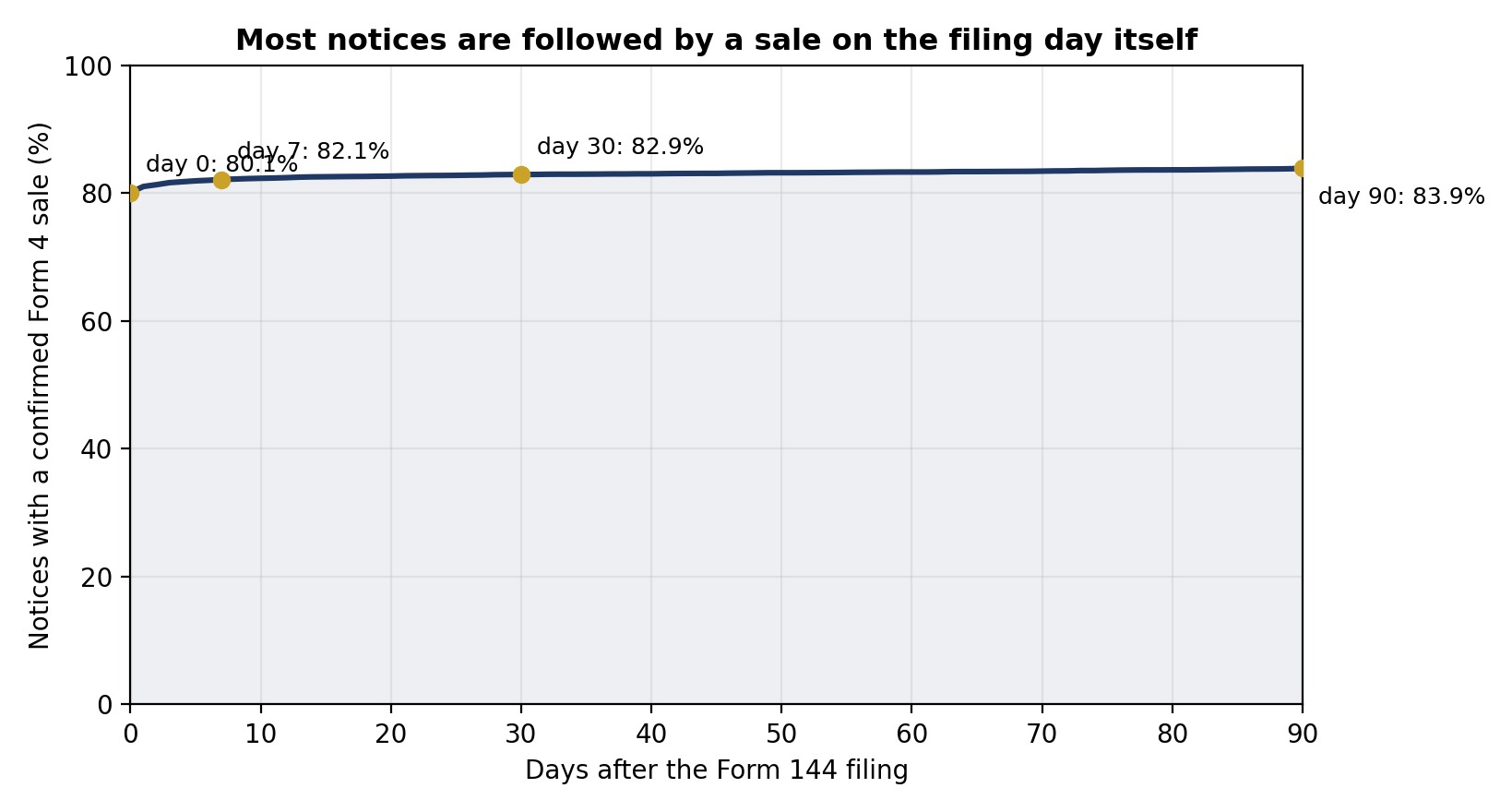
The timing is the sharpest part of the result. The median time to the first confirmed sale is zero days: 80.1% of all notices already show a sale on the filing date itself. By day 7 the figure is 82.1%, by day 30 it is 82.9%, and the remaining eight weeks add only one more percentage point. One plausible reason is built into the rule itself: a Form 144 must be transmitted concurrently with placing the sell order with a broker or executing with a market maker, so for most filers the notice and the sale are the same event seen from two sides. A notice that will convert at all has almost always converted within a week.
The distribution of execution has one wrinkle worth printing rather than hiding. In 47.4% of cases, the sales we matched inside the 90-day window exceed 110% of the noticed amount. That does not mean sellers systematically sell more than they announce. Repeat notices overlap: a seller running a multi-month programme files notice after notice, and each 90-day window catches sales that belong to neighbouring notices as well. The fulfillment ratios above 100% measure that overlap, which is why we treat "any sale" (conversion) as the primary statistic and the 90% execution rate as the conservative companion, not the reverse.
Who converts — and who is simply invisible
The aggregate 83.9% blends two very different populations. Current officers and directors — the sellers whose trades are fully visible on Form 4 — converted at 90.1% (24,736 notices; 95% CI: 89.7–90.5%), with officers at 90.7% and directors at 88.4%. Notices that list a plan adoption date, the field used to disclose sales under a pre-arranged Rule 10b5-1-style plan, converted at 91.7% against 76.6% for notices without one — consistent with planned sales being executed on schedule, though we did not test that gap for significance beyond the reported intervals.
At the other end sit the sellers Form 4 cannot see. Notices from former officers converted at 0.8% (498 notices), former directors at 1.0%, and former affiliates at 0.0%. These are not plausibly people who announced sales and never sold. A former insider generally stops filing Form 4 after leaving, so the follow-up record we match against no longer exists. Affiliates who are not officers, directors or 10% owners converted at 39.7%, and 10% owners at 61.7% — in between, as their reporting status is in between. Overall, 1,233 of the 8,199 issuer–seller pairs in our sample (15.0%) never appear in the Form 4 sales record at all. Read the headline, therefore, as a floor with a known hole in it: for the insiders readers actually track, follow-through is about nine in ten; the blended 83.9% is dragged down by sellers the confirmation system was never built to observe.
Size points the same way. Notices above $10 million converted at 72.7%, the lowest of any size band, against 86.2% for the $100,000–$1 million band. The unconverted 16.1% of notices account for $68.0 billion, or 36.9%, of the $184.4 billion total noticed value in the sample: the typical unconverted notice is a large holder's, not an officer's.
Does the result hold up?
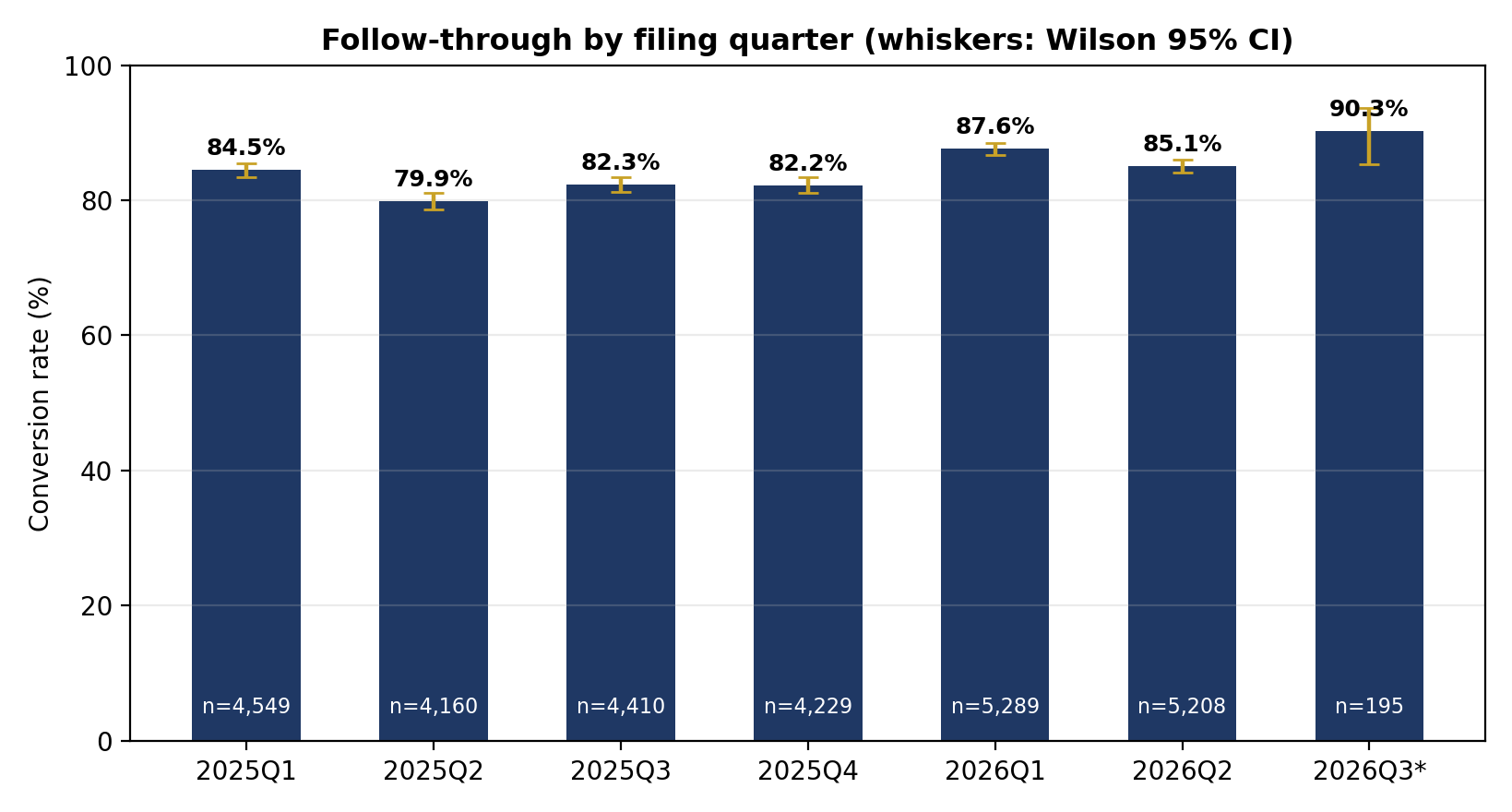
We re-ran the measurement four ways. Shortening the observation window to 30 days yields 82.9% and to 60 days 83.3% — the conclusion does not depend on the 90-day choice, because nearly everything that converts does so in the first week. Removing overlapping notices, so that each issuer–seller pair contributes only the first notice in any 90-day span (14,804 notices instead of 28,040), yields 83.3%: the double counting created by overlapping windows moves the headline by about half a point. Starting the window at the filer's stated approximate sale date instead of the filing date yields 84.4%. By filing quarter, conversion runs from 79.9% (2025Q2, n = 4,160) to 87.6% (2026Q1, n = 5,289), with no quarter anywhere near a coin flip.
| Filing quarter | Notices | Converted | Conversion rate | 95% CI | Fully executed |
|---|---|---|---|---|---|
| 2025 Q1 | 4,549 | 3,842 | 84.5% | 83.4–85.5% | 82.4% |
| 2025 Q2 | 4,160 | 3,323 | 79.9% | 78.6–81.1% | 78.0% |
| 2025 Q3 | 4,410 | 3,631 | 82.3% | 81.2–83.4% | 80.7% |
| 2025 Q4 | 4,229 | 3,478 | 82.2% | 81.1–83.4% | 79.9% |
| 2026 Q1 | 5,289 | 4,633 | 87.6% | 86.7–88.5% | 85.1% |
| 2026 Q2 | 5,208 | 4,431 | 85.1% | 84.1–86.0% | 83.2% |
| 2026 Q3* | 195 | 176 | 90.3% | 85.3–93.7% | 89.2% |
Three cases mark the range. The largest fully executed notice is also the most recognisable: on June 27, 2025, Jeffrey P. Bezos filed notice of a proposed sale of 25,000,000 Amazon shares, noticed at $5.43 billion, with a plan adoption date of March 4, 2025 listed on the form. The matched Form 4 sales total exactly 25,000,000 shares, beginning the same day — a ratio of 1.00. The typical case is smaller and quieter: a MongoDB officer's notice of 1,245 shares ($291,442) filed January 2, 2025, executed in full the same day. The largest notice with no matched sale inside its window is Fluor Corporation's notice of November 7, 2025, covering 110,936,472 shares of NuScale Power noticed at $3.60 billion. Fluor had been selling through September and October 2025, and its next matched sale falls on February 13, 2026 — 98 days after the notice, eight days outside the window. "Unconverted" in our data means "not within 90 days under this measure", and this case is the standing reminder of the difference.
The strongest objections
Three, and we do not think any of them overturns the result — but each one bounds it. First, overlap: as the 110%-plus bucket shows, windows share sales, so per-notice fulfillment above 100% is an artefact; our dedupe check bounds the effect on the headline at roughly half a percentage point. Second, invisibility cuts the other way: sellers without a Form 4 obligation cannot convert in our data even when they sell, so 83.9% understates true follow-through for the full filer population by an amount we cannot recover from these sources. Third, this is a 2025–2026 measurement. Our Form 4 corpus does not support scoring the 2023–2024 notices, and the rate is a property of this period's filers, not a law of nature. Two data-quality notes complete the list: the noticed-value field contains occasional filer entry errors — two notices totalling $42.3 billion imply per-share values above $100,000 and were excluded from dollar aggregates only (they remain in all counts and rates) — and our matching covers non-derivative sales under the seller's own filer CIK, so sales executed through a related filer with a different CIK, or in derivative form, are not counted.
How to read a Form 144
When a notice crosses your feed, three checks take a minute and use only public filings. First, identify the seller's reporting status: if the filer is a current officer or director, history says the announced sale will very likely appear — usually within days — and the Form 4 that follows is the document that confirms size and price. On any GetCoattail stock page, the insider section shows whether the Form 4 record has caught up with the notice. Second, read the plan field: a notice listing an adoption date months in the past is, in our data, the most likely of all to execute (91.7%) and the least likely to represent a fresh decision made this week. Third, size the notice against the seller, not the headline: the notices that go quiet belong disproportionately to large, non-officer holders, which is where a follow-up check matters most. What a notice never tells you is the reason for the sale, and nothing in this study measures what the stock did next — that is a different question, and we have deliberately not answered it here. Our earlier work on insider filing patterns, including insider clusters and filing delays, covers adjacent ground.
Methodology and data
Sources: SEC EDGAR Form 144 filings (full census, Apr 13, 2023–Oct 9, 2026; 63,013 notices) and SEC Form 4 filings (parsed corpus of 316,796 filings, effectively covering 2025–2026 submissions), collected by GetCoattail. Scored sample: original (non-amendment) Form 144 notices filed Jan 1, 2025–Jul 3, 2026 with a seller CIK and a stated share amount, n = 28,040. Matching: (issuer CIK, seller filer CIK = Form 4 reporting-owner CIK); sales are non-derivative Form 4 transactions with code S and disposition flag, transaction-dated within [filing date, filing date + 90 days]. Conversion = matched shares > 0; full execution = matched shares ≥ 90% of noticed shares. Intervals are Wilson score intervals. Dollar aggregates exclude two notices whose stated aggregate value implies a per-share price above $100,000 (apparent filer entry errors). Rule background: SEC, "Rule 144: Selling Restricted and Control Securities" (investor publication), and SEC Release No. 33-11070 on electronic Form 144 filing effective Apr 13, 2023. The full scored dataset accompanies this article: <a href="/research/scored_notices.csv" download>scored_notices.csv</a> (28,040 notices). Past patterns are not a promise of future results. For education only — not investment advice.
Revision history
- v1.0 — October 13, 2026: first publication. Data as of 2026-10-09 (Form 144 census) and the 2025–2026 Form 4 corpus.