A large federal contract can re-rate a stock on a date the government itself publishes. The committees of Congress oversee the agencies that award those contracts, and the officers inside the winning companies know the outcome before anyone else. If advance knowledge were leaking into trades, the 90 days before a contract starts are where it would show: purchases by the members whose committees oversee that industry, and open-market purchases by corporate insiders.
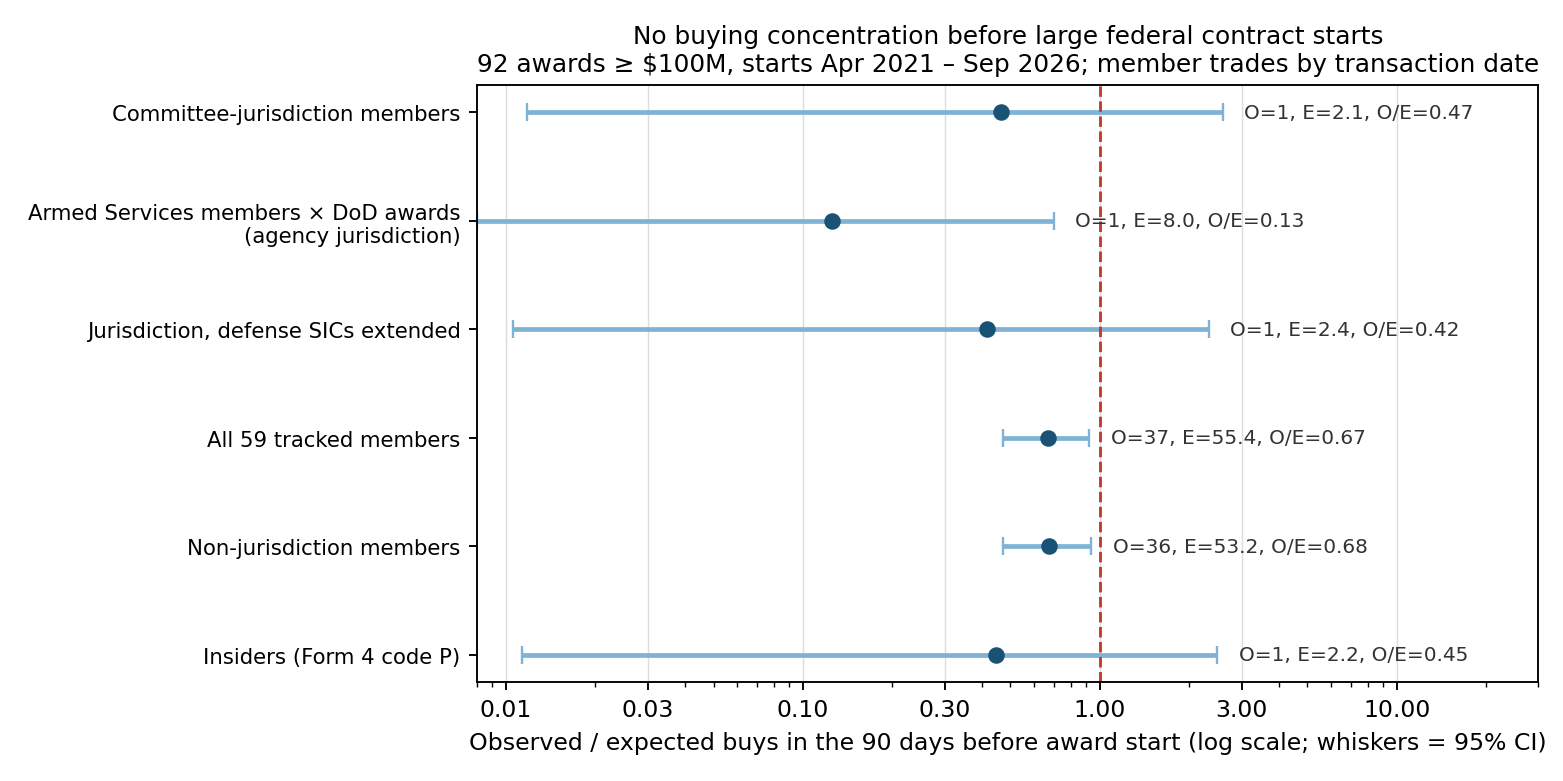
We tested that window, across every large federal award we could date. The result is close to silence. In 92 contract windows, members of the overseeing committees bought the winning company's stock once — against 2.1 purchases expected from their own normal rates. Insiders at the winning companies also bought once in the windows we could test, against 2.2 expected. And across all 59 members of Congress we track, purchases ran below the members' own baseline: 37 observed against 55.4 expected (ratio 0.67, 95% CI 0.47–0.92).
Why these two groups
Committees are where Congress touches contracting. The Armed Services committees oversee the Defense Department's programs; Energy and Commerce covers public health and drug regulation; each standing committee has an industry footprint, which our earlier research mapped to the stock market through industry (SIC) codes. A member of the committee overseeing, say, pharmaceuticals is unusually well placed to hear about a coming drug-procurement award — and unusually visible if they trade on it, because the STOCK Act requires members to report transactions in Periodic Transaction Reports, generally within 45 days of the trade date. Corporate insiders are the second group: officers and directors file Form 4 with the SEC within two business days of a trade, and an open-market purchase (transaction code P) is real money, voluntarily committed.
If either group were systematically trading ahead of contract starts, their purchases in the 90 days before a start date should bunch above their own normal rates in the same stocks. That bunching is what we measured.
What we did
Events. From our USASpending contract database we took every award of $100 million or more whose period-of-performance start date falls between April 1, 2021 and September 30, 2026: 92 awards at 32 companies, $106.5 billion. The Defense Department accounts for 40; the largest civilian source is Veterans Affairs with 27. The biggest award in the sample is Lockheed Martin's $24.6 billion Defense Department contract starting December 23, 2022.
Windows and baselines. For each award we counted purchases in the 90 days before its start date, using transaction dates, not filing dates — when the trade happened, not when it was disclosed. The comparison is each stock's own baseline: how often the same group bought that same stock on ordinary days, excluding all award windows and the 90 days after each start. Expected counts are the baseline daily rate times the window length; intervals are exact Poisson (Garwood) intervals, cross-checked with 2,000 random reshuffles of the start dates — including a variant preserving the calendar month, since federal awards cluster in September, the end of the fiscal year.
Groups. (a) The 59 members of Congress GetCoattail tracks, split into jurisdiction members — those whose committees oversee the stock's industry — and everyone else. (b) Corporate insiders' open-market purchases from Form 4. Our Form 4 archive is effectively limited to filings from 2025 onward, so the insider test covers only the 15 awards starting on or after April 1, 2025 (6 companies); the other 77 are excluded from that axis, not counted as zeros.
One design decision matters: we did not score stock performance after these windows. A USASpending start date is when the period of performance begins, not necessarily when the award was signed or announced. Returns measured from the wrong information date would prove nothing, so this study tests trading concentration only.
What we found
| Group | Observed | Expected | Ratio | 95% CI |
|---|---|---|---|---|
| Committee-jurisdiction members | 1 | 2.1 | 0.47 | 0.01–2.59 |
| Non-jurisdiction members | 36 | 53.2 | 0.68 | 0.47–0.94 |
| All 59 tracked members | 37 | 55.4 | 0.67 | 0.47–0.92 |
| Insiders (Form 4 purchases, 15 awards) | 1 | 2.2 | 0.45 | 0.01–2.49 |
Table 1: Purchases in the 90 days before contract start vs. each stock's own baseline rate. Expected counts are rounded from 2.15 (jurisdiction), 53.2, 55.40 (all members) and 2.24 (insiders).
The typical window was empty: 69 of the 92 windows contain no purchase by any tracked member at all, and the median window has zero. The largest event is typical — in the 90 days before Lockheed Martin's $24.6 billion award started, tracked members bought Lockheed Martin zero times; the same holds for General Dynamics' $6.6 billion award.
Splitting the sample does not rescue a concentration story. Defense awards: 0 jurisdiction purchases vs 1.3 expected. Civilian awards: 1 vs 0.8. Awards of $1 billion or more: 1 vs 0.9. Each company's single largest award only: 0 vs 0.7. A 45-day window: 1 vs 1.1. A 180-day window: 2 vs 3.6.
The strongest test we could build uses agency jurisdiction instead of industry: for the 40 Defense Department awards, count only members of the House and Senate Armed Services committees — the members closest to defense contracting. They buy defense stocks often enough that their baseline predicts 8.0 purchases in the pre-award windows. Observed: 1 (ratio 0.13, 95% CI 0.00–0.70). On the cut with the most statistical power, the pre-award window is not crowded — it is unusually empty.
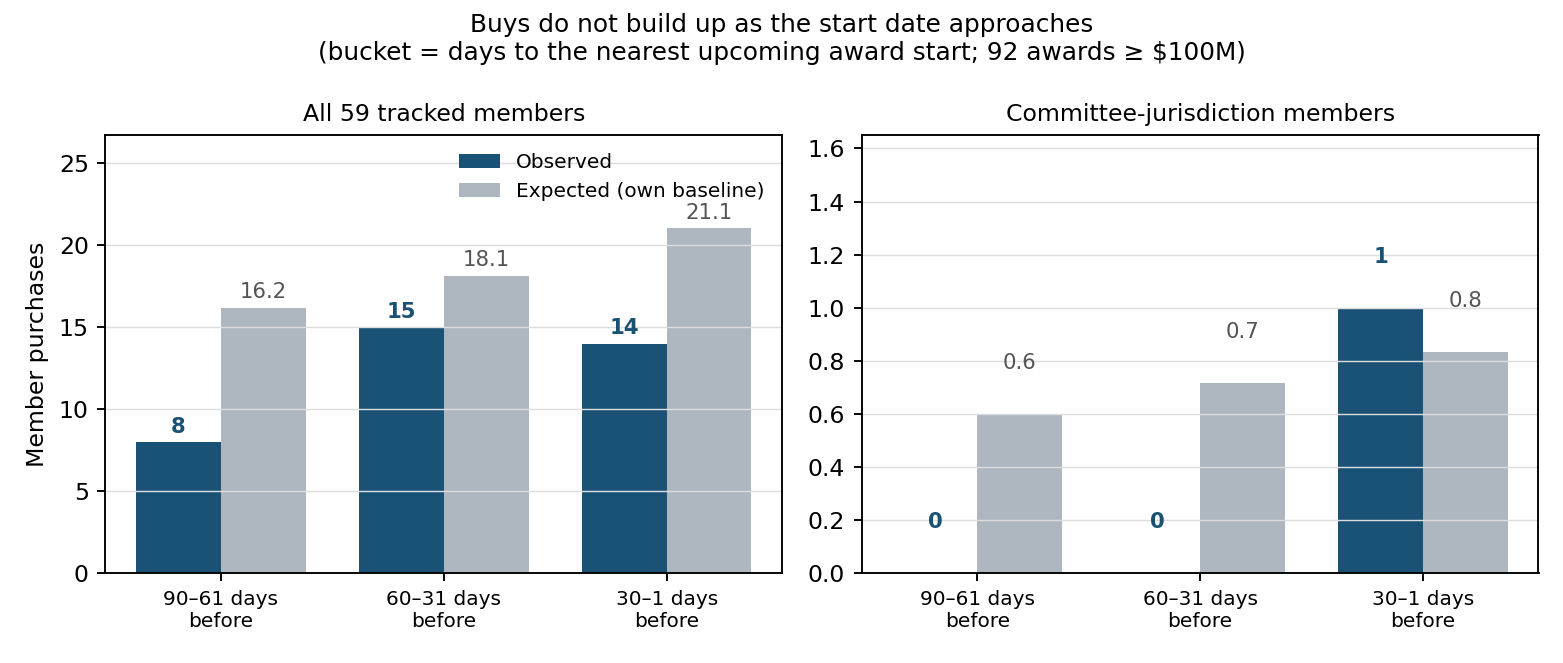
Nor does buying build up as the start date approaches. Splitting purchases by distance to the nearest upcoming start, all-member purchases ran 8 vs 16.2 expected at 90–61 days out, 15 vs 18.1 at 60–31 days, and 14 vs 21.1 in the final 30 days. There is no crescendo into the event.
The two purchases that did happen
Only two windows contain a purchase by someone in the group being tested. Both are single trades, well inside what chance alone predicts, and we report them as facts, not accusations — both were publicly disclosed, as the law requires.
The jurisdiction purchase. On July 15, 2021, Rep. Rick W. Allen of Georgia bought Pfizer stock, in the $15,001–$50,000 reporting range. Fifteen days later, on July 30, a $4.15 billion USAID award to Pfizer began its period of performance. Pfizer's industry (pharmaceuticals, SIC 2834) falls under the health jurisdiction of the Energy and Commerce Committee, on which Allen sat. One wrinkle: the report disclosing this purchase was filed on August 10, 2023 — roughly two years after the trade. Late, batch-filed reports are a recurring feature of congressional disclosure data, and one reason we score trades by transaction date rather than filing date.
The insider purchase. On August 6, 2025, Marc Ehrhardt, Olin Corporation's VP & President, Corporate Development, bought 20,000 shares of Olin on the open market at $18.6978 per share — about $374,000 — and reported it on Form 4 the next day. Forty-two days later, an Army award to Olin worth $537.2 million began. Context cuts both ways, and we draw no conclusion from it: Olin's stock had fallen substantially during 2025 (another insider bought at $28.06 in February), so the purchase is as consistent with buying a dip as with anything else. It is also the only insider purchase in 15 testable windows, against 2.2 expected.
What this does not prove
Three limits deserve plain statement.
A start date is not an announcement date. USASpending's start date is when the period of performance begins — "the date that the parties agree will be the starting date for the contract's requirements." Signing and publicity can precede it, sometimes by months, and orders under older umbrella contracts can follow it. A test keyed to signing dates could look different; ours can only say that buying does not concentrate before starts. Hence a null on trading concentration, not any claim about information.
The narrowest test is weak. Jurisdiction members trade these 32 stocks rarely — only 13 baseline purchases in nearly six years — so the expected count is just 2.1 and the confidence interval runs up to 2.59. For that specific axis we cannot rule out a concentration of up to roughly two-and-a-half times baseline. What we can rule out is concentration in the broader cuts: all members (CI tops out at 0.92) and Armed Services members before Defense awards (0.70).
Coverage is incomplete. Of 651 companies in our contract database, 113 have no award-level detail available and could not contribute events. Committee assignments are the current (119th Congress) rosters applied to the whole period — the same approximation, and limitation, as our committee-jurisdiction study. And the insider axis reaches back only to 2025 filings; 77 earlier awards are untestable on that axis.
Finally, the below-baseline counts for members overall (0.67×) should not be read as members avoiding these stocks before awards. Member trading clusters in particular periods — heavily in 2025, for example — while award starts cluster in others. The two calendars do not line up, and this design cannot say more than that.
How to check any company yourself
Every contractor in this study has a GetCoattail company page with the same lenses used here: the Politicians lens shows member trades in the stock with each member's committee assignments, and the Insiders lens shows Form 4 purchases and sales. Before treating any single pre-award purchase as meaningful, check the buyer's baseline — how often they buy that stock in ordinary times. That is the comparison this study automates. Related reading: our committee-jurisdiction study, which found members buy stocks they oversee less often than chance predicts, and our Form 144 study of how often announced insider sales actually happen.
Methodology and data
Events: USASpending awards ≥ $100M with period-of-performance start dates from Apr 1, 2021 to Sep 30, 2026 (92 awards, 32 companies, $106.5B). Member trades: Periodic Transaction Reports for the 59 members tracked by GetCoattail (48 House, 11 Senate), purchases only, transaction dates Jan 1, 2021–Sep 30, 2026 (5,828 purchases); filers matched to members by bioguide ID. Jurisdiction: the committee-to-industry (SIC) mapping published with our committee-jurisdiction study; robustness checks add SIC 3760 and 3730 to the defense group and use Armed Services membership directly. Insider trades: Form 4 open-market purchases (code P), coverage Jan 1, 2025–Sep 30, 2026; insider axis restricted to awards starting on/after Apr 1, 2025 (15 awards). Expected counts: each stock's baseline daily purchase rate (excluding award windows and 90 days after each start) times window days; intervals are Garwood exact Poisson intervals. Cross-checks: 2,000 start-date permutations, uniform and month-matched. Results were reproduced by an independent implementation using bioguide-ID matching; discrepancies: zero. Four purchases with corrupted transaction years were excluded. The full award list and every in-window purchase behind this study (two records) are published as CSVs alongside this article (events_pre_award.csv, signals_pre_award.csv).
GetCoattail tracks public filings by politicians, insiders, and large investors. This article is data analysis, not investment advice, and alleges no wrongdoing by anyone named; every trade discussed was reported as required by law.
Revision history
- v1.0 — October 13, 2026: first publication. Awards and trades through September 30, 2026.