When an insider sells under a Rule 10b5-1 plan, the standard defence is that the sale was scheduled long in advance, by a formula, at a time when the seller knew nothing special. That defence has a weak spot, and critics of the plans have pressed on it for years: what if the plan itself is new? A trading arrangement adopted in February and selling in March was written recently enough to encode what the seller knew in February. The SEC's December 2022 amendments attacked exactly this gap, imposing a cooling-off period — for officers and directors, no trades until at least 90 days after a plan is adopted. The rules have now been in force long enough to ask the empirical question: in the filings, how old are the plans that are actually selling, and does a plan's age tell you anything about the sale that follows it?
What we measured
Our earlier study matched 28,040 Form 144 sale notices filed from January 1, 2025 through July 3, 2026 to the sellers' own Form 4 reports, and found that 83.9% were followed by a confirmed sale within 90 days. This study takes the same 28,040 notices and the same matching, and adds the field that study left on the table: the plan adoption date printed on the form. Of the 28,040 notices, 13,428 (47.9%) list an adoption date. For each, plan age is the number of days from adoption to the notice. We grouped notices into four bands — under 90 days, 90–364 days, one year or more, and no date listed — then measured three things per band: how often the sale actually happened (the same 90-day Form 4 conversion test as before), what the stock did in the quarter after the first confirmed sale (63 trading days, excess over SPY, entering at the next trading day's close after the sale), and, for plans adopted under the new regime, how long after adoption the first sale arrived.
The young-plan bucket is almost empty
The first result is a headcount, and it is lopsided. Of the 13,428 plan-dated notices, 69 (0.5%) were filed within 90 days of adoption. The mass sits where the cooling-off rule pushes it: 11,778 notices (87.7%) arrived at a plan age of 90–364 days, and 1,581 at a year or more. The median plan age at filing, for plans adopted on or after April 1, 2023, is 182 days.
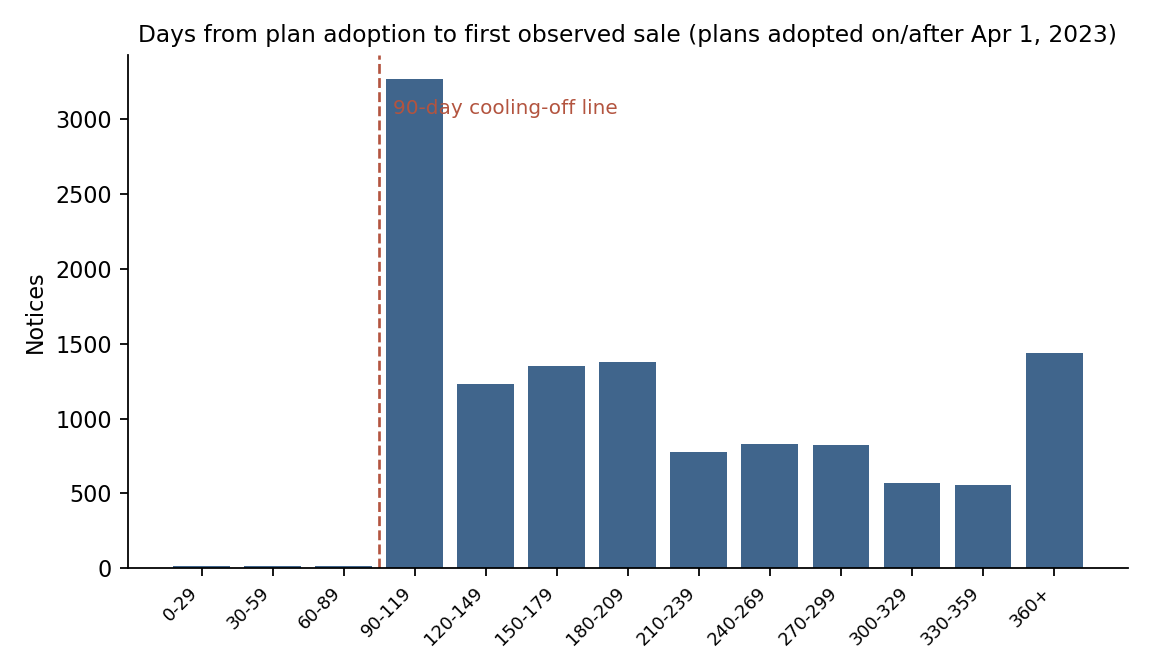
The adoption-to-first-sale gap shows the rule's fingerprint even more directly. Among 12,269 converted notices whose plans were adopted under the new regime, the median time from adoption to the first observed sale is 183 days, the 10th percentile is 93 days — just past the statutory line — and only 47 notices (0.38%) show a first sale within 90 days of adoption. The single largest band of the distribution is 90–119 days, with 3,266 notices: plans start selling almost as soon as they legally may, and essentially not before. Among officers and directors alone, the under-90-day share is 0.35% (41 of 11,862). The exceptions that do appear in the young band are disproportionately sellers the officer/director cooling-off does not govern in the same way — the largest young-plan notice in the sample is not an executive at all, but the Hershey Trust, a 10% stockholder, which filed on March 16, 2026 to sell 2,000,000 Hershey shares ($439,764,000) under a plan adopted 38 days earlier, on February 6, 2026.
Young plans also convert less — but there are barely any to convert
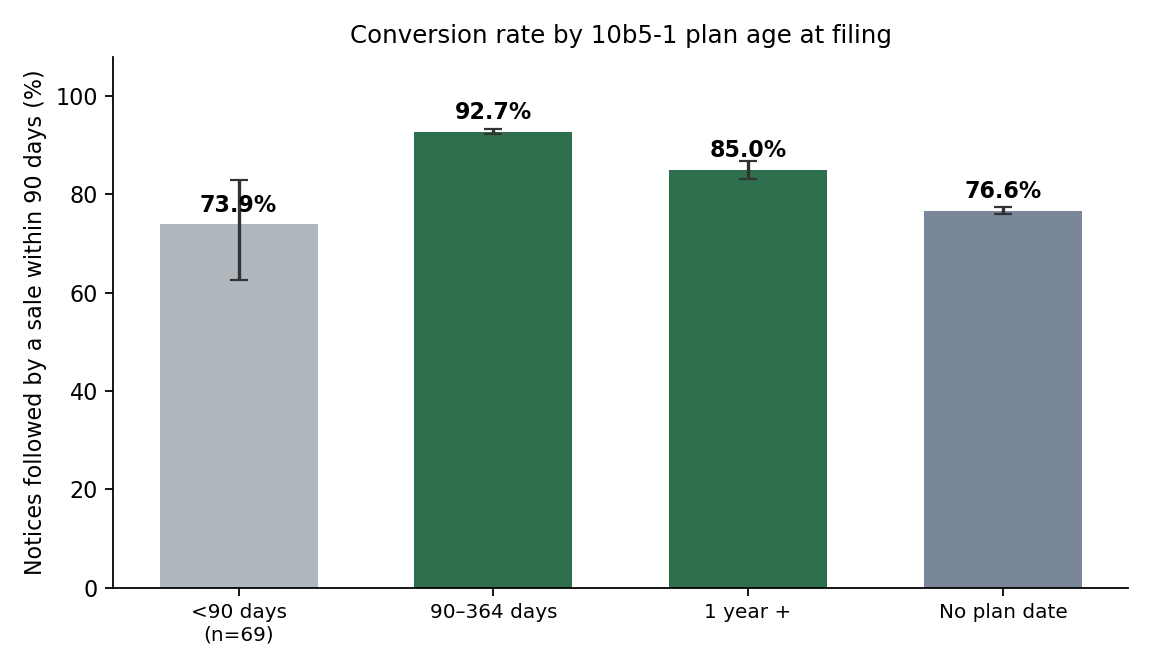
Follow-through varies by age in a hump shape. Notices at a plan age of 90–364 days converted at 92.7% (95% CI: 92.2–93.2%), peaking at 94.2% for the 90–179-day band — a plan in its first selling season behaves like a timetable. Plans a year or older converted at 85.0% (83.2–86.7%), and notices with no plan date at 76.6% (75.9–77.3%), replicating our earlier plan-versus-no-plan split. The young band converted least often, at 73.9% — but that is 51 of 69 notices, with an interval running from 62.5% to 82.8%, and it is the same band where non-officer sellers concentrate. We report the number; with a sample this small we would not build on it.
What the stock did next: no informed-selling signature
If fresh plans encoded fresh information, the stocks sold under them should sag afterwards. They do not — but the honest version of that sentence needs both the average and the typical case, because in this data they point in different directions.
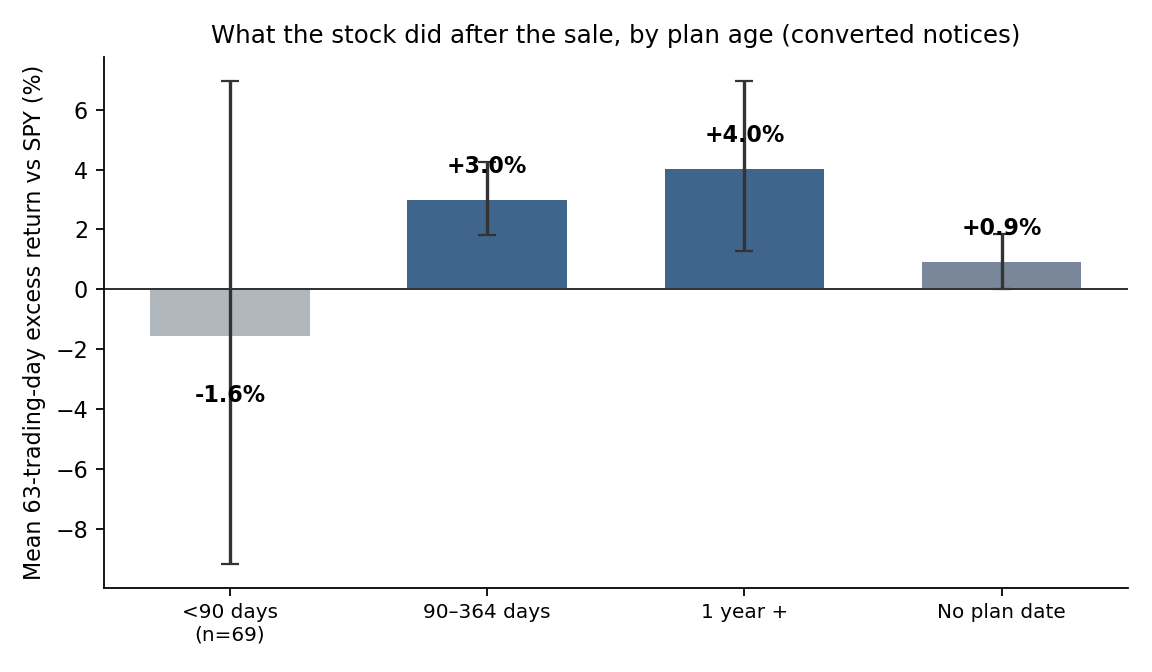
Averaged across notices, the stocks sold under plans aged 90–364 days rose against SPY in the 63 trading days after the first sale: mean excess return +3.00% (cluster-bootstrapped 95% CI: +1.81 to +4.25%, n = 10,121). For plans a year or older the mean is +4.03% (+1.28 to +6.96%, n = 1,263). Notices with no plan date average +0.90% (+0.00 to +1.85%). The young band averages −1.56%, but on n = 50 its interval runs from −9.16% to +6.97% — it excludes nothing and establishes nothing.
The medians tell the quieter story. The median post-sale outcome is slightly negative in every band (−1.62% for 90–364 days, −0.39% for a year or more, −3.03% with no plan date, −6.45% for the young band), and the share of sales that beat SPY over the following quarter is below half everywhere (46.5%, 48.9%, 43.4% and 34.0% respectively). The positive means are carried by a minority of very large winners: the single best outcome in the sample, an Invivyd officer's sale followed by a +393.33% excess quarter, sits on a notice for $28,002 of stock. And the single worst outcome — OrbiMed's exit from Sionna Therapeutics, followed by −89.63% — sits in the oldest band, under a plan adopted 473 days before the notice. Rank plan age against the post-sale return directly and there is essentially no relationship: Spearman's ρ is 0.019 across 11,434 scored plan-dated notices. Whatever distinguishes one insider sale from another in 2025–2026, how long ago the plan was signed is not measurably it.
Does the result hold up?
We re-ran the return test at 21 and 126 trading days, from the filing date instead of the sale date, and after removing overlapping notices so each issuer–seller pair contributes only its first notice in any 90-day span. The picture does not move. At 126 days the big plan bands' means rise (+5.92% for 90–364 days, +8.91% for a year or more) — the longer the window, the more the average is dominated by winners — while the medians stay near zero or below. Entering at the notice rather than the sale makes the oldest band stronger still (+7.28%, 95% CI: +3.27 to +11.83%), the opposite direction from the fresh-plan hypothesis. De-duplication narrows the samples (the young band falls to 27 scored sales) and widens every interval, but no check turns the young band's estimate significantly negative or produces an age gradient. Among officers and directors only, conversion by band is 76.8% / 94.6% / 88.1% / 86.2% — the same hump as the full sample.
The strongest objections
Four, and each bounds the conclusion. First, the window: this is a 2025–2026 measurement in a rising market, scored against a Form 4 corpus that is effectively complete only for those years; in a falling market the same scheduled sales might show negative average drift, and nothing here would detect it. Second, our price database covers currently tracked tickers, so roughly 6–8% of converted notices in each band — delisted and untracked names among them — drop out of the return test; the dropout rates are similar across bands, which protects the comparison more than the levels. Third, "no plan date listed" is a mixed bag: genuinely discretionary sales sit next to plan sales whose filers left the field blank, so that band is a residual, not a clean control group. Fourth — the deepest limit — the cooling-off rule has made the hypothesis nearly untestable in its strong form. There are only 69 young-plan notices to study because the rule works as designed. This study can say fresh-plan sales are rare and, in this sample, unremarkable; it cannot prove that a determined insider could not time a plan adoption, only that the filings show no residue of it at scale.
How to read the adoption date on a Form 144
Three checks, all from the form itself. First, find the adoption date and do the subtraction: a plan adopted six months ago, selling on schedule, is the normal case — 91.7% of plan-dated notices convert, and the sale is the least surprising event in the filing. Second, if the adoption date is recent — under 90 days — look at who the seller is before you look at the size: in current data that combination is rare (0.5% of plan notices) and belongs mostly to large holders and trusts rather than to officers and directors, for whom the cooling-off period makes it close to impossible. Third, do not read the sale as a forecast either way: across more than eleven thousand scored plan sales, what the stock did over the next quarter had no measurable relationship to the plan's age, and the typical sale in every band was followed by a small lag behind the index, not a collapse.
Methodology and data
Sources: SEC EDGAR Form 144 filings (full census, Apr 13, 2023–Oct 9, 2026; 63,013 notices) and SEC Form 4 filings (parsed corpus, effectively covering 2025–2026 submissions), collected by GetCoattail. Scored sample: the same 28,040 original (non-amendment) notices filed Jan 1, 2025–Jul 3, 2026 used in our Form 144 conversion study, matched on (issuer CIK, seller filer CIK); a notice converted if non-derivative code-S sales appear within 90 days of filing. Plan age = filing date minus the latest listed adoption date not after the filing date; no notice in the window had all listed dates after filing. The corpus contains 16 duplicate accession numbers, each recorded twice under the seller's ticker and the issuer's ticker; six such pairs (12 notices) fall in the scored window and are counted in notice-level rates exactly as in the earlier study, but return scoring keeps only the issuer-ticker copy of each pair. Forward returns: entry at the close of the next trading day after the first matched sale, held 63 trading days (21 and 126 as robustness), stock minus SPY over identical dates, adjusted closes from the GetCoattail bars database (coverage through Oct 2, 2026). Return intervals are seller-cluster bootstraps (2,000 resamples); rate intervals are Wilson score intervals. The adoption-to-first-sale gap is measured to the first sale observed after the notice, which is not necessarily the plan's first-ever sale. Rule background: SEC, "Insider Trading Arrangements and Related Disclosures," Release No. 33-11138 (Dec. 14, 2022) — cooling-off of at least 90 days for directors and officers, effective Feb. 27, 2023, compliance Apr. 1, 2023; SEC investor publication, "Rule 144: Selling Restricted and Control Securities." The full scored dataset accompanies this article: scored_notices_plan_age.csv (28,040 notices). Past patterns are not a promise of future results. For education only — not investment advice.
Revision history
- v1.0 — October 14, 2026: first publication. Data as of 2026-10-09 (Form 144 census) and the 2025–2026 Form 4 corpus.