A large federal contract award is one of the few corporate events whose timing is partly visible from outside: agencies announce winners, and the government's own spending records stamp when the work starts. If anyone positioned ahead of that news, the trading should show up in the two disclosure streams we track — insiders' Form 4 purchases and members of Congress's transaction reports. We assembled every award of $50 million or more in our USASpending collection whose recipient maps to a listed parent — 154 events at 46 companies, $114.6 billion of recorded obligations, starts from 2021 through September 2026 — and counted the buying in the 30 days on either side of each start date, against each stock's own baseline. Before the start, there was nothing to see. After it, the insiders appeared — at five events. And none of it predicted what the stocks did next.
The event is a start date, and that matters
An event here is one or more awards of at least $50M to the same listed parent starting on the same date. The Department of Defense accounts for 79 of the 154 events; the largest single event is Lockheed Martin's $24.59 billion award starting December 23, 2022. Two honest constraints shape everything below. First, the date we have is the period-of-performance start recorded in the USASpending extract — not the award's action date and not its announcement. Awards are ordinarily public knowledge by the time performance starts, so buying after a start date is buying after the news, and we report it that way; the “before” window tests positioning ahead of the start, not ahead of the press release. Second, the collection holds each company's ten largest awards, so the event count is a floor, not a census.
The baseline is each stock's own behavior: the number of buys expected in a 30-day window is that stock's buy rate across the whole measurement era, times the window's overlap with the era. A stock whose insiders buy every month is expected to buy near its awards too; only buying above the stock's own rate counts as clustering. Intervals are ticker-cluster bootstraps — buys at one company are not independent trials — with Poisson intervals alongside, and a date-permutation test for the pooled figures.
Before the start: nobody
Insider measurement is bounded by our Form 4 corpus, which effectively covers 2025–2026, so the insider test runs on the 32 events starting in 2025 or later. In the 30 days before those starts, insiders bought twice, against 2.64 buys expected from their own baselines: a rate of 0.76×, with a cluster interval of 0.00 to 2.71 that sits comfortably on “nothing unusual.” Members of Congress, measured across all 154 events, bought 47 times before the starts against 52.57 expected (0.89×). Whatever positioning a large federal award might invite, neither disclosure stream shows it happening in advance.
After the start: the insiders showed up — at five events
In the 30 days after the start, insiders bought 19 times against 2.64 expected — 7.21× baseline, and the cluster interval (1.14 to 11.85) stays above 1 even after allowing buys at the same company to move together. Combined over the full ±30 days the rate is 3.98×, but the pooled interval (0.48 to 6.32) spans 1, because the empty “before” half dilutes it; the elevation lives entirely in the “after” half. And it is concentrated. All 21 insider buys in the combined windows sit in five of the 32 events:
- SAIC (General Services Administration, $722.4M, starting March 13, 2025): eleven buys by eleven different insiders between 12 and 25 days after the start, about $0.75 million in total — a genuine cluster, not one person's program.
- Firefly Aerospace (NASA, $86.5M, starting July 29, 2025): five buys by five insiders dated a single day, eight days after the start — the day before the stock's first trading day, a sequence our returns test cannot score.
- Caterpillar: two buys (May 2 and May 7, 2025) fall after one Defense award's start (April 29, $83.5M) and before the next one's (May 21, $97.2M), so the same two trades appear in both events' windows.
- Oracle (Veterans Affairs, $173.3M): one buy of about $948,000, 21 days after the start.
Dropping any single event leaves the combined rate at 2.97× or higher, and the point estimate is stable at the $100M (4.00×) and $250M (4.17×) thresholds. What this cannot be read as is front-running: the start date post-dates the award's public announcement in the ordinary course, so the pattern is insiders buying into a public catalyst — or companies whose insider buying clusters after any large news. What it is not is broadly based: five events at four companies, out of 32.
Congress never showed up
Across all 154 events, members bought 94 times in the ±30-day windows against 106.81 expected — 0.88×, cluster interval 0.70 to 1.25, permutation p of 0.86. Forty events (26.0%) had at least one member buy nearby; the baselines predict 30.2% would. The House sits below baseline on both sides (0.81× before, 0.75× after; 0.78× combined). Senators point the other way — 20 buys against 11.85 expected, 1.69× — but on 20 buys the cluster interval runs 0.70 to 2.35 and includes 1, so we report the direction and decline to call it a finding. Counting by disclosure date instead of trade date — the day a reader could first have seen each purchase — changes nothing: 37 events have a buy whose filing lands in the window, against 40 by trade date.
| Buyer group | Observed | Expected | Rate | Cluster 95% CI |
|---|---|---|---|---|
| Insiders, 30d before | 2 | 2.64 | 0.76× | 0.00–2.71 |
| Insiders, 30d after | 19 | 2.64 | 7.21× | 1.14–11.85 |
| Insiders, ±30d | 21 | 5.28 | 3.98× | 0.48–6.32 |
| Senators, ±30d | 20 | 11.85 | 1.69× | 0.70–2.35 |
| House members, ±30d | 74 | 94.96 | 0.78× | 0.58–1.20 |
| Congress pooled, ±30d | 94 | 106.81 | 0.88× | 0.70–1.25 |
A buy next to the award did not make it pay
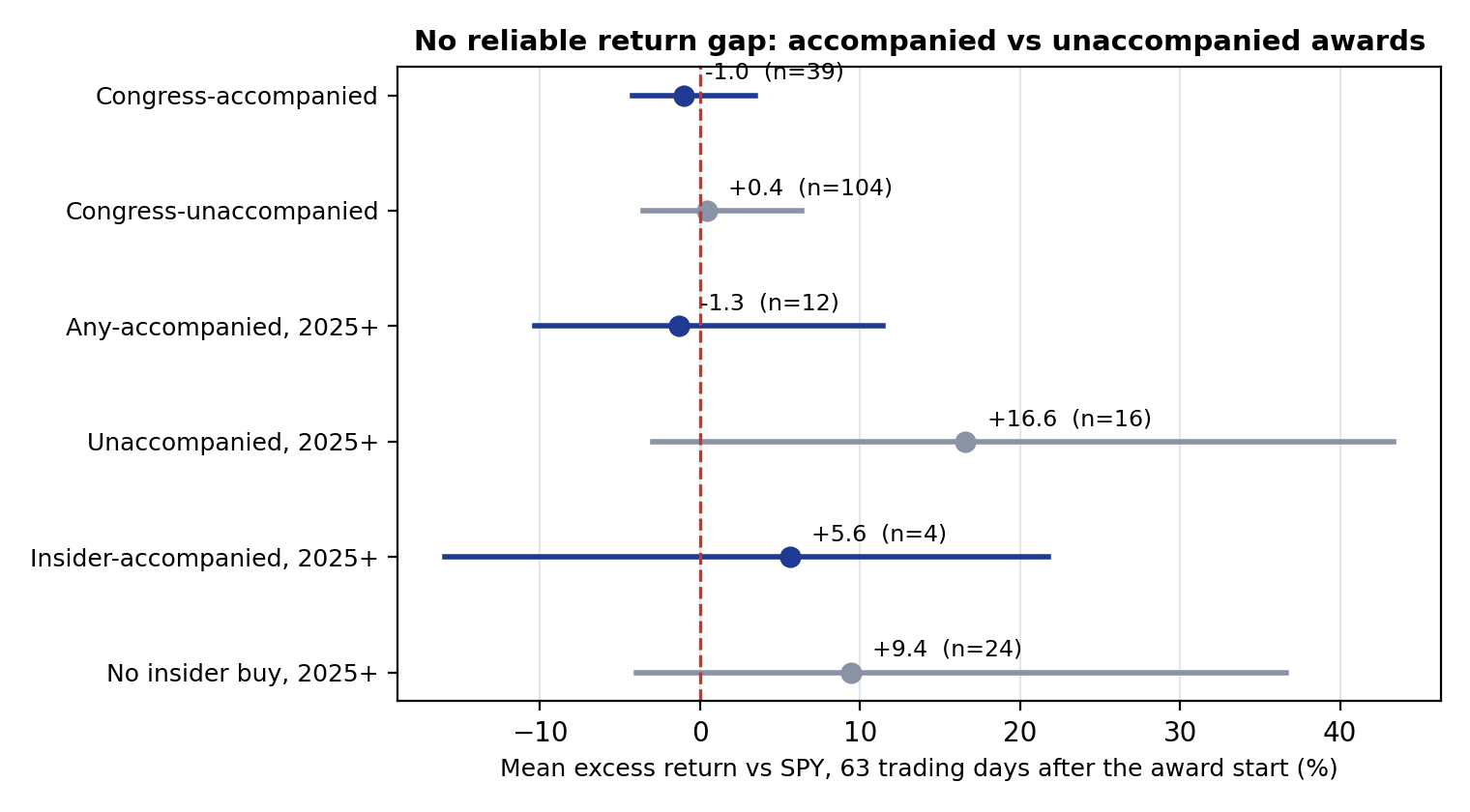
We scored 143 of the 154 events at 63 trading days (entry the first trading day after the start, excess return versus SPY): the other 11 start before their stock traded publicly or too late for a full window. Taken as a whole, award starts were not a payday — the 143 averaged +0.05 points of excess return with a median of −2.82 and a 42.0% win rate. The question is whether a nearby buy separated the winners. It did not:
- Awards with a congressional buy in the window (39 scored): mean −1.01 points, median −3.50, win rate 41.0%. Without (104): +0.44, median −2.80, win rate 42.3%. The gap is −1.45 points with a cluster interval of −8.19 to +4.90 — zero inside.
- Split the timeline and the gap flips sign: +0.57 points in the 2021–2023 derivation half, −6.14 in the 2024–2026 holdout, both intervals spanning zero. Whatever the pooled figure says, it does not replicate.
- In the 2025+ insider era (28 scored events), awards with an insider or congressional buy averaged −1.34 points (median +1.82) against +16.59 for the unaccompanied — but that unaccompanied average is one event, Viasat's +240.61, sitting in a group of 16. Trim the joint top 1% and the gap is −3.00 points, interval spanning zero.
- The four scored insider-accompanied events averaged +5.62 (the two Caterpillar events gained; SAIC fell 5.10 and Oracle 15.92) against +9.45 for the 24 without — a difference of −3.83 points on an interval 61 points wide. Four events cannot rank anything, and we do not pretend otherwise.
| Group (63 trading days) | n | Mean | Median | Win rate |
|---|---|---|---|---|
| Congress buy in window | 39 | −1.01 | −3.50 | 41.0% |
| No congress buy | 104 | +0.44 | −2.80 | 42.3% |
| Insider or congress buy (2025+ events) | 12 | −1.34 | +1.82 | 50.0% |
| Neither (2025+ events) | 16 | +16.59 | +4.16 | 56.3% |
| Insider buy (2025+ events) | 4 | +5.62 | +5.29 | 50.0% |
| No insider buy (2025+ events) | 24 | +9.45 | +2.30 | 54.2% |
Two small cells deserve naming rather than hiding. In the 2026 holdout slice of the insider era — four accompanied events against five unaccompanied — the gap is −18.80 points and its interval happens to exclude zero; with nine events in the cell we treat that as what it is, a small-sample artifact, and report the pooled interval, which includes zero. And Firefly's five-buy day never enters the returns test at all: its award started nine days before the stock existed.
What could change this answer
Three data upgrades would sharpen every number above. Award action dates — the day the obligation was actually signed, closer to the announcement — would let the “before” window test positioning ahead of the news rather than ahead of the start of work. The full award history per company, beyond each company's ten largest, would add events at the heaviest contractors. And a Form 4 corpus reaching back before 2025 would let the insider test cover the full 154 events instead of 32. Until then, the pattern the record supports is narrow and, we think, more interesting than the conspiracy version: nobody in either disclosure stream bought ahead of these awards; a handful of companies' insiders bought right after the work started; and none of it was worth following.
Methods and data
Contract records come from our USASpending collection pulled on October 13, 2026 (fiscal 2021–2026), which stores, for each of 436 mapped tickers, the company's ten largest awards with recipient, agency, recorded amount and period-of-performance start. We deduplicated awards by award ID (IDs shorter than six characters are truncation artifacts shared by unrelated awards and were not treated as identities), normalized share-class tickers to their listed parent, and audited all 48 tickers that clear the $50M threshold by hand: two mappings pointed at listed vehicles unrelated to the recipient — SpaceX awards under SPCX (SpaceX is privately held) and a Bank of Montreal award under OILU (an unrelated leveraged ETF) — and were excluded from every test. Awards starting on the same date at the same company merge into one event. Recorded amounts are cumulative obligations on the contract vehicle, not cash spent.
Insider buys are Form 4 open-market purchases (transaction code P, non-derivative), collapsed to one episode per insider per day, from a corpus whose filings run January 2025 to October 2026; 523 episodes carried trade dates inconsistent with their own filing dates (a parsing artifact concentrated in closed-end funds) and were excluded, leaving the insider era December 2, 2024 to October 2, 2026. Congressional buys are purchases in the canonical Senate and House periodic transaction reports, resolved to members by bioguide ID (167 distinct members bought with a ticker named); our extraction reproduces the canonical corpus totals exactly, including its known gap of buys reported without a ticker (2,503 in the Senate), which no ticker-level test can see. The event-level file behind every figure is published with this article.
Returns use split-adjusted closes (the site's five-year bars and long-history panels, plus Yahoo adjusted closes fetched for 12 tickers those panels could not serve — SAIC and Firefly among them), entered at the first trading day after the start date. An entry more than seven calendar days after the start does not count as served by a price series: that rule exists because we caught it failing — Palantir's April and May 2021 events initially “entered” at the first bar of a series that begins that September and printed identical returns to ten decimal places. Unscored events carry a reason code in the published file: 8 with no usable entry (including Firefly's four pre-IPO starts) and 3 whose 63-day window runs past the price calendar. Confidence intervals are 2,000-replication bootstraps clustered by ticker (seed 20261021); the derivation/holdout split is 2021–2023 versus 2024–2026 for congressional tests and 2025 versus 2026 inside the insider era.
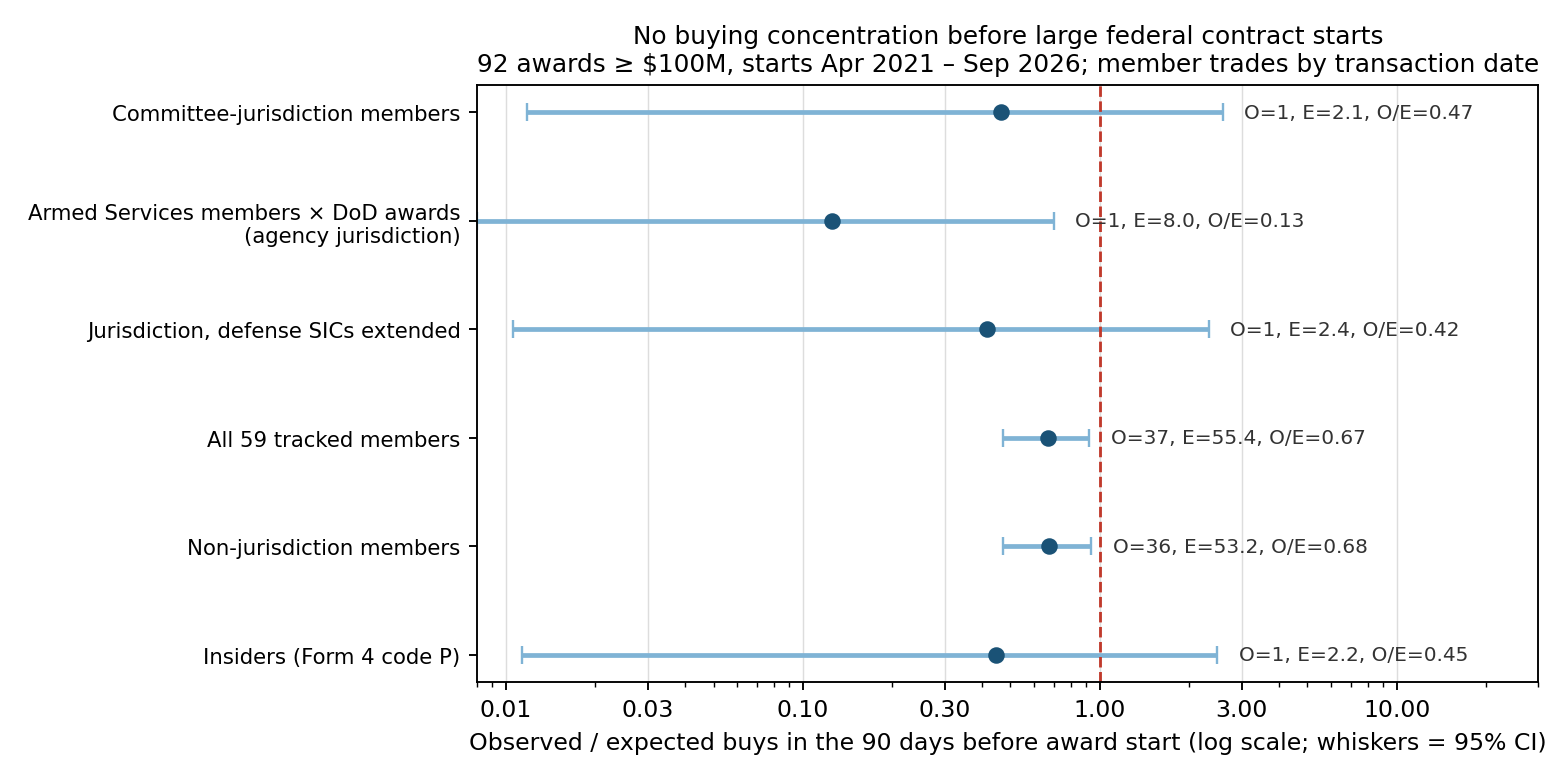
This study widens an earlier, narrower one: our pre-award study looked only at the 90 days before awards of $100M or more, for insiders and a 59-member tracked set, with no returns test. Its quiet “before” window and this one agree; everything else here — both window directions, the full congressional corpus, the $50M threshold and the returns — is new measurement, not a restatement.
Disclosures
GetCoattail is a data publication, not an investment adviser; nothing here is a recommendation. Contract records are USASpending data as collected on October 13, 2026; insider records are SEC Form 4 filings and congressional records are Senate and House periodic transaction reports, all as extracted in the published package. The event date is a period-of-performance start date, not an award announcement; recorded award amounts are obligations on contract vehicles, which can include ceiling value never spent. Figures may differ from other providers that date awards by action date or count obligations differently.
Data download
Full event list — all 154 events with amounts, agencies, accompaniment counts and flags, entry dates and 21/42/63-day excess returns (or the reason an event has none): gov-contract-insider-congress-events.csv. Chart data: chart1_oe_forest.csv, chart2_returns.csv.
Revision history
Oct 21, 2026: First published.