In the third quarter of 2026, officers and directors of listed U.S. companies bought $1.24 billion of their own stock in open-market purchases — and sold $25.20 billion. That is $20.28 sold for every $1 bought, across 1,466 individual buyers and 5,211 sellers. Every figure in this article comes from a full census of Form 4 filings with transaction dates between July 1 and September 30, 2026 — not a sample, and not a screenshot of somebody else's table. Where our totals differ from the roundups already circulating, we show exactly which definitional switch causes the difference, and by how much.
The biggest purchases, in the buyer's own name
The table ranks purchases held in the buyer's own name (direct ownership, Form 4 ownership code D) — money out of a personal account, not a fund or family vehicle.
| Buyer | Company | Role | Purchased | Days |
|---|---|---|---|---|
| Cohen Ryan | GME | President, CEO and Chairman | $57,333,419 | 3 |
| Tan Anthony Ping Yeow | GRAB | Chief Executive Officer | $29,876,310 | 1 |
| MALONE JOHN C | GLIBK | Director | $13,583,480 | 4 |
| Hudson Steven Kenneth | PNAQ | Chief Executive Officer | $12,500,000 | 1 |
| Courtis Kenneth S. | AMR | Director | $10,546,063 | 5 |
| KHOSROWSHAHI DARA | UBER | Chief Executive Officer | $10,005,952 | 1 |
| Mahoney Michael F | BSX | Chairman, President & CEO | $9,001,408 | 1 |
| Mindlin Marcos Marcelo | PAM | Director | $8,848,931 | 5 |
| Nechmad Yair | NYAX | CEO, Co Founder & Chairman | $8,827,385 | 4 |
| SIMPSON BOB R | TXO | Director | $5,638,175 | 5 |
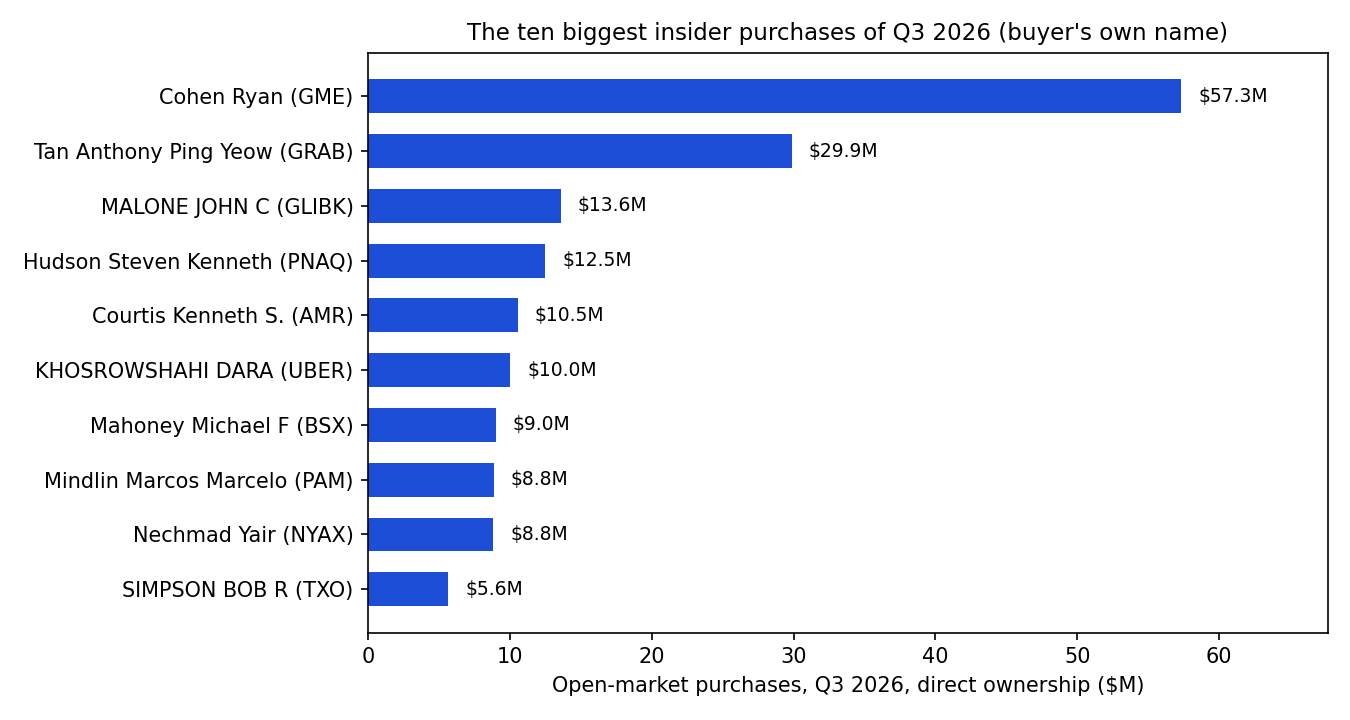
311 insiders with a CEO title bought during the quarter, $413.0 million in total. The single largest purchase — Cohen's three September tranches of GameStop — is $57.3 million, and the top ten direct buyers together account for a third of the quarter's direct-ownership buying. On the other side of the ledger, the largest sales were:
| Seller | Company | Sold |
|---|---|---|
| Chu James Michael | BIRK | $1,102,769,135 |
| STEVENS MARK A | NVDA | $946,627,633 |
| Lee Tony W | PRMB | $497,399,986 |
| Ullal Jayshree | ANET | $446,013,758 |
| Meister Keith A. | ILMN | $436,157,160 |
The Birkenstock print is an indirect block reported through an affiliated holder; the largest sale in a seller's own name is Mark Stevens' $946.6 million of NVIDIA.
Why every roundup of this quarter disagrees
A widely shared Q3 tally reports $21.0 billion sold and $923 million bought. Ours reports $25.2 billion and $1.24 billion. Neither is a typo. Three switches explain the gap, and we quantify each one because readers deserve to know which number they are looking at:
- Indirect ownership. Purchases and sales held through funds, family vehicles and affiliated entities (ownership code I) are included in our headline totals. They add $768 million of buying and $11.74 billion of selling — including the quarter's single largest print, the $1.10 billion Birkenstock block. Exclude indirect rows and our totals drop to $474.5 million bought and $13.46 billion sold.
- Entity reporting persons. Some Form 4 filers are firms, not people (advisors and funds that sit on boards). We exclude them from the headline. Including them moves the census to $1.86 billion bought and $27.74 billion sold.
- Amendments. Form 4/A filings restate earlier filings. Counting them double-counts trades; we skipped 4,523 amendment documents.
Where definitions overlap, the numbers agree to the dollar: Cohen's $57.3 million, Khosrowshahi's $10.0 million, Mahoney's $9.0 million and Stevens' $947 million appear identically in our census.
The filings themselves contain a trap
A naive shares-times-price pass over this corpus says insiders bought $10.36 trillion in Q3. The cause is a recurring filer error: some Form 4s print the aggregate transaction value in the price-per-share field — one filing records 4,545,306 shares at a "price" of $2,272,653, which is the shares times $0.50. We validated every row's price against the issuer's market close on the transaction date; 17 rows were aggregate-in-price prints and were valued as printed, and 157 rows had prices that reconciled with nothing and were excluded from dollar totals (and counted, in the methodology). Any insider-buying table that does not describe this check has not done it.
A related trap sits in the indirect table. The largest indirect prints, as printed:
| Buyer (indirect) | Company | As printed |
|---|---|---|
| Huang Jack Jiajia | COE | $113,001,382 |
| Aghazadeh Behzad | SCTX | $36,259,761 |
| Chimovits Erez | BRVE | $34,920,000 |
| Wilks Matthew | FTK | $34,320,013 |
| MOROUN MATTHEW T | PAMT | $31,225,740 |
The 51Talk (COE) print counts ordinary shares against an ADS market price, so the printed figure overstates the ADS-equivalent value. We list indirect prints separately, labelled as printed, and never rank them against direct purchases.
What was happening around the buys
A purchase does not happen in a vacuum, and the other filings at the same address are public too. Of the 852 issuers with officer or director buying in Q3, only 85 also had Form 144 notices of proposed sales filed in the quarter — and the buy dollars at issuers where the noticed supply met or exceeded the buying total just $24.8 million, 2.0% of all buy dollars. The configuration readers worry about — the CEO buys while the building heads for the exit — was rare this quarter. At Uber, the two nearly cancelled: Khosrowshahi bought $10.01 million while $11.41 million of Form 144 sale notices were filed at the same issuer (notices are predominantly other people's pre-planned sales; both numbers are facts, and neither cancels the other). Superinvestor overlap varies just as widely: 22 of the 149 funds we track held Uber at the last 13F, 10 held Boston Scientific, 4 held Grab — and none held GameStop.
What this does not say
A Form 4 purchase is a fact about where an insider's money went. It is not, on our evidence, a forecast: our own full-corpus studies of insider-buying clusters found no proven forward edge once the comparison is done honestly, and this census measures no returns at all. What it does provide is the verified record — who bought, how much, in whose name, and what the same quarter's other filings say — which is the part of the story that can actually be checked.
Methodology
Form 4 corpus of 316,796 parsed filings (submissions through October 2, 2026). Population: officers and directors of issuers with a resolvable ticker; open-market non-derivative purchases (code P) and sales (code S) with transaction dates in Q3 2026; original Form 4 only (4,523 amendment documents skipped); 1,704 documents at unlisted or unmapped issuers skipped. After filing-level exclusions, 25,331 rows entered price validation: 12,382 priced-normal, 4 priced aggregate-corrected, 12,788 without a reference price (12,775 normal, 13 aggregate-corrected under a $1,000/share screen, Berkshire class A excepted), and 157 price-unusable rows excluded from dollar totals — the waterfall closes exactly (12,382 + 4 + 12,775 + 13 + 157 = 25,331). Natural-person reporting persons in headline totals; entity filers quantified separately. Form 144 supply: our full Form 144 collection, notices filed in Q3 2026. Superinvestor counts: the 149-fund roster's latest (Q2 2026) 13F holdings. Q3 trades filed after October 2 are a missing tail. An independent verification pass recomputed every headline figure from the raw corpus with zero mismatches.
Data download
Totals, the top direct and indirect purchases and the top sales, as printed in this article: insider_buying_q3_2026_tables.csv
Revision history
Oct 21, 2026: First published.