GetCoattail Research — Meta just posted 28% revenue growth and an earnings miss in the same quarter, and the market is arguing about a $130 billion-plus spending plan. We ran it through every filing lens we maintain. In the second quarter — a quarter when the share price fell — the concentrated money added 27.1% more shares and five managers opened new positions. And in the entire parsed insider record, no Meta insider has ever bought a share on the open market.
Start with the narrative, because it is a live argument. Meta reported second-quarter 2026 results on July 29: revenue of $60.80 billion, up 28% year over year and ahead of the $60.29 billion consensus, with advertising revenue of $59.36 billion, up 27%. The other side of the print was cost: diluted EPS of $6.18 missed a consensus of roughly $7.19 to $7.22 and fell from $7.14 a year earlier, the operating margin narrowed to 31% from 43%, and total costs and expenses rose 55% to $42.03 billion, including a $2.40 billion legal charge and $1.18 billion of severance. Capital expenditure reached about $31.1 billion in the quarter, and full-year 2026 capex guidance stands at $130 billion to $145 billion. In September the stock rallied — up 27% in the month, according to Yahoo Finance — after the September 8 launch of the Muse AI agent, which drew 5 million downloads by September 30. The shares closed at $728.08 on October 2, 2026 in our price file, up 10.3% year to date and below the 252-session closing high of $777.59 (September 24, 2026). Analyst consensus targets average roughly $788 to $792. Meta was the eleventh most-searched ticker on Benzinga Pro for October; its third-quarter report is expected on October 28, 2026.
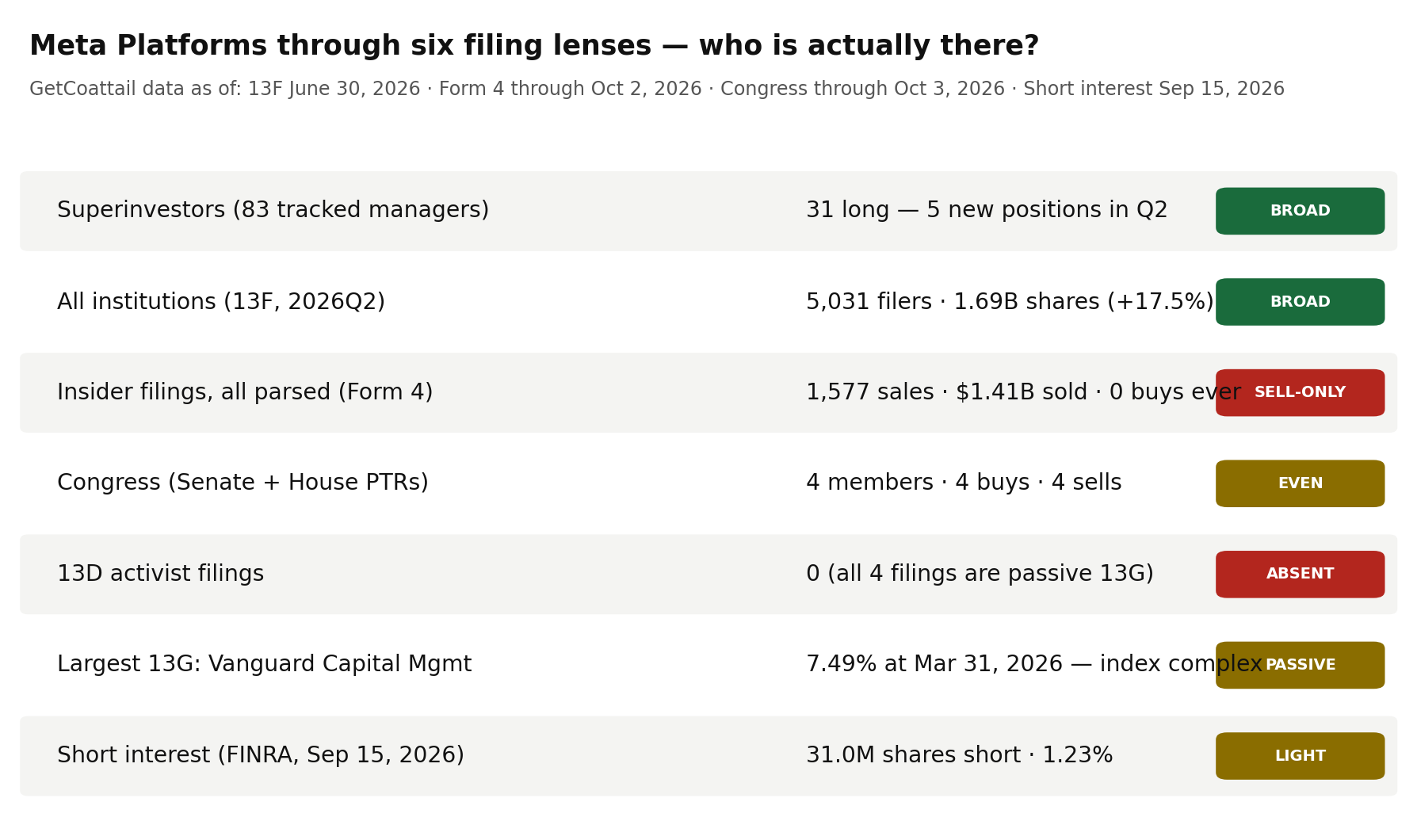
Now the filings. GetCoattail tracks the portfolios, trades and disclosures of the investors with the most information about any company: superinvestors, institutions as a whole, insiders, members of Congress, and 5% holders. For Meta — the ninth Filing Tape audit, after IREN, CoreWeave, Micron, NVIDIA, Tesla, AMD, Apple and Amazon — the sponsorship is broad and it grew into a falling price. The insider lens, again, points the other way.
Lens 1: the superinvestors — thirty-one long holders, five of them new
We track 83 large, mostly long-only managers whose 13F portfolios we collect directly from SEC EDGAR. As of June 30, 2026, thirty-one held Meta in long common-stock positions — every one of the 31 reported rows is a long position, with no option rows in the count. Across the whole collection, only four tickers have more long holders: Microsoft at 37, Alphabet's Class A at 36, Amazon at 35 and Alphabet's Class C at 34. Within this audit series, Meta's 31 is second only to Amazon's 35. The cohort's combined long position rose on a like-for-like pipeline basis from 20,701,109 shares at March 31 to 26,315,988 shares at June 30 — up 27.1% — in a quarter when the share price itself fell 1.5%, from a $572.13 close to $563.29 in our price file. The pipeline and EDGAR-collection second-quarter totals agree exactly, at 26,315,988 shares, worth $14,823,865,063.
The largest holder, Dodge & Cox Funds, holds 6,489,255 shares and increased 29.4% — 24.7% of the cohort's Meta stock. First Eagle holds 3,217,353 shares (up 0.8%). The quarter's story is the new money: five managers opened new positions totalling 5,970,380 shares — Pershing Square with 3,196,062 shares (9.25% of its portfolio), Viking Global with 1,867,619, Maverick Capital with 764,041, CAS Investment Partners with 136,246 and Miller Value Partners with 6,412. Appaloosa increased 54.6% to 675,000 shares. The direction count is not one-way, though: of the 31 long holders, 13 decreased, 9 increased, 5 were new and 4 were unchanged — Jensen cut 67.9%, Polen 30.9%, Ruane Cunniff 23.3% and Fundsmith 20.4%, and Tiger Global trimmed 8.5% to 2,823,180 shares. The top three holders together account for 49.0% of the cohort. The cohort added shares in aggregate because the new and increased positions outweighed the trims, not because the trims were absent.
Lens 2: institutions — 5,031 filers, shares up 17.45%
Zoom out to the whole 13F market and the register matches the superinvestor picture. At June 30, 2026, 5,031 institutions reported positions in Meta, up from 4,983 at March 31 — a 1.0% rise — and 5,016 of them reported long positions. Reported share counts rose 17.45%, from 1,434,933,057 to 1,685,360,726 shares. The register churned underneath: 2,056 filers entered and 2,008 left. The dataset's reported aggregate value rose 15.0% to $1,008,796,603,754; the aggregate includes option rows, so we treat filer and share counts as the reliable series and the dollar figure as reported (see methodology). One plausible reading is that part of this breadth is mechanical — Meta sits in nearly every index basket. But here the concentrated cohort moved the same way as the broad register, and it moved more: its share count rose 27.1% while the full register's rose 17.45%.
Lens 3: the 5% register — passive, and shrinking at the margin
Four SC 13D/G filings cover Meta, and all four are 13G or 13G/A — the passive form. There is not one 13D, the filing an investor uses when it wants something from management. The largest reporter is Vanguard Capital Management at 7.49% (163,839,861 shares, as of March 31, 2026) — an index complex, filing passively. The other sized reporters are FMR LLC and Abigail P. Johnson, filing jointly: 96,176,347.85 shares, 4.4%, as of June 30, 2026 — down from the 134,555,687.03 shares and 6.1% in their previous report (as of December 29, 2023), so the register's second name has been reducing its reported stake. A separate Vanguard Group amendment reported 0 shares and 0.0% as of March 13, 2026; we record it without interpreting the internal reorganisation it appears to reflect. No activist has filed: the register is an index complex and a mutual-fund complex, both passive.
Lens 4: insiders — zero purchases in the entire parsed record
In the 90 days through October 2, 2026, Meta insiders filed 34 reports covering 109 sale transactions totalling $105,268,930.58 — 155,435 shares sold by ten insiders, 102 of the 109 transactions by officers. Open-market purchases in the same window: zero.
Widen the window and the purchase side does not just stay empty — it has never been anything else. Over the full year through October 2, 2026, the record shows 167 filings covering 297 sale transactions totalling $259,896,781.92 by eleven sellers, and zero open-market purchases. Across the entire parsed Form 4 record (391 filings), purchases total exactly zero transactions, against 1,577 sale transactions totalling $1,409,923,662.85 by eleven sellers. Some selling is mechanical — vesting and tax withholding generate filings regardless of anyone's view — and we assign no motives. But the purchase side has no mechanical explanation: in a year when the stock traded from a $525.72 closing low (March 27, 2026) to a $777.59 closing high, no Meta insider bought a single share at market price, and none appears in the parsed record at any earlier date either. Our site's separate 90-day insider aggregate agrees on the two headline facts — zero buys, ten sellers — while its sale count and value (98 sales, $101,819,633.75, compiled as of October 8, 2026) differ from the full-parse figures; we headline the full-parse record and note the difference in the methodology.
Lens 5: Congress — four members, four buys against four sells
Across the Senate and House transaction record we maintain (as of October 3, 2026), four members of Congress have traded Meta: four purchases and four sales, with the most recent purchase on June 17, 2026, and both parties represented. All eight transactions are in the House record; the Senate aggregate carries no Meta record at all. The counts are small and exactly balanced, and congressional disclosures report ranges rather than exact values, so we record direction only.
Lens 6: short interest — 1.23% of shares out, off its lows
As of September 15, 2026 — the most recent FINRA settlement date — 30,990,107 Meta shares were sold short: 1.23% of the 2,521,000,000 shares in our fundamentals file (a weighted-average basic share count as of December 31, 2025 — see methodology), with days-to-cover of 1.57. That is a small borrow for a stock of Meta's size.
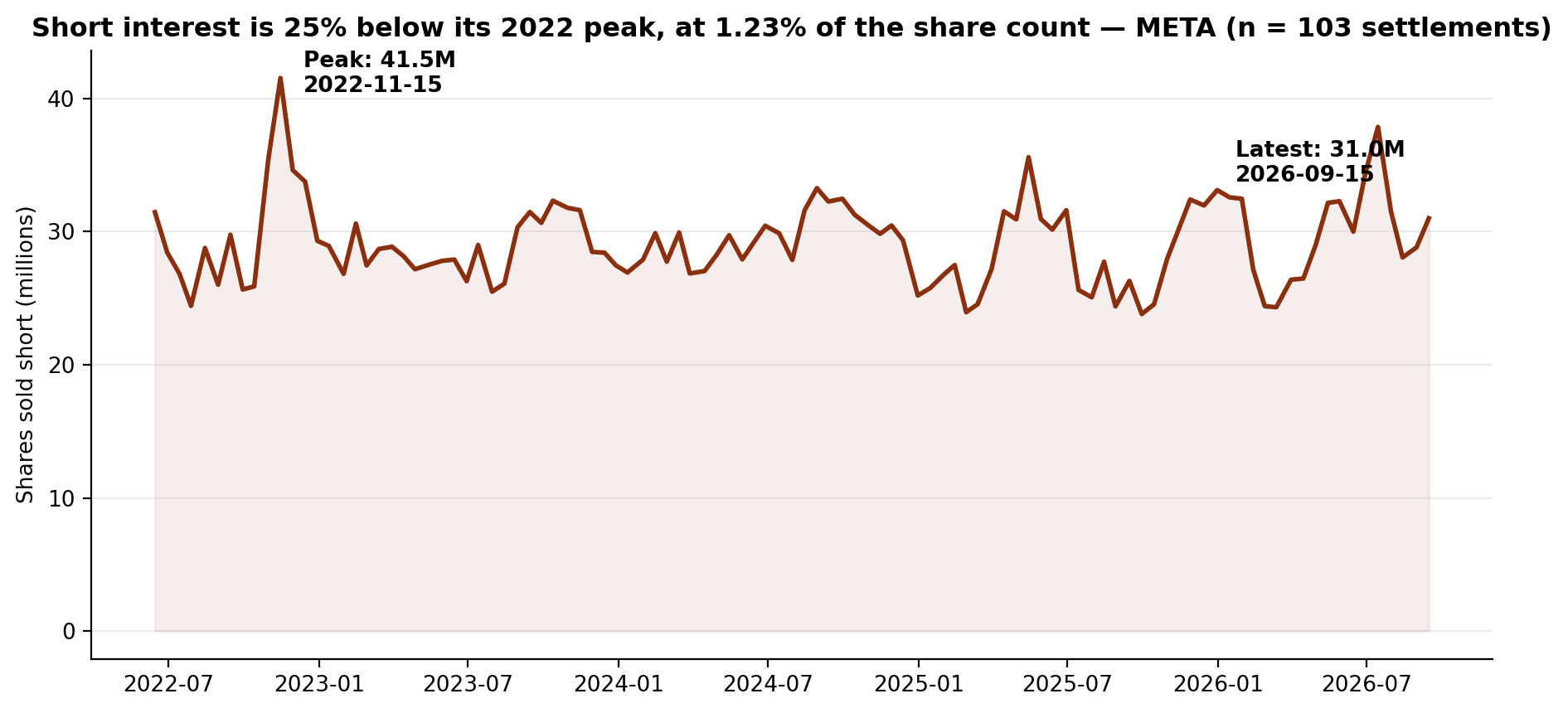
The latest reading sits 25.4% below the series peak of 41,523,267 shares on November 15, 2022. The recent path is two-sided: the borrow rose to 37,847,633 shares on July 15, 2026, fell at two consecutive settlements to 28,048,106 on August 14, and has since risen at two consecutive settlements to 30,990,107 — and it is 17.9% above its year-ago level of 26,292,755 shares. The borrow is neither at its lows nor large: at 1.23% of the share count, it is not a crowded short either.
The gap, stated plainly
Meta's filing record splits along a familiar line in this series, with one twist. The concentrated money did not just hold the stock through a quarter of margin headlines — it added: 31 of 83 tracked managers long, cohort shares up 27.1% in a quarter when the price fell 1.5%, five new positions totalling 5,970,380 shares, and a full register of 5,031 filers with shares up 17.45%. The 5% register stayed passive, though its second name, the FMR complex, has reduced its reported stake from 6.1% to 4.4%. The short borrow, at 1.23% of the share count, says few are betting heavily against the story. Congress is exactly balanced at four buys and four sells. And the insider lens is the one lens that does not move with the story: 1,577 sales totalling $1,409,923,662.85 in the parsed record — $105,268,930.58 of it in the last 90 days — and not one open-market purchase, ever, in that record. The institutions are buying the advertising-and-AI story in size. The people inside the company, on the record, only sell.
What would change the picture
Nothing above is a recommendation. It is a record. These are the filings that would change the description, in the order the data will arrive:
- 1. Third-quarter results on October 28, 2026. The next print tests the growth-versus-spending narrative — $60.80 billion of second-quarter revenue, up 28%, against full-year capex guidance of $130 billion to $145 billion and third-quarter revenue guidance of $61 billion to $64 billion. It changes no filing above, but it sets the backdrop for the next quarter's filings.
- 2. The 2026Q3 13Fs (filing window closing mid-November 2026). Whether the holder count holds above 31, whether Pershing Square's new 3,196,062-share position grows or was a one-quarter trade, and whether the 13 second-quarter trimmers keep trimming, is the cleanest test of whether the new money is settling in or passing through.
- 3. The first insider open-market purchase. A single Form 4 purchase code would be the first in the entire parsed record — 391 filings, 1,577 sales, zero purchases. Watch also whether the sales pace — $259,896,781.92 over the last year — changes.
- 4. Any 13D, from anyone. Four passive 13G filings — a Vanguard entity at 7.49% and the FMR complex at 4.4% — are the whole register. A first 13D converts the register from passive to intent, and any new sized 13G reporter would be the first name on it that is neither an index nor a mutual-fund complex.
- 5. The short-interest series from its September level. Short interest has risen at two consecutive settlements from 28,048,106 shares (August 14, 2026) to 30,990,107. Whether it rebuilds into the October 28 earnings print, or falls back from 1.23% of the share count, is the fastest-updating series in this audit: FINRA publishes it biweekly.
Until one of those prints, the filing record describes a stock the concentrated money demonstrably bought into weakness — five new tracked positions and a 27.1% larger cohort stake in a down quarter — trimmed by a minority of its tracked holders even as it added shares in aggregate, held passively at the 5% level by an index complex and a shrinking mutual-fund stake, and never, on the record, bought by the people who work there.
Related reading: Thirty-Five of 83: The Superinvestors Own Amazon. Its Insiders Have Never Bought a Share. — Filing Tape #8; Zero of 83: The Superinvestors Aren't in IREN — Filing Tape #1; 80% Overlap, No Copycat Signal: Congress vs. the Superinvestors. Meta's own page: Meta Platforms (META) on GetCoattail.
Methodology and data notes
- Superinvestor lens: 83 managers collected directly from SEC EDGAR Form 13F (managers_13f collection), positions as of June 30, 2026; Meta identified by CUSIP 30303M102. Thirty-one distinct managers hold long positions totalling 26,315,988 shares; all 31 reported rows are long (no put or call rows). Quarter-to-quarter cohort totals (20,701,109 shares across 28 pipeline rows at March 31; 26,315,988 across 31 pipeline rows at June 30) are from the site pipeline's holdings files on the same CUSIP basis in both quarters; the change is +27.1% ((26,315,988 / 20,701,109) − 1), and the pipeline's second-quarter total agrees exactly with the EDGAR collection's long total. Dodge & Cox's share of the cohort is 6,489,255 / 26,315,988 = 24.7%; the top three holders (Dodge & Cox, First Eagle 3,217,353 shares, Pershing Square 3,196,062 shares) are 49.0%; the five new positions (Pershing Square, Viking Global 1,867,619, Maverick Capital 764,041, CAS Investment Partners 136,246, Miller Value Partners 6,412) total 5,970,380 shares. Full-collection long-holder counts: Microsoft 37, Alphabet Class A (GOOGL) 36, Amazon 35, Alphabet Class C (GOOG) 34, Meta 31, Visa 30. The "second in this series" claim covers the nine stocks audited in the Filing Tape series (IREN 0, CoreWeave 1, Micron 5, NVIDIA 19, Tesla 6, AMD 6, Apple 22, Amazon 35, Meta 31).
- Full-market lens: SEC Form 13F Data Sets full-market aggregation (the fixtures underlying our 2026Q1–Q2 market tables). Holders = distinct filers reporting the CUSIP; 5,016 of the 5,031 reported long positions. Reported-value caution: the aggregate value ($1,008,796,603,754 over 1,685,360,726 shares) implies ≈$598.56 per share against a June 30, 2026 close of $563.29 in our price file. The aggregate sums the VALUE of every information-table row — including put and call option rows — while the share count covers long common-stock rows only, so we headline filer and share counts and label dollar values "reported."
- Insider lens: full-parse Form 4 aggregation (agg_by_ticker), record as of October 2, 2026 (391 filings). Sale and purchase counts are transaction-code counts (S and P) in non-derivative rows; grants and exercises are not counted as purchases. The site's 90-day insider aggregate, compiled on a different as-of date (October 8, 2026), agrees on zero buys and ten sellers but differs on the 90-day sale count and value (98 sales, $101,819,633.75, against the full-parse 109 sales, $105,268,930.58); we headline the full-parse figures.
- 13D/G lens: full-parse SC 13D/G aggregation and parsed filings (4 filings, 3 of them amendments, 4 reporters in aggregate), filings through August 6, 2026. Reporter percentages are as reported in each filing for its event date; the same holder can appear in several filings. FMR LLC and Abigail P. Johnson file jointly and each report the same 96,176,347.85 shares (4.4%, event date June 30, 2026); the figure is counted once, not summed. One parsed row (The Vanguard Group, event date March 13, 2026, filed March 27, 2026) carries zero shares in the parse and is not used for any figure here.
- Congress lens: Senate PTR archive and House PTR archive as maintained on this site, combined record as of October 3, 2026. Counts are transaction counts in the aggregated member record; congressional disclosures report value ranges, so no dollar figures are used for this lens. The combined record shows four members, four buys and four sells; all eight transactions are in the House record, and the Senate aggregate (as of October 1, 2026) carries no Meta record.
- Short interest lens: FINRA Equity Short Interest files (biweekly settlement dates), collected directly from FINRA's public distribution. Symbol-history note: the META symbol belonged to a different issuer before Meta Platforms' June 2022 rename from FB; the 13 pre-rename META rows in the files (July 15, 2021 – January 14, 2022) are excluded, and the series used here covers 103 settlements from June 15, 2022 to September 15, 2026 — Meta Platforms appears in every settlement file from the rename onward. FINRA publishes each settlement about two weeks after the fact. The share-count ratio uses the fundamentals file's share count of 2,521,000,000 — a weighted-average basic share count as of December 31, 2025, not a point-in-time shares-outstanding figure, so the 1.23% ratio is approximate.
- Fundamentals note: our fundamentals collection carries Meta's fiscal-2025 figures — revenue $200,966,000,000, net income $60,458,000,000, assets $366,021,000,000 — for the fiscal year ended December 2025. The second-quarter 2026 figures in the introduction are from the company's July 29, 2026 results as reported by multiple outlets (see market context sources), not from our fundamentals file. The market value of about $1.86 trillion uses that file's October 6, 2026 price ($738.88) and reported share count.
- Prices: our own daily-close file for Meta through October 2, 2026 ($728.08 close, +10.3% year to date on that file; 252-session closing high $777.59 on September 24, 2026; closing low $525.72 on March 27, 2026; closes of $572.13 at March 31, 2026 and $563.29 at June 30, 2026, a second-quarter change of −1.5%; close of $592.85 at September 2, 2026, so +22.8% over the final month of the file). The October 2 close of $728.08 matches the close reported by ad-hoc-news for the same date.
- Market context sources: second-quarter 2026 results (revenue $60.80 billion, +28% year over year, against a $60.29 billion consensus; advertising revenue $59.36 billion, +27%; diluted EPS $6.18 against a consensus of roughly $7.19–$7.22, from $7.14 a year earlier; operating margin 31% against 43%; total costs and expenses $42.03 billion, +55%, including a $2.40 billion legal charge and $1.18 billion of severance; quarterly capital expenditure of about $31.1 billion; free cash flow down about 91% to roughly $0.78 billion) — company results as reported by Yahoo Finance, MarketBeat, Trivano and Blockchain.news, checked October 8, 2026; third-quarter revenue guidance of $61 billion to $64 billion and full-year 2026 capital-expenditure guidance of $130 billion to $145 billion — same sources; Muse AI launch (September 8, 2026; 5 million downloads September 8–30, Sensor Tower via Investing.com) and a 27% September share-price gain — Investing.com and Yahoo Finance via ad-hoc-news; third-quarter results date (October 28, 2026) — Blockchain.news and AsiaTokenFund; analyst consensus average target (about $788 to $792) — MarketBeat via ad-hoc-news; most-searched ranking (eleventh, Benzinga Pro October) — Benzinga via Market News Now, checked October 8, 2026. Figures we could not confirm against two sources were left out.
- Meta is in the GetCoattail stock-page universe: Meta Platforms (META) stock page. Series data: meta_lens_data.csv · meta_short_interest_series.csv. Earlier audits: Amazon · Apple · IREN.
This article describes public filings as of the dates stated. It is not investment advice and makes no recommendation. Filings lag reality: 13F positions are as of June 30, 2026, and later trading is not yet public.
Revision history
- v1.0 — October 8, 2026: first publication.