“Nancy Pelosi stock trades” is one of the most searched phrases in retail investing, and most of what ranks for it is a screenshot, a tracker with numbers nobody re-checked, or a trade dated weeks before the public could have known about it. So here is the whole 2026 record, from the filings themselves: the Pelosi household filed three periodic transaction reports this year — on January 23, June 23 and August 21 — disclosing 27 transactions. Nothing has been filed since August 21. The newest information in the public record is two months old, and everything in it is listed below, including what the stocks did after the filings made them public — the only version of this record a reader could ever have acted on.
The January filing: a year-end reshuffle (filed January 23)
Eighteen transactions, mostly dated December 24–30, 2025. The household sold stock into year-end — 45,000 shares of Apple (disclosed range $5,000,001–$25,000,000), 20,000 of Amazon ($1,000,001–$5,000,000), 20,000 of NVIDIA ($1,000,001–$5,000,000), 10,000 of Disney and 5,000 of PayPal — and contributed a further 28,200 Apple shares and 7,704 Alphabet shares to a donor-advised fund (charitable transfers, not market sales, and labelled as such in the filing). The same week it bought new call options on Alphabet, Amazon, Apple and NVIDIA, all dated December 30. On January 16 it exercised the January-2025 call vintage on Alphabet, Amazon, NVIDIA, Tempus AI and Vistra, and bought 25,000 shares of AllianceBernstein outright ($1,000,001–$5,000,000). A Versant (VSNT) spinoff receipt rounds out the report.
The June filing: two option trades (filed June 23)
Two rows, both dated May 29, 2026: 200 Intel call options with a $50 strike ($1,000,001–$5,000,000) and 200 Uber call options with a $50 strike ($500,001–$1,000,000). No stock changed hands in this report.
The August filing: Bloom Energy and Intel (filed August 21)
Seven rows, dated July 24–28. This is the filing the trackers led with, and the stock rows are: Bloom Energy — 10,000 shares bought July 24 ($1,000,001–$5,000,000) and 5,000 more on July 28 ($500,001–$1,000,000), each tranche paired the same day with 100 Bloom call options ($100 strike, expiring June 2027); Intel — 10,000 shares bought July 24 ($500,001–$1,000,000) plus 50 Intel calls ($50 strike, June 2027). The seventh row is a further $500,001–$1,000,000 into REOF XXV, LLC, a San Francisco hotel vehicle that recurs across her filings.
The disclosure lag is part of the record
House rules give members up to 45 days to disclose. Across this year's filings the lag between transaction and disclosure ran from 7 to 30 days, with a median of 24. The July stock purchases were made on July 24 and 28 and became public on August 21 — four weeks later. Any “Pelosi bought Bloom Energy” headline you read in August described a decision taken in July, at July prices. That is not a criticism of the filer; it is the system's design, and it changes what the trades can mean to anyone reading them.
What happened after the trades became public
We score the stock rows the only honest way available to a reader: entry at the close on the first trading day after the filing date, measured to October 2, 2026, against the S&P 500 over the same days.
| Trade | Filed | Entry | Stock | S&P 500 | Excess (pp) |
|---|---|---|---|---|---|
| Bloom Energy — bought Jul 24 & 28 | Aug 21 | Aug 24 | +41.7% | +1.1% | +40.7 |
| Intel — bought Jul 24 | Aug 21 | Aug 24 | +36.8% | +1.1% | +35.7 |
| Apple — sold Dec 24 (+ DAF Dec 30) | Jan 23 | Jan 26 | +31.0% | +12.0% | +19.0 |
| NVIDIA — sold Dec 24 | Jan 23 | Jan 26 | +25.8% | +12.0% | +13.8 |
| Amazon — sold Dec 24 | Jan 23 | Jan 26 | +5.5% | +12.0% | −6.5 |
| Alphabet — DAF contribution Dec 30 | Jan 23 | Jan 26 | +3.3% | +12.0% | −8.7 |
| PayPal — sold Dec 30 | Jan 23 | Jan 26 | −5.9% | +12.0% | −17.9 |
| Disney — sold Dec 30 | Jan 23 | Jan 26 | −7.5% | +12.0% | −19.5 |
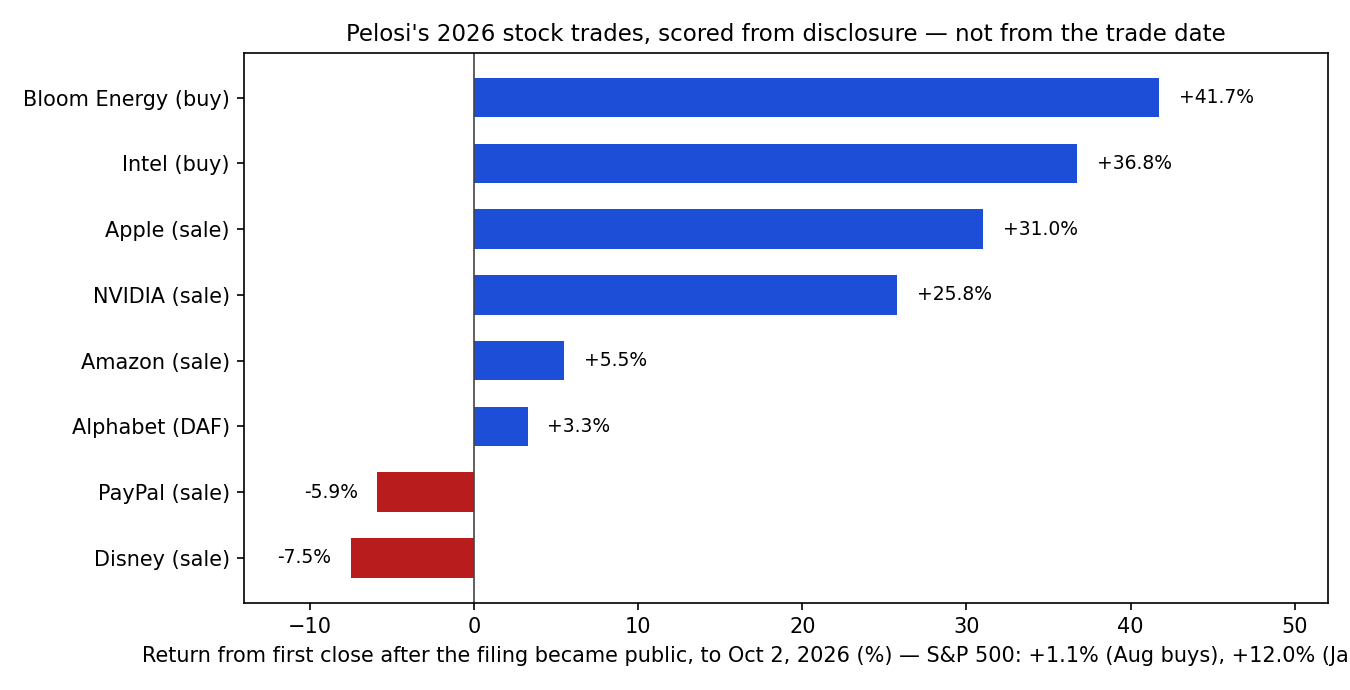
The two July stock buys have run far ahead: Bloom Energy +41.7% and Intel +36.8% against the S&P 500's +1.1% over the same six weeks. Two names is not a pattern, and this article claims nothing more than the fact: a reader who bought both stocks on the day the filing landed would be well ahead today. (The January AllianceBernstein purchase cannot be scored in our price series, which does not cover that security; it is disclosed here rather than silently dropped.)
The January sales cut the other way. Apple gained 31.0% after the January 23 filing disclosed its sale, and NVIDIA 25.8% — the household sold both before strong runs, on the same post-disclosure measure. Disney (−7.5%) and PayPal (−5.9%) fell after their sales. Post-disclosure, this year's record is not a one-way legend in either direction.
The options layer, stated plainly
Fourteen of the 27 transactions in this year's filings involve options — purchases, and exercises of year-old calls. As we showed in our full-record analysis, The Pelosi Legend Is an Options Book, the options book is the larger and more structured part of this household's activity. Options cannot be scored from stock prices, and we do not pretend otherwise: they are listed in the ledger, with strikes and expiries, and left unscored. Any tracker that converts them into a single “Pelosi return” number has made assumptions it is not showing you.
Cross-checks from the other filing systems
Intel is where this year's Pelosi trades meet the rest of the disclosure system. Intel's own chief executive, Lip-Bu Tan, bought $9,999,985 of Intel stock in open-market Form 4 purchases in the same quarter — recorded in our Q3 2026 insider-buying census — and 14 of the 149 superinvestor funds we track held Intel at the last 13F. Bloom Energy is held by 6 of the 149; Uber, the other name in the June filing, by 22. None of that makes the trades right or wrong; it is the company they keep in the public record.
What happens next
Under the 45-day rule, any trades the household makes in the fourth quarter must surface by mid-February 2027 at the latest — and if the pattern of the last several years holds, year-end activity will arrive in a single January filing, as it did this year. Until a new PTR appears, the August 21 report is the record, and this page will be updated when it changes.
Methodology
Transactions are from the House Clerk's financial-disclosure index, re-parsed with our Pelosi-specific parser (which preserves asset descriptions, owner and option terms the general parser drops) and checked against the filing texts; index refreshed October 21, 2026. The reporting owner on the household's PTRs is the spouse (SP). Amounts are the filings' own disclosed ranges and are printed as ranges throughout. Post-disclosure returns use split- and dividend-adjusted closes from our price database (through October 2, 2026); entry is the first close strictly after the filing date — never the filing day itself. Options rows are listed, not scored. An independent verification pass recomputed the ledger counts, lags and returns from the source files with zero mismatches.
Data download
The full 27-row ledger — filing, transaction date, ticker, asset class, type, disclosed amount range and the filing's own description: pelosi_2026_trades.csv
Revision history
Oct 21, 2026: First published.