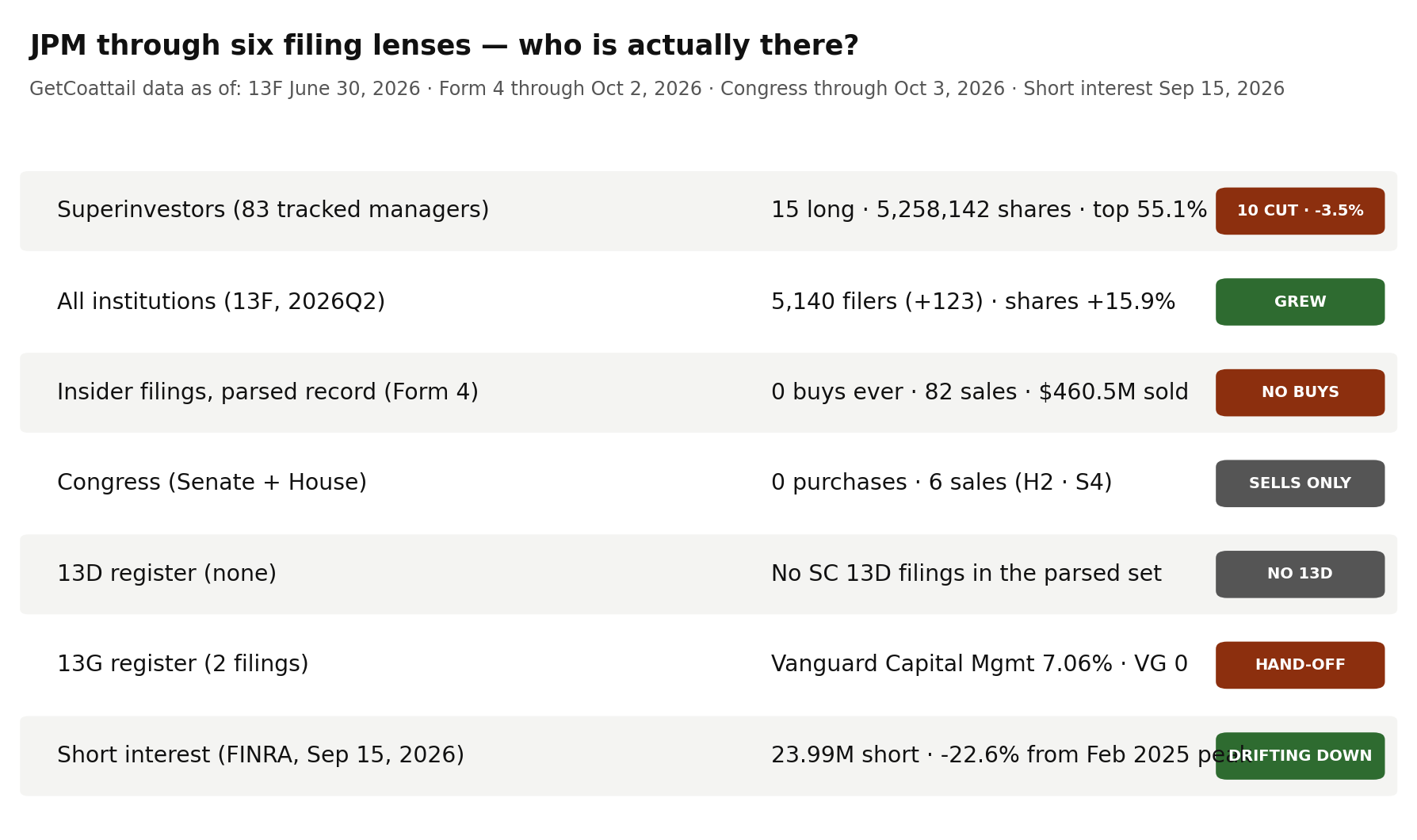
GetCoattail Research — JPM is the largest U.S. bank, reporting third-quarter results before the open on Tuesday, October 13, 2026 — the print that opens bank earnings season — after a second quarter that beat consensus by a wide margin. The filings describe a register that leaned the other way in that second quarter: fifteen tracked superinvestors hold it, ten of them cut, the cohort total fell 3.45% while the price rose 11.3% and the full market added 269,210,309 reported shares, insiders have recorded zero open-market purchases across the whole parsed Form 4 record against 82 sales, Congress records six sales and no purchases, and the borrow stands 22.6% below a peak it set in February 2025.
Start with the narrative. JPMorgan Chase reports third-quarter 2026 results before the market opens on Tuesday, October 13, with a conference call at 8:30 a.m. ET — a date the bank itself flagged on September 17 — and, as the first of the large lenders to report, its print sets the tone for the bank earnings season that follows. The consensus bar, as aggregated in the previews, sits near $5.93 of earnings per share on roughly $51.19 billion of revenue (AlphaStreet's count of 12 analysts; MarketBeat's October 6 count put the EPS consensus at $5.90), implying double-digit growth against the year-ago quarter. The bar is high because the second quarter was strong: on July 14, the bank posted earnings of $6.14 a share against a $5.59 consensus, with revenue of $58.02 billion, up 27.7% year over year. On September 15 it raised the quarterly dividend from $1.50 to $1.65 a share, payable October 31 to holders of record on October 6. A MarketBeat count on October 6 put the analyst consensus at Moderate Buy with an average target of $363.08. The stock itself comes into the print cooled off: previews note the shares have pulled back about 10% from their August high, and our own price file — which ends October 2 — closes JPM at $332.38, down 9.0% from its 252-session closing high of $365.18 set on August 12, 2026, up 3.2% year to date, and up 17.5% from its 252-session closing low of $282.84 set on March 27, 2026. MarketBeat's October 12 list of financial stocks to watch — ranked on recent dollar trading volume — placed JPMorgan second among five names. The next scheduled test after the print is not a filing at all; it is whether the registers below move when the third-quarter 13F season closes in mid-November.
Now the filings. For JPM — the fifty-sixth Filing Tape audit — the tape shows a fifteen-name tracked cohort whose centre of gravity is a single holder, a broad register that added filers and shares over the same quarter, a 5% register of exactly two Vanguard-complex rows, an insider record with sales and no purchases at any horizon we can measure, a congressional record with the same shape, and a borrow that peaked nineteen months ago and has been drifting down since.
Lens 1: the superinvestors — fifteen holders, ten of them cutting
We track 83 large, mostly long-only managers whose 13F portfolios we collect directly from SEC EDGAR. As of June 30, 2026, 15 held JPM long — no option rows — totalling 5,258,142 shares worth $1,721,147,489. The direction count, on the collection's own labels, is ten decreases, two increases, two unchanged and one new position — and the collection's exit list holds one JPM row: Steven Check - Check Capital Management, out after holding 956 shares at March 31. The cohort total moved from 5,446,018 shares at March 31, across 16 filing rows, to 5,258,142 at June 30, across 15 rows, a change of -3.45%, a difference of -187,876 shares.
The register's centre of gravity is one holder. Viking Global Investors holds 2,899,386 shares worth $949,056,019, a 2.71% portfolio weight — 55.1% of the tracked cohort's JPM shares. The EDGAR collection labels that row NEW. The pipeline's own quarter files complicate the label, and we print both: Viking already appears in the March 31 file with 2,704,018 shares, so on a filing-continuity basis the position grew 7.2% in the second quarter rather than appearing in it. Every other continuing holder's label agrees with its continuity change (see methodology). Strip Viking out on the continuity basis and the rest of the cohort fell from 2,742,000 shares to 2,358,756 — -13.98% — in the quarter the price rose 11.3%. The next-largest holder, Mairs & Power Funds, holds 923,550 shares worth $302,305,621, a 2.77% weight, flagged decreased by 12.4%. Christopher Davis - Davis Advisors holds 476,389 shares worth $155,936,320, decreased 14.4%. Richard Pzena - Pzena Investment Management holds 334,094 shares worth $109,358,989, decreased 0.9%, and Thomas Gayner - Markel Group holds 252,550 shares worth $82,667,192, unchanged. Below them: David Katz - Matrix Asset Advisors (132,893 shares, decreased 1.2%), Dodge & Cox Funds (117,130 shares, decreased 1.1%), Francois Rochon - Giverny Capital (47,876 shares, decreased 8.5%), Samantha McLemore - Patient Capital Management (29,360 shares, decreased 0.0%), Thomas Russo - Gardner Russo & Quinn (24,719 shares, decreased 83.4%), Bill Nygren - Oakmark Funds (6,215 shares, increased 6.9%), Glenn Greenberg - Brave Warrior Advisors (5,643 shares, unchanged), Torray Funds (2,959 shares, decreased 92.4%), Kahn Brothers Group (2,878 shares, increased 2.1%) and Greenhaven Associates (2,500 shares, decreased 37.5%). The cohort's implied price, $327.33 per share, sits exactly on the June 30 close of $327.33. The price rose from $294.16 at March 31 to $327.33 at June 30, a change of +11.3% — this register held 3.45% fewer shares at the end of that rise than at the start of it, and outside its largest holder it held 13.98% fewer.
Lens 2: institutions — 123 more filers, 269.2 million more shares
Zoom out to the whole 13F market and the register grew on both counts, in the opposite direction from the tracked cohort. At June 30, 2026, 5,140 institutions reported positions, up 123 from 5,017 at March 31 (+2.45%), and 5,125 of them reported long positions. Reported shares rose 15.93%, from 1,689,620,659 to 1,958,830,968 shares — 269,210,309 more shares than the prior quarter. Reported aggregate value rose 30.62% to $632,425,836,141; the aggregate includes option rows, so we headline filer and share counts and label dollars "reported" (see methodology). Here the implied value per share, $322.86, sits 1.4% below the June 30 close of $327.33 — a gap, printed as found, and one more reason to headline the share count rather than the dollars: the value increase mostly restates the quarter's price move, while the share count rose 15.93% and the filer count rose by 123 in the same quarter in which the tracked cohort cut 3.45% — and cut 13.98% outside its largest holder.
Lens 3: the 5% register — two filings, and the Vanguard hand-off again
Our full parse holds two SC 13D/G filings for JPM — one SC 13G filing and one SC 13G/A amendment, and no SC 13D of any kind in the parsed set, two reporting-person rows across two names, the most recent filed April 30, 2026. Both rows belong to the Vanguard complex, and they trace the hand-off pattern this series keeps meeting. In an SC 13G/A filed March 27, 2026, The Vanguard Group prints 0 shares (0.0%) as of March 13, 2026. In an SC 13G filed April 30, 2026, Vanguard Capital Management prints 190,479,749 shares (7.06%) as of March 31, 2026 — the register's maximum and its most recent filing. That is the whole 5% register in our parsed coverage: two filings, both index-complex paper, and no activist paper at all. Read as filed — the rows are reported exactly as filed, never summed — the register describes a passive complex re-papering its stake under a second name, and nothing else.
Lens 4: insiders — zero purchases in the whole parsed record, 82 sales
The parsed Form 4 record holds 232 filings through October 2, 2026. Across the whole record, open-market purchases total exactly 0 transactions — no insider purchase appears in the parsed record at any horizon — while sales total 82 transactions, totalling 1,673,777 shares and $460,498,505.07, by 12 sellers, 80 of the transactions recorded as officer sales. The last year holds 122 filings and likewise no purchases, against 43 sales totalling 410,453 shares and $126,350,253.06 by 11 sellers. The last 90 days hold 9 filings, no purchases, and 2 sales totalling 5,000 shares and $1,785,544.50 by a single seller. Our site's insider aggregate, compiled as of October 12 over its 90-day window, prints the same 90-day line exactly — 0 purchases, 2 sales, $1,785,544.50 — so the two collections agree here. We assign no motives to any of it; a tape with 82 sales and no purchases is the fact.
Lens 5: Congress — six sales, no purchases, in both chambers' records
The congressional record we maintain has the same shape as the insider record, at a much smaller scale. The combined record (as of October 3, 2026) carries a JPM row printing 0 purchases and 6 sales, with no last-purchase date. The House aggregate (as of October 3, 2026) prints 0 purchases and 2 sales, and the Senate aggregate (as of October 1, 2026) prints 0 purchases and 4 sales — the two chambers sum to the combined line exactly. So this lens is not blank, as it was for the previous audit in this series; it is one-directional: six recorded sales and no recorded purchases across the Senate and House records as this site maintains them. The aggregates' member-count field prints zero for this issuer in all three collections, so we report transaction counts only and make no member-level claim from it.
Lens 6: short interest — 23,990,561 shares, and a peak left behind in 2025
FINRA's files carry the borrow across 137 settlements, from January 15, 2021. As of September 15, 2026 — the most recent settlement — 23,990,561 JPM shares were sold short, with days-to-cover of 3.64. The latest step was down: the reading fell 9.60% from the prior settlement's 26,537,949 shares on August 31, 2026. The level sits below the top of the series because the top is old: the peak is 31,008,899 shares on February 14, 2025, a fact we verified by taking the maximum across the whole series, and the latest reading sits 22.6% below it — this borrow set its record nineteen months ago and has not approached it since. Against September 15, 2025 the latest reading is down 11.0% from 26,956,512 shares. Against the fundamentals file's 2,658,186,195 shares outstanding, that is 0.90% of the share count. The June 30, 2026 settlement — the date the 13F lenses snapshot — printed 26,871,351 shares, above the present. The recent settlements run 29,481,916 on July 15, then 28,235,459, 25,289,205, a one-step rebound to 26,537,949 on August 31, and 23,990,561 — lower than where the summer began, though not in a straight line. The series minimum is 14,473,691 shares on November 30, 2021; the series' own first settlement, on January 15, 2021, printed 25,926,892 shares — above the latest reading.
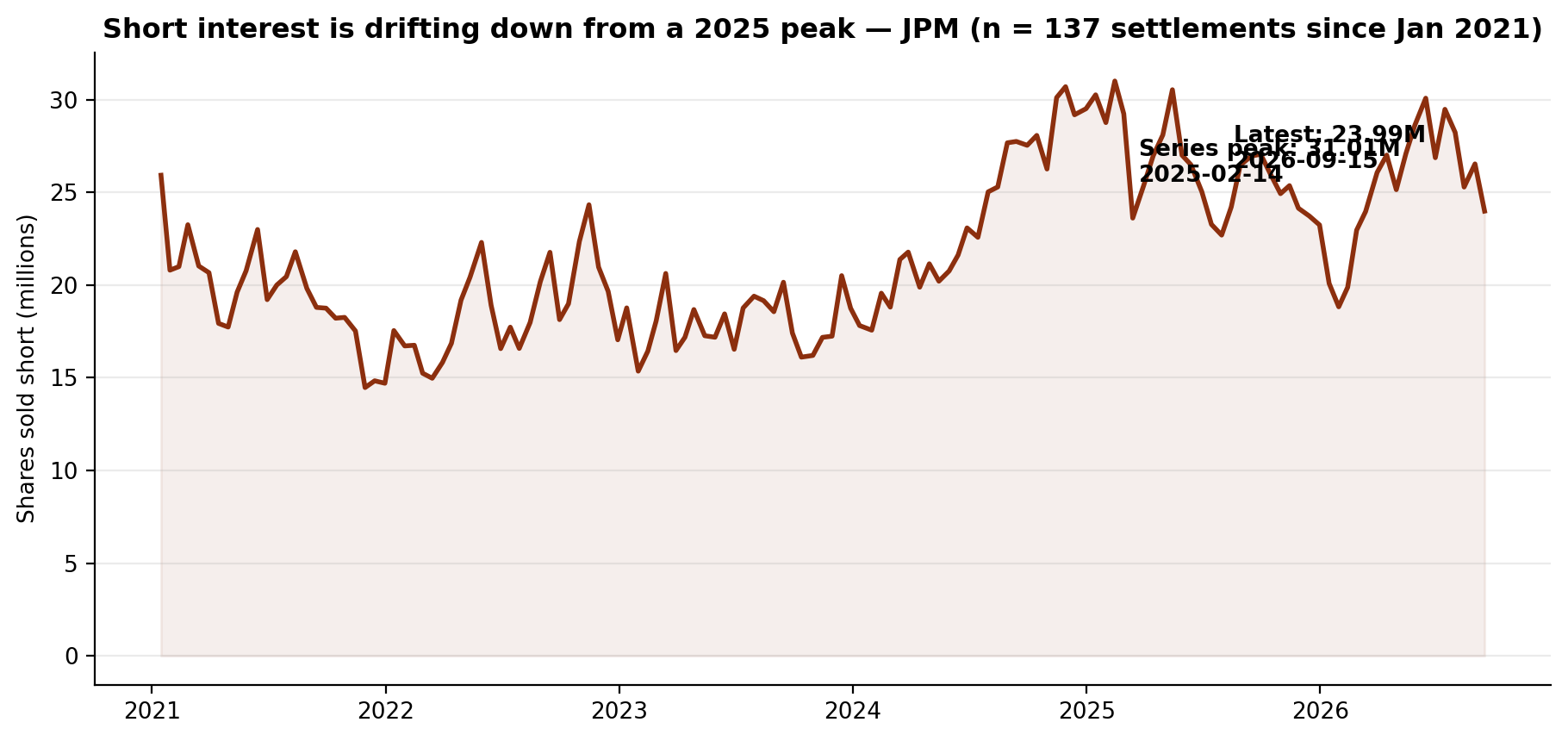
The borrow peaked in February 2025, before any of this year's earnings prints — and it has been drifting down, unevenly, ever since.
The gap, stated plainly
The narrative describes the largest U.S. bank walking into the print that opens earnings season: a consensus near $5.93 a share on roughly $51.19 billion of revenue, a second quarter that had just beaten by $0.55 a share on revenue up 27.7%, a dividend raised to $1.65, a Moderate Buy consensus averaging $363.08 — and a stock down 9.0% from its August closing high into the report. The tracked superinvestors held 5,258,142 shares at June 30 across fifteen holders, having cut 3.45% in a quarter when the price rose 11.3%, with ten decreases, two increases, two unchanged rows, one label that says new against a continuity record that says +7.2%, one exit, and Viking Global Investors at 55.1% of the cohort — outside which the cohort cut 13.98%. The full market moved the other way: 1,958,830,968 reported shares, up 269,210,309, across 5,140 filers — 123 more than the prior quarter. The 5% register printed two filings, both Vanguard-complex paper: The Vanguard Group at zero on a March 2026 date, Vanguard Capital Management at 7.06% on the March register. Insiders, across 232 parsed filings, recorded zero purchases in the whole record against 82 sales totalling $460,498,505.07. Congress records six sales and no purchases, split two House and four Senate. And the borrow stands at 23,990,561 shares — down 11.0% year over year and 22.6% below the series record it set on February 14, 2025, at 3.64 days to cover and 0.90% of the share count. One plausible reading is that the registers are describing different JPM stories on different clocks: the broad register spent the second quarter adding filers and shares into a rising price, the tracked cohort spent it trimming almost everywhere except its largest seat, the insider and congressional tapes record selling without a single offsetting purchase at any horizon, and short sellers built their largest borrow of this series in February 2025 and have spent nineteen months unwinding it — all of it snapshot at June 30 or earlier, before the third-quarter print that makes this week's story existed as news. The record supports each clause separately; it does not say which register is right, and it cannot — the tracked cohort's whole position is a June 30 snapshot of 5,258,142 shares, taken months before the October print.
What would change the picture
Nothing above is a recommendation. It is a record. These are the filings that would change the description:
- 1. The 2026Q3 13Fs (filing window closing mid-November 2026). The tracked cohort held 5,258,142 shares at June 30 across fifteen holders, after a -3.45% move built from ten decreases and one exit. Whether Viking Global Investors' 2,899,386 shares — 55.1% of the cohort — grow again on the continuity basis, and whether the other fourteen holders' combined 2,358,756 shares fall for a second straight quarter, are the first things the next register will answer.
- 2. A first insider purchase. The parsed record holds exactly 0 purchase transactions against 82 sales, with no purchase in the last year or the last 90 days either. A single open-market purchase would end the zero this audit is built on; another quarter of sales-only filings would extend it.
- 3. A congressional purchase. The combined congressional record prints 0 purchases and 6 sales (House 2, Senate 4). A first recorded purchase in either chamber's aggregate would change this lens from one-directional to mixed.
- 4. An original SC 13D, or a non-Vanguard 13G. The 5% register in our parsed coverage holds two filings, both of them Vanguard-complex paper. A first 13D in the parsed set — any filer declaring an active stake — or a 13G from outside that complex would change this lens from re-papered passive holdings into something else.
- 5. Whether the borrow keeps drifting down. Short interest stands at 23,990,561 shares, down 11.0% in a year and 22.6% below the February 14, 2025 series record of 31,008,899. The settlements that will print the earnings week have not been published yet: a reading back above the 2025 record would restart the build, and continued declines would extend a nineteen-month unwind.
Until one of those prints, the record describes a stock held by fifteen of our 83 tracked superinvestors — 5,258,142 shares, cut 3.45% in the quarter its price rose 11.3% and cut 13.98% outside its largest holder — whose full market added 269,210,309 reported shares and 123 filers, whose insiders have recorded no purchase in the whole parsed record against 82 sales, whose congressional register records six sales and no purchases, and whose borrow has fallen 22.6% from the series record it set in February 2025 — all of it snapshot at June 30, before the earnings print that opens the season.
Related reading: Two of 83: Both Superinvestors Cut Humana as the Price Rose 129.1% in Q2 — Filing Tape #55; Seven of 83: One Holder Is 78.8% of the Superinvestors' UPS Stake. Short Interest Set a Series Record in August. — Filing Tape #54; Zero of 83: The Superinvestors Aren't in IREN — Filing Tape #1. JPM's own page: JPMorgan Chase & Co. (JPM) on GetCoattail.
Methodology and data notes
- Superinvestor lens: 83 managers collected directly from SEC EDGAR Form 13F (managers_13f collection), positions as of June 30, 2026; JPM identified by CUSIP 46625H100. Fifteen distinct managers hold long positions totalling 5,258,142 shares; all fifteen reported rows are long (no put or call rows); the direction count on the collection's labels is ten decreased, two increased, two unchanged and one new, and the collection's exit list contains one JPM row (Steven Check - Check Capital Management, 956 shares at March 31, $281,230). Quarter-to-quarter cohort totals (5,446,018 shares at March 31 across 16 filing rows; 5,258,142 shares at June 30 across 15 filing rows; change -3.45%) are from the site pipeline's holdings files on the same CUSIP basis in both quarters, and the pipeline's second-quarter share and value totals match the EDGAR collection's long totals exactly (differences of 0 shares and $0). Per-holder quarter changes are matched by filing continuity across the two pipeline files: for fourteen of the fifteen continuing holders they agree with the EDGAR collection's own percentage labels. The exception is the largest holder: the collection labels Viking Global Investors' row NEW, while the pipeline's March 31 file already carries a Viking row of 2,704,018 shares, so on the continuity basis the position grew from 2,704,018 to 2,899,386 shares (+7.2%). This audit reports both bases wherever the label matters, computes the cohort's ex-largest-holder change on the continuity basis (2,742,000 shares at March 31 to 2,358,756 at June 30, -13.98%), and does not describe the position as new money. Viking Global Investors' share of the cohort is 55.1% = 2,899,386 / 5,258,142.
- Full-market lens: SEC Form 13F Data Sets full-market aggregation. The primary table is the full13f collection's by-ticker file (holders = distinct filers reporting the CUSIP; 5,125 reported long positions out of 5,140 filers). JPM reports under two CUSIP spellings, 46625H100 and 46625h100, and the by-ticker row sums both. The backfill fixtures' by-CUSIP file carries the two spellings as separate rows — the uppercase spelling (5,084 filers; 1,954,374,009 shares; $631,061,552,161 reported) and the lowercase spelling (56 filers; 4,456,959 shares; $1,364,283,980 reported) — and the two rows sum exactly to the by-ticker totals above, so the cross-check matches once both spellings are counted. (The pipeline's own superinvestor files show the same split: one tracked filer's rows carry the lowercase spelling.) The by-ticker file's entered/exited fields (2,033 and 1,910, a net of +123 that matches the change in holder count) are gross flows, so this audit headlines the net change. Reported-value caution: the aggregate value ($632,425,836,141 over 1,958,830,968 shares) implies $322.86 per share against a June 30, 2026 close of $327.33 in our price file, a gap of -1.4% — printed here as found. The aggregate sums the VALUE of every information-table row — including put and call option rows — while the share count covers long common-stock rows only, so we headline filer and share counts and label dollar values "reported."
- Insider lens: full-parse Form 4 aggregation (agg_by_ticker), record as of October 2, 2026 (232 filings). Sale and purchase counts are transaction-code counts (S and P) in non-derivative rows; grants and exercises are not counted as purchases, and one filing can contain many transaction rows. Purchase transactions total exactly 0 across the parsed record (0 shares, $0.00, zero buyers) — and zero in the last year (122 filings) and in the 90-day window (9 filings) as well. Sale transactions total 82 across the record (1,673,777 shares, $460,498,505.07, 12 sellers, 80 of them recorded as officer sales); the last year holds 43 (410,453 shares, $126,350,253.06, 11 sellers) and the 90-day window holds 2 (5,000 shares, $1,785,544.50, one seller, both recorded as officer sales). The site's insider aggregate (compiled as of October 12, 2026, 90-day window) prints the same 90-day line exactly, so the two collections agree for this name. "Purchases" in this audit is scoped to this parsed record, whose 232 filings are the coverage stated here.
- 13D/G lens: full-parse SC 13D/G parsed filings (2 filings matching issuer CIK 19617 on CUSIP 46625H100, 2 reporting-person rows across 2 names: one SC 13G filing and one SC 13G/A amendment, no SC 13D filings), filings through April 30, 2026. The site aggregation's by-ticker file carries the same totals (2 filings, 2 reporters, latest filing April 30, 2026, maximum 7.06%, total reported 190,479,749 shares), so the aggregate and the parse agree here. The Vanguard Group's row (0 shares at 0.0% as of March 13, 2026, filed March 27, 2026, SC 13G/A) and Vanguard Capital Management's row (190,479,749 shares at 7.06% as of March 31, 2026, filed April 30, 2026, SC 13G) are reported as filed, under the reporting-person names exactly as they appear. No rows are summed in the article, because aggregation totals across these rows would add different dates together. No reason for any change is asserted — the filings themselves are the record. The parsed coverage for this issuer holds these two filings; a 5% holder that has not filed in the covered window would not appear here.
- Congress lens: Senate PTR archive and House PTR archive as maintained on this site. The combined record (as of October 3, 2026) prints 0 purchases and 6 sales for JPM, with no last-purchase date; the House aggregate (as of October 3, 2026) prints 0 purchases and 2 sales; and the Senate aggregate (as of October 1, 2026) prints 0 purchases and 4 sales — the chambers sum to the combined line. All three aggregates print a member count of zero for this issuer alongside those transaction counts, an inconsistency we report rather than resolve: this audit cites transaction counts only and makes no member-level claim.
- Short interest lens: FINRA Equity Short Interest files (biweekly settlement dates), collected directly from FINRA's public distribution. The published series covers 137 settlements from January 15, 2021 (25,926,892 shares) to September 15, 2026. The latest reading is 23,990,561 shares on September 15, 2026, which sits 22.6% below the series maximum of 31,008,899 shares on February 14, 2025 (verified by a maximum query over the series, not read off the latest row), down 11.0% from the September 15, 2025 reading of 26,956,512 and down 9.60% from the prior settlement (26,537,949 on August 31, 2026). The series minimum is 14,473,691 shares on November 30, 2021. FINRA publishes each settlement about two weeks after the fact, so the October 13, 2026 earnings print is not yet in this series. The share-count ratio (0.90%) uses the fundamentals file's shares-outstanding figure below.
- Fundamentals note: our fundamentals collection carries JPM's revenue of $182,447,000,000 labelled fiscal 2025, its net income of $57,048,000,000 labelled fiscal 2025, and its assets of $4,424,900,000,000 labelled fiscal 2025. The file is marked ok for this name, with no missing fields: shares outstanding of 2,658,186,195 (as of June 30, 2026 in the file, sourced in the file to the issuer's reported shares-outstanding figure) and a file-computed market value of $880,603,919,434.74. The file's price for the name is $331.28 as of October 6, 2026; our daily-close file ends October 2, 2026 at $332.38, and we keep the two files' figures separate rather than blending them.
- Prices: our own daily-close file for JPM through October 2, 2026 ($332.38 close, +3.2% year to date on that file; 252-session closing high $365.18 on August 12, 2026; 252-session closing low $282.84 on March 27, 2026; closes of $294.16 at March 31, 2026 and $327.33 at June 30, 2026, a second-quarter change of +11.3%; change from June 30 to October 2 of +1.5% ((332.38 / 327.33) − 1)). The drawdown from the 252-session closing high is -9.0%, the gain from the 252-session closing low is +17.5%, and the series in our price file begins June 1, 2021. The earnings-week price context is outside this file and is cited from press reports only, as stated in the text.
- Market context sources: MarketBeat, Financial Stocks To Keep An Eye On — October 12th (October 12, 2026; five financial names ranked on recent dollar trading volume — Robinhood Markets, JPMorgan Chase, Visa, Berkshire Hathaway and Coinbase Global — checked October 13, 2026); the third-quarter report date (before the open on Tuesday, October 13, 2026, call at 8:30 a.m. ET — the bank's September 17, 2026 notice, as reported by multiple outlets in October 2026); the consensus detail (earnings of about $5.93 a share on revenue of about $51.19 billion, 12 analysts — AlphaStreet preview, October 2026; a $5.94 estimate on $52.21 billion of revenue — Zacks preview, October 8, 2026; an EPS consensus of $5.90 — MarketBeat data as reported October 6, 2026); the second-quarter results (released July 14, 2026; earnings $6.14 a share against a $5.59 consensus; revenue $58.02 billion, up 27.7% year over year — as reported by multiple outlets); the dividend increase (from $1.50 to $1.65 a share, announced September 15, 2026, payable October 31, 2026 to holders of record on October 6, 2026 — company announcement as reported); the analyst consensus (Moderate Buy, average target $363.08 — MarketBeat data as reported October 6, 2026); the pre-earnings pullback (shares down about 10% from their August high — TickerOn earnings preview, October 2026, consistent with the -9.0% drawdown from the August 12 closing high in our own price file). Figures we could not confirm against two sources were left out.
- JPM is in the GetCoattail stock-page universe: JPMorgan Chase & Co. (JPM) stock page. Series data: jpm_lens_data.csv · jpm_short_interest_series.csv. Earlier audits: Humana · UPS · IREN.
Past patterns are not a promise of future results. For education only — not investment advice.
This article describes public filings as of the dates stated. It is not investment advice and makes no recommendation. Filings lag reality: 13F positions are as of June 30, 2026, and later trading is not yet public.
Revision history
- v1.0 — October 13, 2026: first publication.