GetCoattail Research — Oracle just reported 30% revenue growth, a $664 billion contracted backlog and $28.5 billion of capital spending in one quarter, and the market is arguing about the cost. We ran it through every filing lens we maintain. The broad register added a quarter more shares in the second quarter. The concentrated cohort went the other way — and what is left of it sits mostly in one portfolio.
Start with the narrative, because it is a genuine fight. Oracle reported fiscal first-quarter 2027 results on September 10, 2026: revenue of $19.3 billion, up 30% year over year, adjusted EPS of $1.92 against a consensus of roughly $1.74, cloud infrastructure revenue up 121% to $7.4 billion, and remaining performance obligations — contracted revenue not yet recognised — of $664 billion, up $209 billion in a year and ahead of the roughly $618 billion to $630 billion analysts expected. The other side of the print was the cost: capital expenditure of $28.5 billion in a single quarter, against expectations of about $19.23 billion, free cash flow of roughly negative $5.4 billion, and about $125 billion of long-term borrowings. The stock rose about 4% after hours and fell roughly 5% the next session. Oracle was the seventh most-searched ticker on Benzinga Pro for September, closing October 1 at $138.07, down 29.5% year to date on that provider's figures. Consensus targets average roughly $238 to $246.
Now the filings. GetCoattail tracks the portfolios, trades and disclosures of the investors with the most information about any given company: superinvestors, institutions as a whole, insiders, members of Congress, and 5% holders. For Oracle — the tenth Filing Tape audit, after IREN, CoreWeave, Micron, NVIDIA, Tesla, AMD, Apple, Amazon and Meta — the broad and concentrated registers moved in opposite directions, and the borrow is at a record.
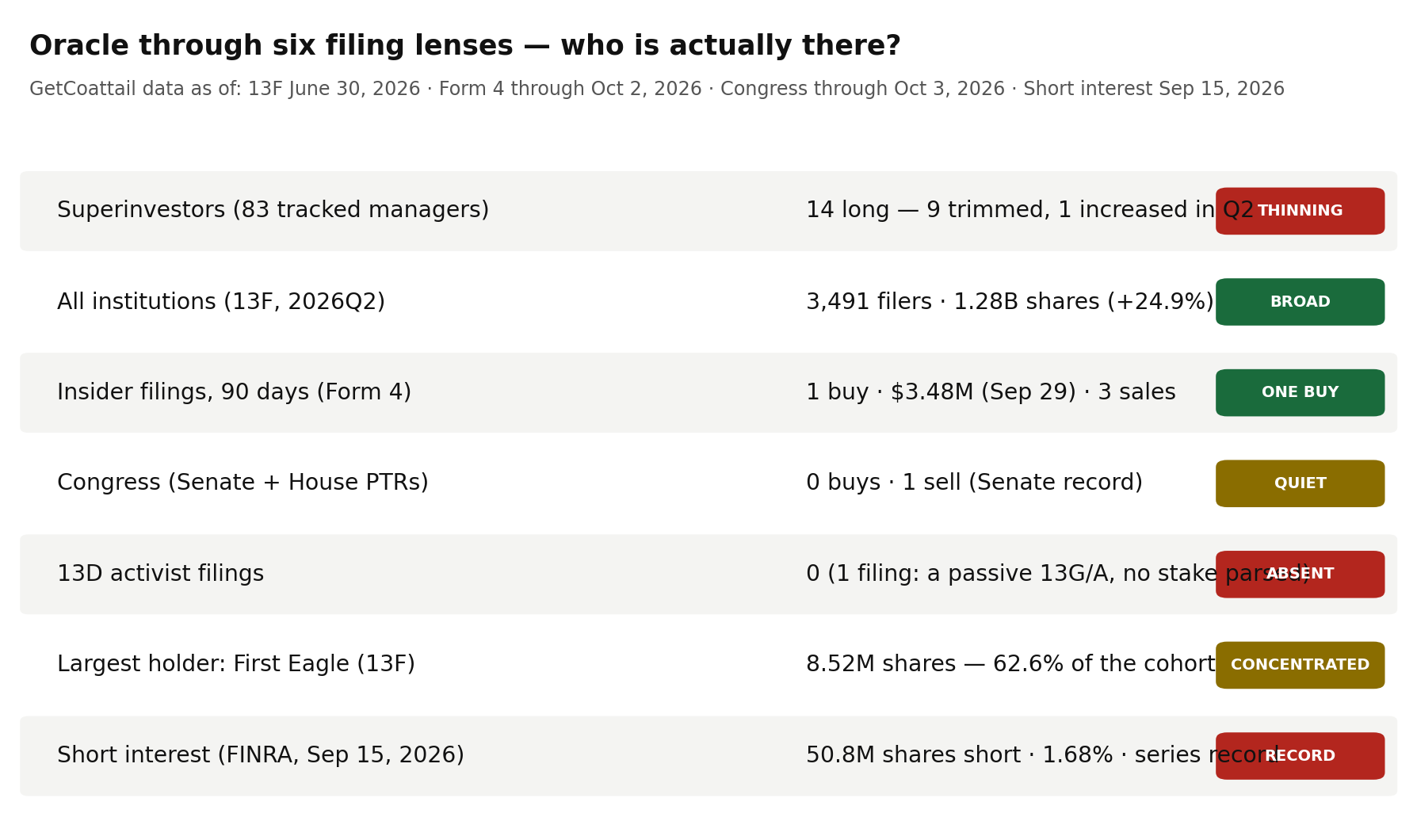
Lens 1: the superinvestors — fourteen holders, one of them 62.6%
We track 83 large, mostly long-only managers whose 13F portfolios we collect directly from SEC EDGAR. As of June 30, 2026, fourteen held Oracle in long common-stock positions — every one of the 14 reported rows is a long position, with no option rows in the count. The cohort's combined long position fell on a like-for-like pipeline basis from 15,815,143 shares at March 31 to 13,603,158 shares at June 30 — down 14.0% — in a quarter when the share price was nearly flat, closing at $147.11 on March 31 and $146.55 on June 30 in our price file (−0.4%). The pipeline and EDGAR-collection second-quarter totals agree exactly, at 13,603,158 shares, worth $1,993,537,107. Fourteen holders is a mid-pack bench — 20 tickers in the collection have more long holders, and three more match its fourteen — and the bench shrank its stake while the price did nothing.
What remains is concentrated to a degree none of the nine previous audits showed. The largest holder, First Eagle Investment Management, holds 8,516,878 shares — 62.6% of the cohort's entire Oracle position — and it is the only one of the 14 that increased, up 1.0%. The top three holders — First Eagle, Polen Capital with 3,574,259 shares, and Oakmark Funds with 650,879 — account for 93.7% of the cohort. The direction count: of the 14 long holders, 9 decreased, 1 increased, 2 were new and 2 were unchanged. Polen cut 28.9%; Cantillon Capital cut 91.8% and Mairs & Power cut 55.6%. The two new positions total 456,784 shares — Sound Shore with 454,708 and Pzena Investment Management with 2,076 — a fraction of the 2,211,985 shares the cohort shed net. This is not a cohort that left. It is a cohort that thinned to one large holder and a long tail.
Lens 2: institutions — 3,491 filers, shares up 24.93%
Zoom out to the whole 13F market and the register points the other way. At June 30, 2026, 3,491 institutions reported positions in Oracle, up from 3,416 at March 31 — a 2.2% rise — and 3,476 of them reported long positions. Reported share counts rose 24.93%, from 1,021,059,136 to 1,275,600,531 shares. The dataset's reported aggregate value rose 21.0% to $206,831,699,399; the aggregate includes option rows, so we treat filer and share counts as the reliable series and the dollar figure as reported (see methodology). One plausible reading is that part of this breadth is mechanical — index baskets and options books move share counts without any view on the company. But the contrast inside one quarter is the fact: the full register's share count rose by a quarter while the concentrated cohort's fell 14.0%, in a quarter when the price fell 0.4%.
Lens 3: the 5% register — one amendment, no readable stake
Exactly one SC 13D/G filing covers Oracle in our full-parse aggregation, and it is an amended 13G — the passive form. There is not one 13D, the filing an investor uses when it wants something from management. The single reporter is The Vanguard Group, in an amendment filed March 27, 2026 (event date March 13, 2026) — and its share count parses as zero in the filing data, the same reporting-structure pattern recorded in the Meta audit, so we do not use it as a sized stake. The honest summary: this register carries no readable sized position and no activist presence.
Lens 4: insiders — one purchase, dated September 29
The insider lens is where Oracle breaks this series' pattern. In the 90 days through October 2, 2026, Oracle insiders filed 14 reports covering one open-market purchase: 25,000 shares for $3,483,800, an average of $139.352 a share, by one buyer. Our site's insider aggregate dates that purchase to September 29, 2026 and agrees with the full-parse figures exactly. Against it sit three sale transactions totalling $5,342,123.36 — 36,075 shares sold by two sellers, all three sales by officers. The buyer was not an officer: the aggregate records zero officer purchases in the window, in the last year, and across the entire parsed record.
Widen the window and the proportions stay stark. Over the full year through October 2, 2026, the record shows the same single purchase — the only one in twelve months — against 28 sale transactions totalling $119,105,308.14 by nine sellers. Across the entire parsed Form 4 record (103 filings), purchases total five transactions and $4,655,116.03 by four buyers, against 86 sale transactions totalling $2,769,190,866.41 by thirteen sellers. Some selling is mechanical — vesting and tax withholding generate filings regardless of anyone's view — and we assign no motives, including to the purchase. What the record establishes is narrower: in a stock that closed at a 252-session low of $114.99 on July 24, 2026, exactly one insider transaction in a year was a purchase at market price.
Lens 5: Congress — one sale, no buys
Across the Senate and House transaction record we maintain (as of October 3, 2026), Oracle shows one sale transaction and zero purchases. The single sale sits in the Senate aggregate; the House aggregate carries no Oracle record at all. Congressional disclosures report value ranges rather than exact amounts, so we record direction only.
Lens 6: short interest — a series record, at 1.68% of the share count
As of September 15, 2026 — the most recent FINRA settlement date — 50,840,436 Oracle shares were sold short: the highest reading in the entire 137-settlement series we maintain. That is 1.68% of the 3,023,736,000 shares outstanding in our fundamentals file (a dei share count as of September 7, 2026), with days-to-cover of 1.36.
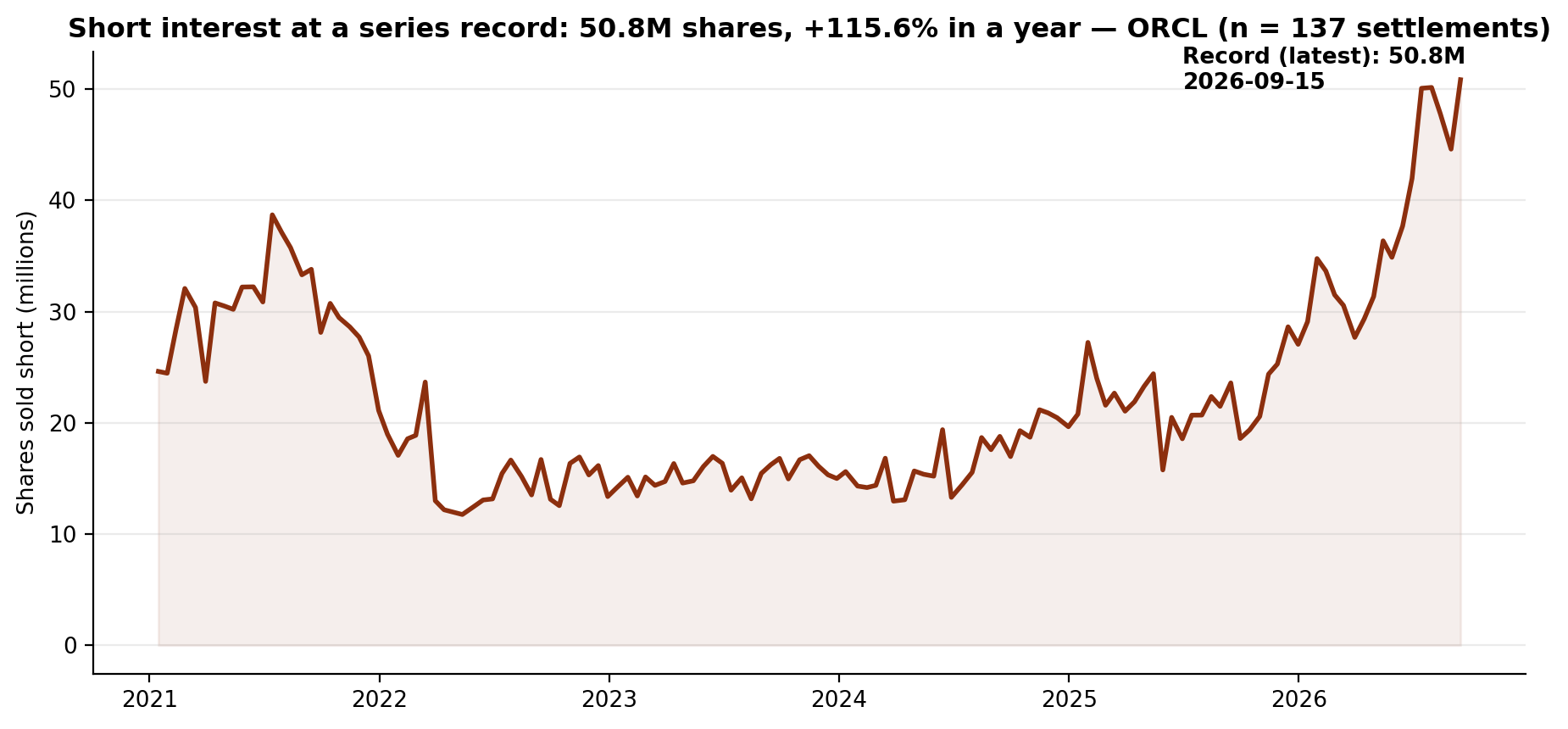
The path into the record matters. Short interest reached 50,143,917 shares on July 31, 2026, then fell at two consecutive settlements — to 47,767,442 on August 14 and 44,597,874 on August 31 — before jumping 14.0% to the record 50,840,436. The latest reading is up 115.6% from 23,583,435 a year earlier (September 15, 2025).
The gap, stated plainly
Oracle's filing record does not line up on one side. The broad register added 24.93% more shares in the second quarter and now counts 3,491 filers. The concentrated cohort did the opposite: 14 holders, shares down 14.0% in a flat quarter, nine of fourteen trimming, and 62.6% of what remains in a single portfolio — First Eagle's, the one position that grew. The 5% register is effectively blank, Congress has sold once and never bought, and the short borrow stands at a series record of 50,840,436 shares, up 115.6% in a year. Against all of that sits the most unusual insider fact in ten audits: one open-market purchase, 25,000 shares for $3,483,800 on September 29, 2026 — the year's only insider buy, made by a non-officer, in a stock down 54.5% from its 252-session closing high of $313.00 (October 16, 2025). One plausible reading is that the record describes a stock accumulated by the broad market's machinery, trimmed by the concentrated money, borrowed against at a record pace — and bought, once, by somebody inside it. The record supports each clause separately; it does not say which one leads.
What would change the picture
Nothing above is a recommendation. It is a record. These are the filings that would change the description:
- 1. The short-interest series from its record. Short interest jumped 14.0% at the September 15 settlement to 50,840,436 shares after two settlements of decline. Whether the next settlements hold the borrow above 50 million shares or unwind it is the fastest-updating series in this audit: FINRA publishes it every two weeks.
- 2. The 2026Q3 13Fs (filing window closing mid-November 2026). Whether First Eagle's 8,516,878 shares grow again, whether Polen's 28.9% cut continues, and whether the holder count holds at 14 is the cleanest test of whether the thinning was a quarter or a direction.
- 3. A second insider purchase — or none. One purchase in a year (25,000 shares, September 29, 2026) is a fact; a pattern would need a second Form 4 purchase code, from any insider, at any size. Watch also whether officer selling — $119,105,308.14 over the last year — continues.
- 4. Any 13D, or a readable 13G. The 5% register currently holds one passive amendment with no parseable stake. A first 13D converts the register from blank to intent, and any new sized 13G reporter would be the first readable name on it.
- 5. Second-quarter fiscal results, expected in December 2026. The next print tests the narrative the filings are arguing over — $664 billion of remaining performance obligations against the spending pace that produced roughly negative $5.4 billion of free cash flow in the September quarter.
Until one of those prints, the filing record describes a stock the broad register accumulated and the concentrated money trimmed, whose borrow has never been larger, and whose only insider purchase of the year arrived in late September.
Related reading: Thirty-One of 83: Five Managers Opened New Meta Positions. Its Insiders Have Never Bought a Share. — Filing Tape #9; Zero of 83: The Superinvestors Aren't in IREN — Filing Tape #1; 80% Overlap, No Copycat Signal: Congress vs. the Superinvestors. Oracle's own page: Oracle (ORCL) on GetCoattail.
Methodology and data notes
- Superinvestor lens: 83 managers collected directly from SEC EDGAR Form 13F (managers_13f collection), positions as of June 30, 2026; Oracle identified by CUSIP 68389X105. Fourteen distinct managers hold long positions totalling 13,603,158 shares; all 14 reported rows are long (no put or call rows). Quarter-to-quarter cohort totals (15,815,143 shares across 12 pipeline rows at March 31; 13,603,158 across 14 pipeline rows at June 30) are from the site pipeline's holdings files on the same CUSIP basis in both quarters; the change is −14.0% ((13,603,158 / 15,815,143) − 1), and the pipeline's second-quarter total agrees exactly with the EDGAR collection's long total (difference: 0 shares). First Eagle's share of the cohort is 8,516,878 / 13,603,158 = 62.6%; the top three holders (First Eagle, Polen Capital 3,574,259 shares, Oakmark Funds 650,879 shares) are 93.7%; the two new positions (Sound Shore 454,708 shares, Pzena Investment Management 2,076 shares) total 456,784 shares. Direction counts across the 14 long holders: 9 decreased, 1 increased, 2 new, 2 unchanged. Full-collection long-holder counts: Microsoft 37, Alphabet Class A (GOOGL) 36, Amazon 35, Alphabet Class C (GOOG) 34, Meta 31 — 20 tickers in the collection have more long holders than Oracle's 14, and three more (TXN, WFC, CMCSA) also have 14.
- Full-market lens: SEC Form 13F Data Sets full-market aggregation (the fixtures underlying our 2026Q1–Q2 market tables). Holders = distinct filers reporting the CUSIP; 3,476 of the 3,491 reported long positions. Reported-value caution: the aggregate value ($206,831,699,399 over 1,275,600,531 shares) implies ≈$162.14 per share against a June 30, 2026 close of $146.55 in our price file. The aggregate sums the VALUE of every information-table row — including put and call option rows — while the share count covers long common-stock rows only, so we headline filer and share counts and label dollar values "reported."
- Insider lens: full-parse Form 4 aggregation (agg_by_ticker), record as of October 2, 2026 (103 filings). Sale and purchase counts are transaction-code counts (S and P) in non-derivative rows; grants and exercises are not counted as purchases. The 90-day purchase (1 transaction, 25,000 shares, $3,483,800) implies an average price of $139.352. Officer purchases (officerBuyTx) are zero in the 90-day, one-year and full-record windows; all three 90-day sale transactions are officer sales. The site's 90-day insider aggregate (compiled as of October 8, 2026) agrees with the full-parse figures exactly — one buy, three sales, identical values — and supplies the purchase date, September 29, 2026.
- 13D/G lens: full-parse SC 13D/G aggregation and parsed filings (1 filing, an amendment, 1 reporter in aggregate), filings through March 27, 2026. The single parsed filing (The Vanguard Group, event date March 13, 2026, filed March 27, 2026) carries zero shares in the parse and is not used for any figure here; no 13D filing exists in the aggregation for Oracle.
- Congress lens: Senate PTR archive and House PTR archive as maintained on this site, combined record as of October 3, 2026. Counts are transaction counts in the aggregated member record; congressional disclosures report value ranges, so no dollar figures are used for this lens. The combined record shows zero buys and one sell; the sell is in the Senate aggregate (as of October 1, 2026), whose member-count field for Oracle reads zero — a quirk of that aggregate — so we report transaction counts only. The House aggregate carries no Oracle record.
- Short interest lens: FINRA Equity Short Interest files (biweekly settlement dates), collected directly from FINRA's public distribution; the Oracle series covers 137 settlements from January 15, 2021 to September 15, 2026, and the latest reading is the series maximum, verified across all 137 rows. FINRA publishes each settlement about two weeks after the fact. The share-count ratio uses the fundamentals file's share count of 3,023,736,000 — a dei shares-outstanding count as of September 7, 2026.
- Fundamentals note: our fundamentals collection carries Oracle's fiscal-2026 figures — revenue $67,357,000,000, net income $17,087,000,000, assets $261,759,000,000 — for the fiscal year ended May 31, 2026. The fiscal first-quarter 2027 figures in the introduction are from the company's September 10, 2026 results as reported by multiple outlets (see market context sources), not from our fundamentals file. The market value of about $437.7 billion uses that file's October 6, 2026 price ($144.77) and reported share count.
- Prices: our own daily-close file for Oracle through October 2, 2026 ($142.30 close, −27.0% year to date on that file; 252-session closing high $313.00 on October 16, 2025; closing low $114.99 on July 24, 2026; closes of $147.11 at March 31, 2026 and $146.55 at June 30, 2026, a second-quarter change of −0.4%; highest close in the file $328.33 on September 10, 2025). The drawdown from the 252-session closing high is −54.5% ((142.30 / 313.00) − 1). The 52-week intraday range of $114.50 to $322.54 and the October 1 close of $138.07 (down 29.5% year to date) are Benzinga Pro figures via Longbridge, checked October 9, 2026 — a different basis from our closing-price file, and the two are not mixed.
- Market context sources: fiscal first-quarter 2027 results (revenue $19.3 billion, +30% year over year; adjusted EPS $1.92 against a consensus of roughly $1.74; GAAP EPS $1.56; total cloud revenue $11.6 billion, +62%; cloud infrastructure revenue $7.4 billion, +121%; remaining performance obligations $664 billion, up $209 billion year over year, against analyst expectations of roughly $618 billion to $630 billion; capital expenditure $28.5 billion against expectations of about $19.23 billion; free cash flow of roughly negative $5.4 billion; long-term borrowings of about $125 billion; fiscal 2027 guidance raised to at least $90 billion of revenue and $8.10 of adjusted EPS) — company results as reported by StockTitan (company release), MarketWatch via TradingView, CryptoDaily and AInvest, checked October 9, 2026; after-hours gain of about 4% and a next-session decline of roughly 5% — MarketWatch and AInvest; most-searched ranking (seventh, Benzinga Pro September) and consensus average price targets (about $237.97 as of September 30, 2026, and about $245.75 in a more recent compilation) — Benzinga via Longbridge, OneMoreMoney and Parameter.io. Figures we could not confirm against two sources were left out.
- Oracle is in the GetCoattail stock-page universe: Oracle (ORCL) stock page. Series data: orcl_lens_data.csv · orcl_short_interest_series.csv. Earlier audits: Meta · Amazon · IREN.
This article describes public filings as of the dates stated. It is not investment advice and makes no recommendation. Filings lag reality: 13F positions are as of June 30, 2026, and later trading is not yet public.
Revision history
- v1.0 — October 9, 2026: first publication.
- v1.1 — October 9, 2026: two figures corrected on post-publication verification — 20 tickers (not 23) have more long holders than Oracle, with three more tied at 14; and the March 31, 2026 pipeline total covers 12 rows (not 14). Share totals, percentages and conclusions are unchanged.