GetCoattail Research — The Filing Tape #65. Seagate is the AI storage trade: a hard-drive maker whose stock rose 146.3% in the second quarter. The filings describe who arrived, and who never did: three tracked superinvestors who all opened new positions that quarter, a full market that added 518 filers, an insider record with zero purchases in its entire parsed history against 821 sales, and a borrow rising since mid-July.
The Hype
Seagate makes the mass-capacity hard drives that AI data centres store their data on, and scarcity has been the story: demand ran ahead of supply, drive prices rose, and the stock followed. On our daily-close file it went from $391.76 at March 31 to $965.00 at June 30 — up 146.3% in the second quarter — reached a 252-session closing high of $1,094.04 on June 22, and eased to $807.62 by October 6, down 26.2% from that high and up 193.3% year to date. Our fundamentals file records fiscal 2026 revenue of $12,195,000,000 and net income of $3,184,000,000, and the reported recent quarter kept the story going — revenue of $3.63 billion, up 48.5% year over year, earnings per share of $5.71 against a $5.10 consensus (MarketBeat). October brought the first counter-narrative: reports that rival Toshiba plans to expand hard-drive capacity sent the shares down about 10% in a day (Insider Monkey, October 4), and Bloomberg reported, via StockTwits on October 6, that Seagate is bidding against Toshiba for TDK's magnetic-heads business. The stock ranked eighth on MarketBeat's trending-stocks list when we checked on October 13, 2026 — the highest-ranked name this series had not yet audited.
The Tape
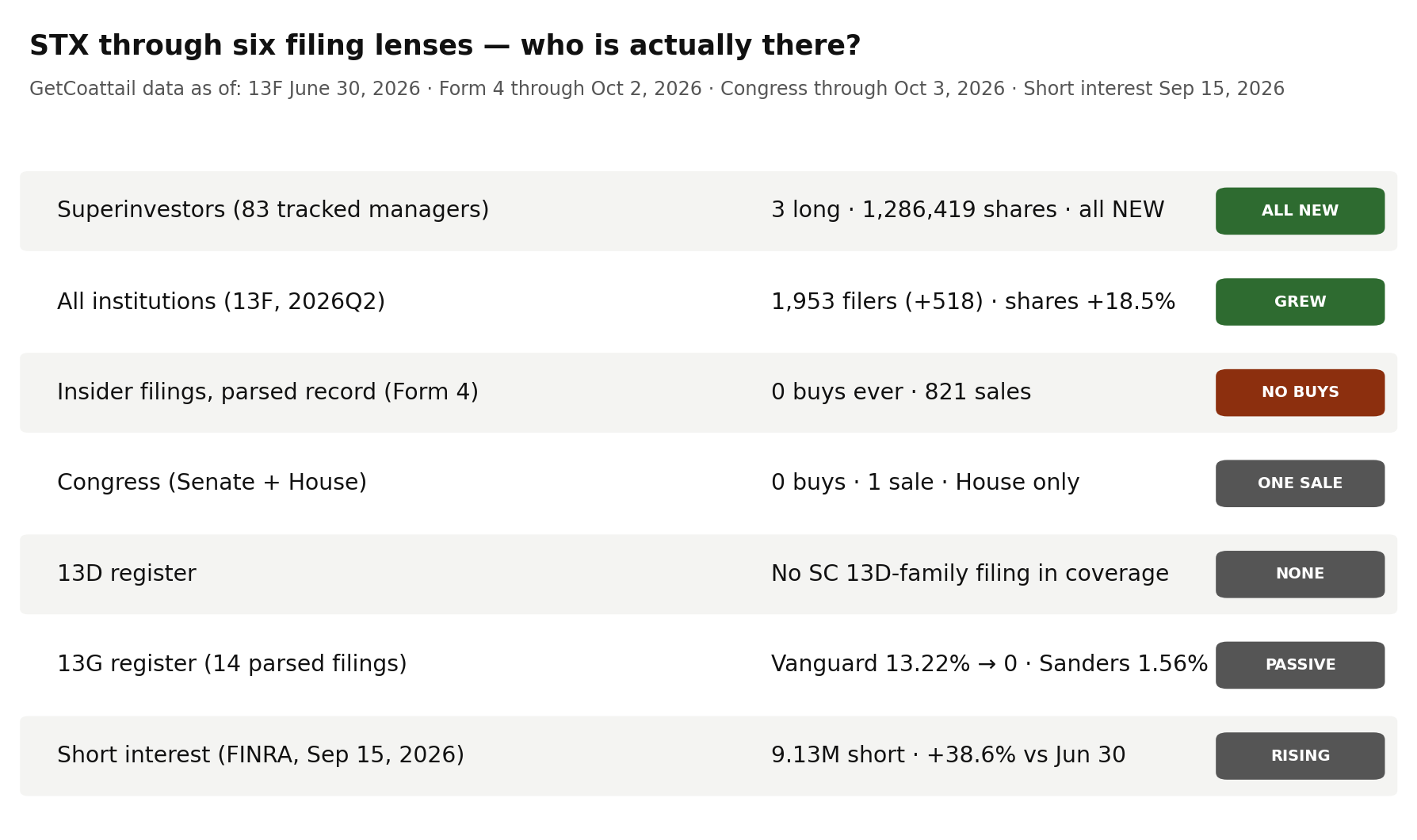
For STX — the sixty-fifth Filing Tape audit — the tape shows a tracked cohort that did not exist in this name one quarter earlier, a broad register that grew by more than a third, a passive 5% register in quiet retreat, an insider purchase line that has never printed, a congressional record of exactly one sale, and a borrow rebuilding from a low base.
| Lens | As of | What the filings show | Direction vs prior period |
|---|---|---|---|
| Superinvestors (13F) | Jun 30, 2026 | 3 long holders, all NEW; 1,286,419 shares; $1,241,394,335 | From zero: no Q1 position at all |
| All institutions (13F) | Jun 30, 2026 | 1,953 filers; 186,268,493 shares | Filers +518; shares +18.49% |
| Insiders (Form 4) | Oct 2, 2026 | 0 purchases in the entire parsed record; 821 sales | Purchases: none, ever, in coverage |
| Congress | Oct 3, 2026 | 0 purchases; 1 sale; House only | No purchase recorded |
| 13D/G | Aug 5, 2026 | 14 parsed filings, all passive; no SC 13D | Largest reported stake fell from 13.22% to 0 |
| Short interest (FINRA) | Sep 15, 2026 | 9,129,029 shares; 4.03% of shares outstanding | +38.6% vs the Jun 30 settlement |
Lens 1 — the superinvestors: three holders, every one of them new. We track 83 large, mostly long-only managers whose 13F portfolios we collect directly from SEC EDGAR. As of June 30, 2026, 3 held STX long totalling 1,286,419 shares worth $1,241,394,335, with no option rows. Every one carries the collection's NEW label, and the pipeline's March file carries no STX row for any tracked manager — the prior-quarter position was zero shares, so no percentage change exists: the position appeared, whole, in one quarter. Stephen Mandel's Lone Pine Capital is most of it, with 1,000,109 shares worth $965,105,185, a 5.9% portfolio weight and 77.7% of the cohort's STX shares. Chase Coleman's Tiger Global Management holds 285,100 shares worth $275,121,500, a 1.15% weight; Lee Ainslie's Maverick Capital holds 1,210 shares worth $1,167,650, a 0.01% weight. The cohort's implied price, $965.00, sits exactly on the June 30 close. 13F figures are as of June 30, 2026; funds have up to 45 days to file, so this picture is complete — and always lagging.
Lens 2 — institutions: 518 more filers, 29.1 million more shares. At June 30, 2026, 1,953 institutions reported positions, up 518 from 1,435 at March 31 (+36.10%), 1,941 of them long. Reported shares rose 18.49%, from 157,203,922 to 186,268,493 shares. Reported aggregate value rose 194.43% to $197,331,599,659; the aggregate includes option rows, so we headline filer and share counts and label dollars "reported" (see methodology).
Lens 3 — insiders: zero purchases, in the entire record. The parsed Form 4 record holds 215 filings through October 2, 2026, and its purchase line is empty at every horizon. The last 90 days hold 38 filings with no open-market purchase against 379 sale transactions totalling 467,500.5 shares and $379,331,448.23, by six sellers, 378 of them officer sales. The last year holds 138 filings, no purchase, and 739 sale transactions totalling 903,096 shares and $599,678,841.70, by eleven sellers. Across the whole record, purchases total 0 transactions and sales total 821 transactions totalling 1,534,549 shares and $676,986,299.81, by thirteen sellers, 800 of them officer sales. We assign no motives; a purchase line that has never printed, against 821 sales, is the fact.
Lens 4 — Congress: one sale, in one chamber. The combined congressional record (as of October 3, 2026) carries 0 recorded purchases and 1 recorded sale, and no purchase date at all. The House aggregate carries the whole of it. The Senate aggregate (as of October 1, 2026) carries no STX row at all.
Lens 5 — the 5% register: fourteen passive filings, and a quiet retreat. Our full parse holds exactly 14 SC 13D/G filings for STX — three SC 13G and eleven SC 13G/A, and no SC 13D-family filing at all — 17 reporting-person rows across eight names, most recently filed August 5, 2026. The register's maximum is The Vanguard Group at 27,974,083 shares (13.22%) as of December 31, 2024, and that reporter later printed 0 shares (0.0%) as of March 13, 2026 — the re-papering pattern this series has recorded at other names, with Vanguard Capital Management at 16,318,822 shares (7.48%) as of March 31, 2026 and Vanguard Portfolio Management at 11,094,908 shares (5.08%) the same date, the latter down to 7,999,686 shares (3.56%) as of June 30, 2026. The most active retreat is Sanders Capital, LLC and Lewis A. Sanders — the same stake reported by two reporters — at 18,902,646 shares (8.93%) as of March 31, 2025, then 3,496,343 shares (1.56%) as of June 30, 2026: down 15,406,303 shares (-81.5%), with no reason asserted. The remaining rows are in the methodology.
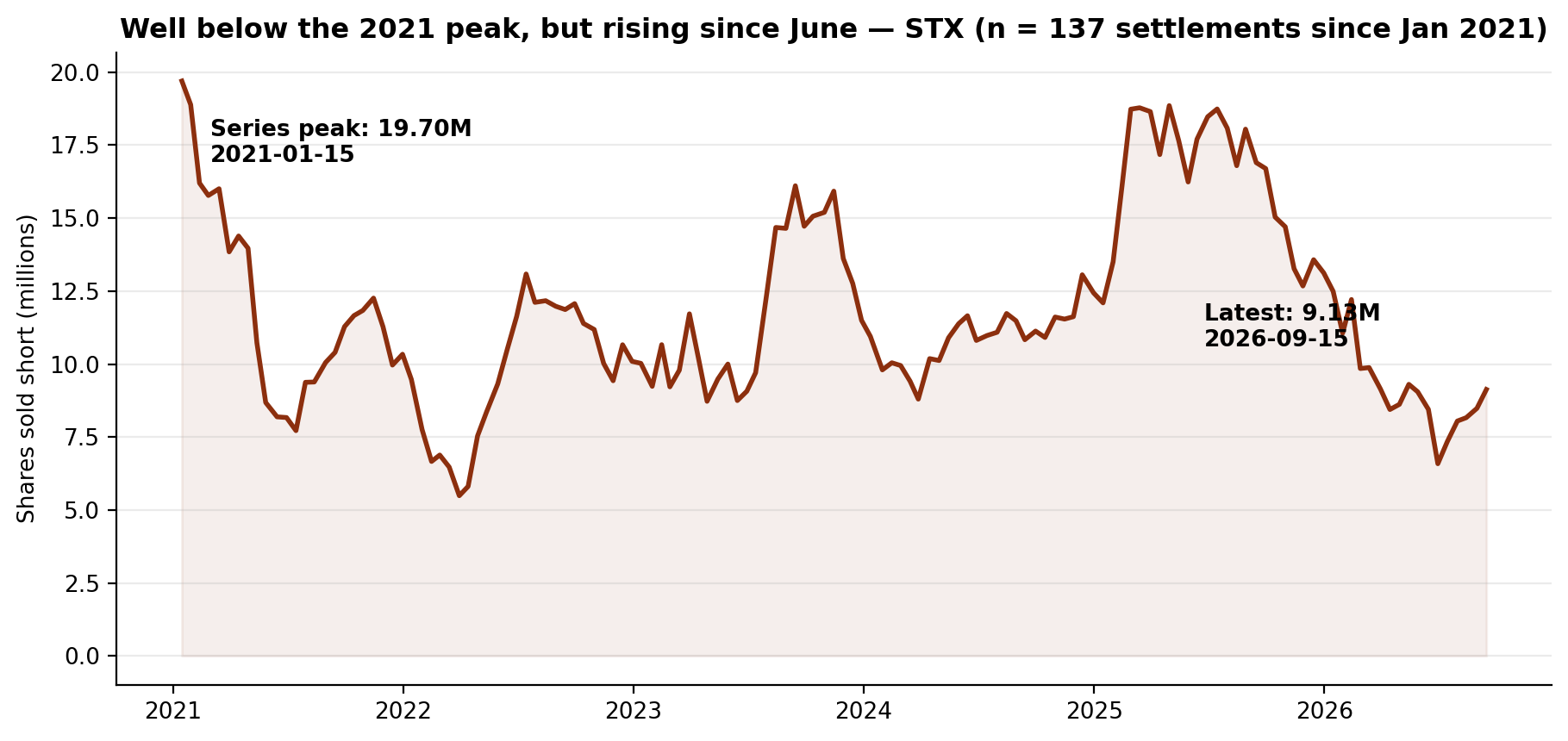
Lens 6 — short interest: 9,129,029 shares, rising since June. FINRA's files carry the borrow across 137 settlements, from January 15, 2021. As of September 15, 2026 — the most recent settlement — 9,129,029 STX shares were sold short. That reading rose 7.62% from the prior settlement's 8,482,797 shares on August 31, 2026, and the last five settlements rose at every step, from 7,342,100 on July 15. The series maximum is 19,698,219 shares on January 15, 2021 — the series' first settlement, verified by a maximum query over the whole series — so the latest sits 53.7% below that peak and 46.0% below the year-ago 16,900,916 shares. But against the June 30, 2026 settlement of 6,584,569 shares — the 13F snapshot date — it is 38.6% higher: the borrow has been rebuilding since the quarter ended. Against 226,644,518 shares outstanding, it is 4.03% of the share count.
The Gap
The narrative describes the storage-scarcity trade: revenue up 48.5% in the reported quarter, a stock up 146.3% in the second quarter, and a first crack only in October, when a rival's capacity plans knocked about 10% off the price in a day. The filings describe the positioning underneath. The tracked superinvestors held no STX at March 31; at June 30 they held 1,286,419 shares across three holders, every position new, Lone Pine carrying 77.7% of the cohort. The full market moved broader: 186,268,493 reported shares, up 29,064,571, across 1,953 filers. The 5% register printed 14 filings, all passive, mostly down: a Vanguard Group stake at 13.22%, a Vanguard Group row at zero, a Sanders stake cut 81.5%. Insiders recorded zero purchases — not in the last year, not in the entire record — against 821 sales. Congress records 0 purchases and 1 House sale; the Senate record holds no row. And the borrow stands at 9,129,029 shares — 53.7% below its January 2021 peak, and 38.6% above the June 30 snapshot date. One plausible reading is that the quarter's believers arrived through the front door of the 13F register — three new tracked positions and 518 new filers — while the registers already there mostly stepped back, and the short side has started to rebuild since the snapshot. The record supports each clause separately; it does not say which register is right, and it cannot — the cohort's position is a June 30 snapshot, before the October slide.
What Would Change the Picture
Nothing above is a recommendation. It is a record. These are the filings that would change the description:
- 1. The 2026Q3 13Fs (filing window closing mid-November 2026). The cohort held 1,286,419 shares at June 30 across three holders, all new. Whether Lone Pine builds on or trims its 1,000,109-share position, whether Tiger Global's 285,100-share position survives its first quarter, and whether a fourth tracked name appears are the first things the next register answers.
- 2. A first insider purchase, ever, in the parsed record. The record holds zero purchases across 215 filings through October 2, 2026, against 821 sales. A single purchase transaction, by any insider, at any size, breaks the pattern this lens shows.
- 3. Whether the Sanders stake steps down a third time. That stake has stepped down twice across its three reported dates, from 18,902,646 shares (8.93%) to 3,496,343 shares (1.56%). Whether the next amendment holds it near 3.5 million shares or prints another step down is this register's first question.
- 4. Whether the borrow keeps rebuilding, or fades back. Short interest stands at 9,129,029 shares, up 38.6% from the June 30, 2026 settlement of 6,584,569 and up at every settlement since July 15. A reading below 6,584,569 ends the rebuild; one above the year-ago 16,900,916 changes its scale entirely.
- 5. A first congressional purchase, or a first Senate record, at any size. The combined record carries 0 purchases and 1 sale, all of it House. A single purchase in either chamber gives this lens its first buy in our coverage.
Until one of those prints, the record describes a stock held by three of our 83 tracked superinvestors — 1,286,419 shares, all opened in the quarter its price rose 146.3% — whose insiders have recorded no purchase in the entire parsed record against 821 sales, whose largest 5% reporter stepped down from 13.22% to zero, and whose borrow has risen 38.6% since the June 30 snapshot.
As-of & Limits
The lenses rest on different clocks, none live: 13F is a June 30, 2026 snapshot published up to 45 days later; Form 4 runs through October 2, 2026; Congress through October 3, 2026 (Senate October 1); 13D/G through the August 5, 2026 filing; short interest through the September 15, 2026 settlement; prices end October 6, 2026. Two limits are specific to this name: the site 13D/G aggregate keys this issuer by CUSIP, not ticker, so Lens 5 is built from the parsed filings and cross-checked against that row (see methodology); and the full-market aggregate's reported value implies $1,059.39 per share against the $965.00 close, so this audit headlines filer and share counts.
Related reading: Five of 83: Micron's Superinvestor Count Rose. Its Biggest Holder Cut Shares 41%. — Filing Tape; Two of 83: The Superinvestors Cut SanDisk 99.7% — to 768 Shares — in the Quarter It Rose 257.9% — Filing Tape; Seven of 83: The Superinvestors Cut Eli Lilly 21.8% in Q2. Its Insiders Have Not Bought in a Year. — Filing Tape #64. STX's own page: Seagate Technology Holdings plc (STX) on GetCoattail.
Methodology and data notes
- Superinvestor lens: 83 managers collected directly from SEC EDGAR Form 13F (managers_13f collection), positions as of June 30, 2026; STX identified by CUSIP G7997R103. Three distinct managers hold long positions totalling 1,286,419 shares; there are no option rows for this name in the collection. The direction count on the collection's labels, across the long rows, is three NEW; the collection's exit list contains no STX row. Quarter-to-quarter cohort totals (0 long shares at March 31; 1,286,419 long shares at June 30) are from the site pipeline's holdings files on the same CUSIP basis in both quarters — the March file contains no G7997R103 row for any tracked manager — and the pipeline's second-quarter totals match the EDGAR collection exactly on both shares and value (differences of 0 shares and $0). Because the prior-quarter total is zero, no quarter-to-quarter percentage change is computed for this lens. Lone Pine's share of the cohort is 77.7% = 1,000,109 / 1,286,419.
- Full-market lens: SEC Form 13F Data Sets full-market aggregation. The primary table is the full13f collection's by-ticker file (holders = distinct filers reporting the CUSIP; 1,941 reported long positions out of 1,953 filers). STX reports under a single CUSIP spelling, G7997R103, and the backfill fixtures' by-CUSIP file carries the same row — the cross-check matches on every numeric field (holders, shares, reported value, prior holders and prior reported value); the fixture row's ticker field is null, which does not affect the numeric match. The by-ticker file's entered/exited fields (1,642 and 1,124, a net of +518 that matches the change in holder count) are gross flows, so this audit headlines the net change. Reported-value caution: the aggregate value ($197,331,599,659 over 186,268,493 shares) implies $1,059.39 per share against a June 30, 2026 close of $965.00 in our price file, a gap of +9.8% — printed here as found. The aggregate sums the VALUE of every information-table row — including put and call option rows — while the share count covers long common-stock rows only, so we headline filer and share counts and label dollar values "reported."
- Insider lens: full-parse Form 4 aggregation (agg_by_ticker), record as of October 2, 2026 (215 filings). Sale and purchase counts are transaction-code counts (S and P) in non-derivative rows; grants and exercises are not counted as purchases, and one filing can contain many transaction rows. Purchase transactions total 0 across the parsed record — in the 90-day window, the last year and the full record alike. Sale transactions total 821 across the record (1,534,549 shares, $676,986,299.81, thirteen sellers, 800 of them recorded as officer sales); the last year holds 739 (903,096 shares, $599,678,841.70, eleven sellers, 727 officer sales) and the 90-day window holds 379 (467,500.5 shares, $379,331,448.23, six sellers, 378 officer sales). The site's insider aggregate (compiled as of October 13, 2026, 90-day window) carries 0 purchases, 379 sales, six sellers and $379,331,448.23 for this name — identical to the full parse's 90-day window — so this audit prints the full parse as the record. Unlike some names in this series, no field of this aggregate had to be excluded: its sale-value totals imply $811.40 per share for the 90-day window, $664.03 for the one-year window and $441.16 across the full record, each inside the traded price range of its window on our price file ($745.49 to $994.79 for the 90-day window's dates, $211.63 to $1,094.04 for the one-year window's, and $48.49 to $1,094.04 across the price file), so all three sale-value totals are cited as figures in this article.
- 13D/G lens: full-parse SC 13D/G parsed filings (14 filings matching issuer CIK 1137789 on CUSIP G7997R103, 17 reporting-person rows across 8 names as filed: three SC 13G filings and eleven SC 13G/A amendments, no SC 13D-family filings), filings through August 5, 2026. The site aggregation's by-ticker file has no row keyed by the STX ticker; it keys this issuer by CUSIP instead — the "CUSIP:G7997R103" row (ticker null) carries 14 filings, 11 amendments, 8 reporters, latest date August 5, 2026, maximum 13.22% and 223,761,840 reported shares, matching the parsed filings on every field. This lens reports the parsed filings directly, with that row as the cross-check. The parsed reporting-person rows sum to 223,761,840 shares, but that total sums reporting-person rows across different dates and counts the Sanders stake twice at each date (Sanders Capital, LLC and Lewis A. Sanders report the same shares), so it is not used as a stake figure in the article. The Vanguard Group's rows (27,974,083 shares at 13.22% as of December 31, 2024, filed January 31, 2025, SC 13G/A; then 0 shares at 0.0% as of March 13, 2026, filed March 27, 2026, SC 13G/A), Vanguard Capital Management's row (16,318,822 shares at 7.48% as of March 31, 2026, filed April 30, 2026, SC 13G), Vanguard Portfolio Management's rows (11,094,908 shares at 5.08% as of March 31, 2026, filed April 29, 2026, SC 13G; then 7,999,686 shares at 3.56% as of June 30, 2026, filed July 31, 2026, SC 13G/A), JPMORGAN CHASE & CO.'s rows (16,848,908 shares at 7.9% as of December 31, 2024; 18,897,740 at 8.9% as of March 31, 2025; 17,890,283 at 8.4% as of June 30, 2025), BlackRock, Inc.'s row (12,954,300 shares at 6.1% as of March 31, 2025), Capital Research Global Investors' rows (15,621,162 shares at 7.4% as of December 31, 2024; then 7,293,420 at 3.4% as of June 30, 2025) and the Sanders rows (18,902,646 shares at 8.93% as of March 31, 2025; 13,035,275 at 5.98% as of March 31, 2026; 3,496,343 at 1.56% as of June 30, 2026, filed August 5, 2026) are reported as filed, under the names exactly as they appear. The parsed coverage for this issuer holds these 14 filings; a 5% holder that has not filed in the covered window would not appear here.
- Congress lens: Senate PTR archive and House PTR archive as maintained on this site. The combined record (as of October 3, 2026) carries 0 recorded purchases and 1 recorded sale, no most-recent purchase date, a member-count field of 0 and an empty party list for this ticker; the House aggregate (as of October 3, 2026) carries the identical record, and the Senate aggregate (as of October 1, 2026) carries no STX row at all, so the combined record is the House record alone. Transaction counts and the aggregate's own fields are reported as the aggregates carry them; this audit does not reconstruct individual filers from the aggregate beyond what the aggregate itself states.
- Short interest lens: FINRA Equity Short Interest files (biweekly settlement dates), collected directly from FINRA's public distribution. The published series covers 137 settlements from January 15, 2021 (19,698,219 shares) to September 15, 2026. The latest reading is 9,129,029 shares on September 15, 2026, up 7.62% from the prior settlement (8,482,797 on August 31, 2026), which had risen from 8,161,824 on August 14, 2026, following 8,047,106 on July 31 and 7,342,100 on July 15 — five settlements rising at every step. The series maximum is 19,698,219 shares on January 15, 2021 (verified by a maximum query over the series, not read off the latest row; the maximum is the series' first settlement), so the latest reading sits 53.7% below the peak. The year-ago settlement (September 15, 2025) printed 16,900,916 shares, so the latest reading sits 46.0% below a year ago. The series minimum is 5,488,510 shares on March 31, 2022, so the latest reading sits 66.3% above the low. The June 30, 2026 settlement printed 6,584,569 shares, so the latest reading sits 38.6% above the 13F snapshot date's borrow. FINRA publishes each settlement about two weeks after the fact, so the October price action is not yet in this series. The share-count ratio (4.03%) uses the fundamentals file's shares-outstanding figure below.
- Fundamentals note: our fundamentals collection carries STX's revenue of $12,195,000,000, net income of $3,184,000,000 and assets of $9,972,000,000, each labelled fiscal 2026 in the file. The file is marked ok for this name, with no missing fields: shares outstanding of 226,644,518 (as of July 31, 2026 in the file, sourced in the file to the issuer's reported shares-outstanding figure) and a file-computed market value of $182,591,624,143.00. The file's price for the name is $805.63 as of October 6, 2026; our daily-close file ends October 6, 2026 at $807.62, and we keep the two files' figures separate rather than blending them.
- Prices: our own daily-close file for STX through October 6, 2026 ($807.62 close, +193.3% year to date on that file; 252-session closing high $1,094.04 on June 22, 2026, so the last close sits 26.2% below it; 252-session closing low $211.63 on October 14, 2025; closes of $391.76 at March 31, 2026 and $965.00 at June 30, 2026, a second-quarter change of +146.3%; change from June 30 to October 6 of -16.3%; change from the 252-session low of +281.6% ((807.62 / 211.63) − 1); change from the September 30, 2025 close of $236.06 of +242.1%). The series in our price file begins June 1, 2021 at $98.25 and holds 1,344 rows.
- Market context sources: MarketBeat trending-stocks list (STX ranked eighth; checked October 13, 2026, at https://www.marketbeat.com/stocks/trending/?show=1); recent-quarter results (revenue of $3.63 billion, up 48.5% year over year; earnings per share of $5.71 against a $5.10 consensus — MarketBeat instant alert, October 9, 2026, at https://www.marketbeat.com/instant-alerts/price-seagate-technology-nasdaq-stx-shares-up-11-time-to-buy-2026-10-09/, checked October 13, 2026); the Toshiba capacity report and the roughly 10% one-day fall (Insider Monkey, October 4, 2026, at https://www.insidermonkey.com/news/toshiba-is-doubling-hard-drive-output-seagate-stx-and-western-digital-wdc-fell-10-each-1848414/, checked October 13, 2026); the TDK magnetic-heads bidding report (Bloomberg reporting carried by StockTwits, October 6, 2026, at https://stocktwits.com/news-articles/markets/equity/stx-stock-inches-higher-overnight-seagate-reportedly-makes-higher-bid-for-tdk-s-multi-billion-magnetic-heads-business/cZDsHKcRBkO, checked October 13, 2026). Figures we could not confirm against two sources were left out; the external items above are reported speech from those outlets, not GetCoattail measurements.
- STX is in the GetCoattail stock-page universe: Seagate Technology (STX) stock page. Series data: stx_lens_data.csv · stx_short_interest_series.csv. Earlier audits: Micron · SanDisk · Eli Lilly.
Past patterns are not a promise of future results. For education only — not investment advice.
This article describes public filings as of the dates stated. It is not investment advice and makes no recommendation. Filings lag reality: 13F positions are as of June 30, 2026, and later trading is not yet public.
Revision history
- v1.0 — October 13, 2026: first publication.