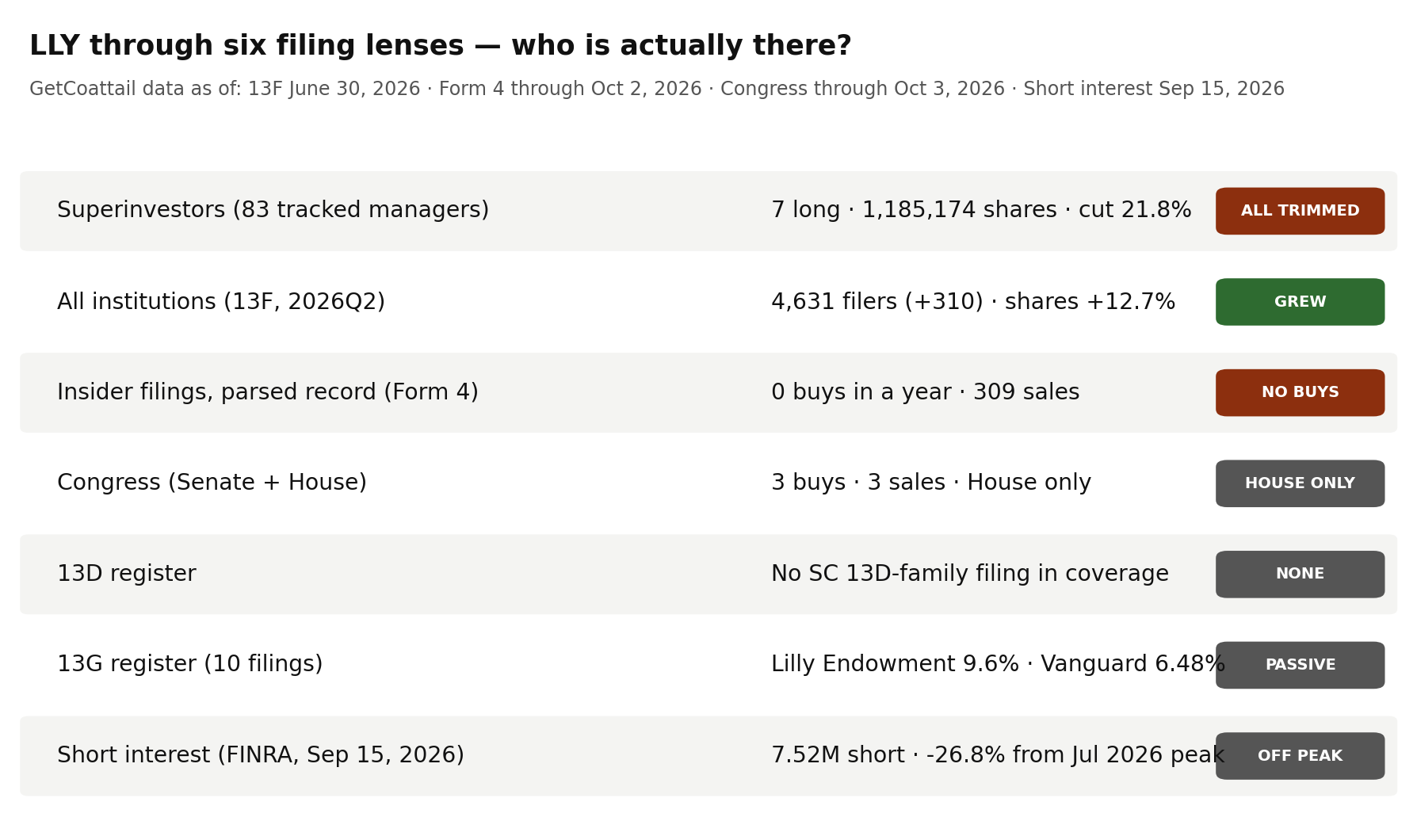
GetCoattail Research — The Filing Tape #64. Eli Lilly is the market's defining growth story: second-quarter revenue up 48%, guidance raised to as much as $87 billion, and analyst targets lifted three times in two weeks. The filings describe the positioning underneath: seven tracked superinvestors who all trimmed or stood still in the second quarter, cutting the cohort's stake 21.8% while the price rose 30.4%; a full market that added 310 filers and 88,217,686 shares in the same quarter; an insider record with zero purchases in a year against 309 sales; and a founding endowment whose reported stake has stepped down six filings in a row.
Start with the narrative. The business story is scale: Lilly reported second-quarter 2026 revenue of about $23 billion, up 48% from a year earlier, with its tirzepatide medicines doing the work — Mounjaro at $9.9 billion, up 91%, and Zepbound at $4.9 billion — and it raised full-year revenue guidance to $85 billion to $87 billion, against the $65,179,000,000 of revenue our fundamentals file records for fiscal 2025. The price ran with it for most of the year: on our daily-close file the stock rose from $919.77 at March 31 to $1,199.43 at June 30, a gain of 30.4% in the second quarter alone, and reached a 252-session closing high of $1,280.34 on August 19 before easing to $1,142.85 by October 2, down 10.7% from that high and up 49.8% from the $763.00 close of September 30, 2025. The commentary followed the price up: JPMorgan raised its target to $1,500 on September 28, Morgan Stanley to $1,430 on October 7 and Cantor Fitzgerald to $1,440 on October 9, as reported by MarketBeat and 24/7 Wall St. Lilly appeared on Zacks' most-searched list on October 9, and MarketBeat's pharmaceutical screener for October 10 put it first among five names by dollar trading volume. Two other items sat alongside the enthusiasm: the stock changed hands at about 30.94 times forward earnings on October 6, below its five-year average of 45.59, a gap bulls and bears each read their own way; and news reports said the Lilly Endowment, the company's largest shareholder, had filed to sell 300,000 shares worth about $347 million. The next scheduled test is the third-quarter report, listed on the company's investor calendar for October 29.
Now the filings. For LLY — the sixty-fourth Filing Tape audit — the tape shows a tracked cohort moving in one direction only, a broad register moving the other way, a passive 5% register whose largest name is a founding endowment in a slow step-down, an insider record whose purchase line has been empty for a year, a congressional record that exists in only one chamber, and a borrow that peaked in July and has since eased by about a quarter.
Lens 1: the superinvestors — seven holders, five cuts, two holds, no adds
We track 83 large, mostly long-only managers whose 13F portfolios we collect directly from SEC EDGAR. As of June 30, 2026, 7 held LLY long totalling 1,185,174 shares worth $1,421,532,846, with no option rows in the register. The direction count on the collection's own labels, across the long rows, is five decreased and two unchanged — no new position, no increase, and the collection's exit list holds no LLY row either. The cohort total moved from 1,514,705 long shares at March 31 to 1,185,174 at June 30, a change of -21.76%, a difference of -329,531 shares, in a quarter when the price rose 30.4%.
Every row can be followed across the quarter, because the pipeline's March file carries the same seven holders and each collection label agrees with the share continuity. The largest holder is Polen Capital Management with 666,912 shares worth $799,914,391, a 6.89% portfolio weight — 56.3% of the tracked cohort's LLY shares — flagged decreased, and the March file carries the position at 914,557 shares, so the label's -27.1% and the continuity agree. Mairs & Power Funds holds 322,129 shares worth $386,371,186, a 3.54% portfolio weight, decreased 1.3% from 326,306 shares. Jensen Investment Management holds 153,735 shares worth $184,394,371, a 4.47% portfolio weight, decreased 33.4% from 230,671 shares — the deepest percentage cut in the register. Dodge & Cox Funds holds 41,258 shares worth $49,486,083, decreased 1.8% from 42,012 shares. The three remaining rows are small: Bill Nygren's Oakmark Funds with 431 shares worth $516,954, decreased 4.2% from 450 shares; Torray Funds with 398 shares worth $477,373, unchanged; and David Katz's Matrix Asset Advisors with 311 shares worth $372,488, unchanged. The cohort's implied price, $1,199.43 per share, sits exactly on the June 30 close of $1,199.43. This register's second quarter, in full: seven holders, five of them selling into a 30.4% price rise, two standing still, and none adding a share on net.
Lens 2: institutions — 310 more filers, 88.2 million more shares
Zoom out to the whole 13F market and the register grew while the tracked cohort shrank. At June 30, 2026, 4,631 institutions reported positions, up 310 from 4,321 at March 31 (+7.17%), and 4,618 of them reported long positions. Reported shares rose 12.72%, from 693,706,599 to 781,924,285 shares — 88,217,686 more shares than the prior quarter. Reported aggregate value rose 49.41% to $942,123,799,338; the aggregate includes option rows, so we headline filer and share counts and label dollars "reported" (see methodology). The implied value per share, $1,204.88, sits 0.5% above the June 30 close of $1,199.43. Where the tracked cohort's register is seven names that together cut 329,531 shares, the broad register is more than four and a half thousand filers who, in aggregate, ended the quarter holding about an eighth more shares than they started it with.
Lens 3: the 5% register — ten passive filings, and an endowment stepping down
Our full parse holds exactly 10 SC 13D/G filings for LLY — one SC 13G and nine SC 13G/A, and no SC 13D-family filing at all — ten reporting-person rows across five names as filed, the most recent filed July 23, 2026. The register's maximum is the Lilly Endowment at 96,891,978 shares (10.2%) as of December 31, 2024, filed January 27, 2025, and its chain is the register's story: 96,016,978 shares (10.1%) as of March 31, 2025; 95,492,993 shares (10.1%) as of September 30, 2025; 92,190,516 shares (9.8%) as of December 31, 2025; 91,896,978 shares (9.7%) as of March 31, 2026; and 90,376,978 shares (9.6%) as of June 30, 2026, filed July 23, 2026 — a step down at every reported date, 6,515,000 shares (-6.7%) from the first row to the latest, printed here as filed, with no reason asserted. The Vanguard rows repeat the re-papering pattern this series has recorded at other names: The Vanguard Group at 80,952,595 shares (8.55%) as of September 30, 2025, filed October 30, 2025, then 0 shares (0.0%) as of March 13, 2026, filed March 26, 2026, with Vanguard Capital Management at 61,295,605 shares (6.48%) as of March 31, 2026 on an original SC 13G filed May 1, 2026. The remaining row is The PNC Financial Services Group at 51,153,837 shares (5.39%) as of December 31, 2024, filed February 7, 2025. That is the whole 5% register in our parsed coverage: a founding endowment reducing in steps, one index complex reporting under two names, one bank holding company, and no activist paper of any kind.
Lens 4: insiders — zero purchases in a year
The parsed Form 4 record holds 226 filings through October 2, 2026. The last year holds 126 of them, with no open-market purchase at all against 309 sale transactions totalling 3,277,828 shares by five sellers. The last 90 days hold 19 filings with the same empty purchase line against 3 sales totalling 13,500 shares and $15,958,170, by three sellers, all three recorded as officer sales. Across the whole parsed record, purchases total 9 transactions — 6,987 shares and $4,537,300.77, by eight buyers, four of them recorded as officer purchases — and every one of those nine predates the last year. Sales across the record total 483 transactions totalling 5,038,328 shares, by six sellers, 13 of them recorded as officer sales. One field of the source aggregate is not used as a figure here: its sale-value totals imply $24,070.86 per share for the one-year window and $16,272.34 per share across the full record, against traded prices between roughly $800 and $1,280, so this audit cites sale counts and share counts for those windows and says why, in the methodology. Our site's insider aggregate, compiled as of October 13 on a 90-day window, matches the full parse's 90-day window exactly — 0 purchases, 3 sales, three sellers, $15,958,170. We assign no motives to any of it; the record itself — a purchase line that has been empty for a year, against 309 sales — is the fact.
Lens 5: Congress — a balanced record, in one chamber only
The congressional record we maintain exists for this name, but only on one side of the Capitol. The combined record (as of October 3, 2026) carries 3 recorded purchases and 3 recorded sales, two members, one from each party, with the most recent purchase dated June 10, 2026. The House aggregate (as of October 3, 2026) carries the whole of it — the same 3 buys, 3 sales, two members and June 10 last-buy date. The Senate aggregate (as of October 1, 2026) carries no LLY row at all: in our coverage, no Senate record for this ticker exists to agree or disagree. Each part of that statement is printed as the aggregates carry it; this audit does not reconstruct individual filers beyond what the aggregates state.
Lens 6: short interest — 7,519,918 shares, down 26.8% from a July peak
FINRA's files carry the borrow across 137 settlements, from January 15, 2021. As of September 15, 2026 — the most recent settlement — 7,519,918 LLY shares were sold short, with days-to-cover of 3.41. That reading fell 4.74% from the prior settlement's 7,894,476 shares on August 31, 2026, after 6,564,742 on August 14, 9,117,184 on July 31 and the series maximum of 10,278,892 shares on July 15, 2026, a fact we verified by taking the maximum across the whole series rather than reading it off the latest row. The latest reading is 26.8% below that peak, and 19.6% below the June 30, 2026 settlement of 9,353,153 shares — the date the 13F lenses snapshot. A year earlier, the September 15, 2025 settlement printed 7,323,001 shares, so the latest reading sits 2.7% above a year ago. The series minimum is 4,286,692 shares on June 15, 2022; the latest reading sits 75.4% above that low, and the series' first settlement, on January 15, 2021, printed 5,763,791 shares. Against the fundamentals file's 941,357,065 shares outstanding, the latest reading is 0.80% of the share count.
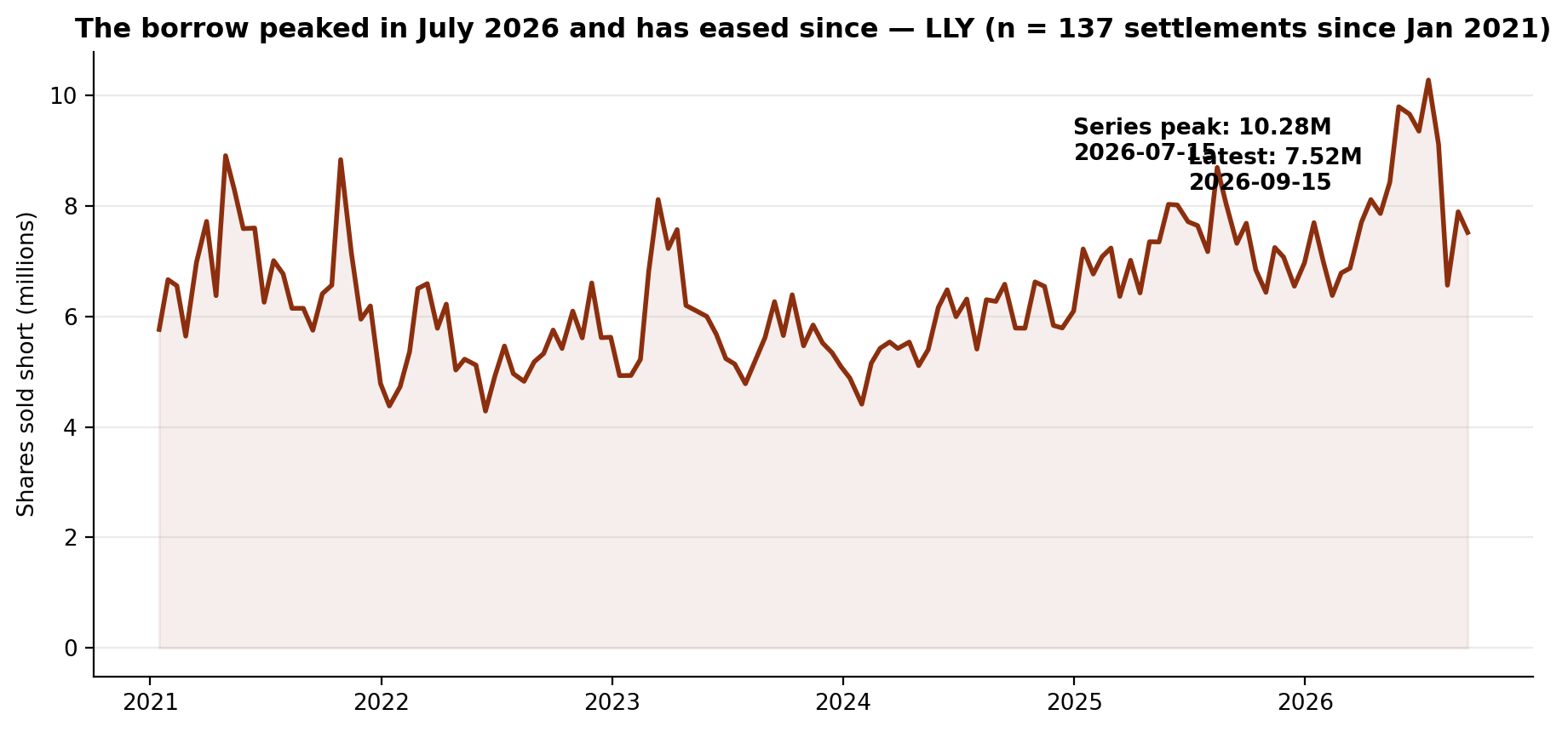
The borrow is small and shrinking from a recent high. It is a position that peaked in mid-July, just before the stock's August closing high, and has since given back about a quarter of itself.
The gap, stated plainly
The narrative describes the market's growth leader: second-quarter revenue up 48%, guidance raised to $85 billion to $87 billion, three target increases in two weeks, a most-searched listing, and a stock that closed at a 252-session high in August. The filings describe the positioning that preceded it. The tracked superinvestors held 1,185,174 shares at June 30 across seven holders, having cut 21.76% — 329,531 shares — in a quarter when the price rose 30.4%, with no holder increasing, none entering, and the largest holder, Polen, carrying 56.3% of the cohort after cutting 27.1%. The full market moved the other way: 781,924,285 reported shares, up 88,217,686, across 4,631 filers — 310 more than the prior quarter. The 5% register printed 10 filings, all passive: a Lilly Endowment stake stepping down from 10.2% to 9.6% across six reported dates, a Vanguard Group stake at 8.55%, a Vanguard Group row at zero, a Vanguard Capital Management stake at 6.48%, and a PNC stake at 5.39%. Insiders, across 226 parsed filings, recorded zero purchases in the last year against 309 sales, and 9 purchases in the whole parsed record, all of them older than a year. Congress records 3 purchases and 3 sales, all of them in the House record; the Senate record holds no row for this name. And the borrow stands at 7,519,918 shares — 26.8% below a peak set on July 15, 2026, and 0.80% of the share count. One plausible reading is that the registers are describing a name the broad market kept adding to while the concentrated holders and the insiders did not: the full register added about an eighth more shares and 310 filers in the very quarter the price rose 30.4%, the tracked cohort cut by more than a fifth with not one increase among seven holders, the insider tape's purchase line stayed empty for a full year, the founding endowment's reported stake fell at every reported date, and the short side peaked in July and faded — all of the 13F part of it snapshot at June 30, when the stock closed at $1,199.43, before the August closing high and the October target raises the current story rests on. The record supports each clause separately; it does not say which register is right, and it cannot — the tracked cohort's whole position is a June 30 snapshot of 1,185,174 shares, taken before the quarter that made the narrative.
What would change the picture
Nothing above is a recommendation. It is a record. These are the filings that would change the description:
- 1. The 2026Q3 13Fs (filing window closing mid-November 2026). The tracked cohort held 1,185,174 shares at June 30 across seven holders, after a -21.76% move made of five cuts and two holds. Whether Polen builds on or keeps cutting its 666,912-share position after a quarter in which the price first set a closing high of $1,280.34 and then fell 10.7%, whether any holder's label turns to increased, and whether any eighth tracked name appears are the first things the next register will answer.
- 2. A first insider purchase after a year of none. The parsed record holds zero purchases in the year through October 2, 2026, and 9 in total, all older than a year, against 483 sales. A single purchase transaction, by any insider, at any size, would break the pattern this lens currently shows; a 90-day window with no sale in it would change its recent shape just as much.
- 3. The Lilly Endowment's next step. The endowment's reported stake has fallen at six consecutive reported dates, from 96,891,978 shares (10.2%) to 90,376,978 shares (9.6%), and news reports describe a further 300,000-share sale filing. Whether the next amendment holds the stake near 90.4 million shares or prints a seventh consecutive step down is the first thing this register will answer.
- 4. Whether the borrow rebuilds toward its July peak, or keeps fading. Short interest stands at 7,519,918 shares, 26.8% below the July 15, 2026 peak of 10,278,892 and 19.6% below the June 30, 2026 settlement of 9,353,153. A reading back above 9,353,153 would mark a rebuild; a reading below the August 14 print of 6,564,742 would extend the fade.
- 5. A first Senate record, at any size. The combined congressional record carries 3 purchases and 3 sales, all of them House, split across two members, one from each party. A single Senate purchase or sale would give this lens a second chamber for the first time in our coverage.
Until one of those prints, the record describes a stock held by seven of our 83 tracked superinvestors — 1,185,174 shares, cut 21.76% in the quarter its price rose 30.4%, with one holder carrying 56.3% of the stake — whose full market added 88,217,686 reported shares across 310 more filers, whose insiders have recorded no purchase in a year against 309 sales, whose largest 5% holder is a founding endowment stepping down from 10.2% to 9.6%, whose congressional register is 3 House purchases and 3 House sales with no Senate row at all, and whose borrow has fallen 26.8% from a peak set two months before its latest reading — all of it snapshot at June 30, before the August closing high and the October target raises the current story rests on.
Related reading: Two of 83: One Holder Is 99.4% of the Superinvestors' Palo Alto Networks Stake. Its Insiders Have Bought Twice. — Filing Tape #63; Fourteen of 83: Wells Fargo's Superinvestors Stood Still as the Full Market Added 15.0%. Its Insiders Have Never Bought a Share. — Filing Tape #62; Zero of 83: The Superinvestors Aren't in IREN — Filing Tape #1. LLY's own page: Eli Lilly and Company (LLY) on GetCoattail.
Methodology and data notes
- Superinvestor lens: 83 managers collected directly from SEC EDGAR Form 13F (managers_13f collection), positions as of June 30, 2026; LLY identified by CUSIP 532457108. Seven distinct managers hold long positions totalling 1,185,174 shares; there are no option rows for this name in the collection. The direction count on the collection's labels, across the long rows, is five decreased and two unchanged; the collection's exit list contains no LLY row. Quarter-to-quarter cohort totals (1,514,705 long shares at March 31; 1,185,174 long shares at June 30; change -21.76%) are from the site pipeline's holdings files on the same CUSIP basis in both quarters, and the pipeline's second-quarter totals match the EDGAR collection exactly on both shares and value (differences of 0 shares and $0). All seven March rows are matched to their June holders by share continuity, and every label agrees with that continuity: Polen Capital Management 914,557 → 666,912 shares (-27.1% on the label), Jensen Investment Management 230,671 → 153,735 (-33.4%), Mairs & Power Funds 326,306 → 322,129 (-1.3%), Dodge & Cox Funds 42,012 → 41,258 (-1.8%), Bill Nygren - Oakmark Funds 450 → 431 (-4.2%), Torray Funds 398 → 398 (unchanged) and David Katz - Matrix Asset Advisors 311 → 311 (unchanged). Polen's share of the cohort is 56.3% = 666,912 / 1,185,174.
- Full-market lens: SEC Form 13F Data Sets full-market aggregation. The primary table is the full13f collection's by-ticker file (holders = distinct filers reporting the CUSIP; 4,618 reported long positions out of 4,631 filers). LLY reports under a single CUSIP spelling, 532457108, and the backfill fixtures' by-CUSIP file carries the same row — the cross-check matches on every field (holders, shares, reported value, prior holders and prior reported value). The by-ticker file's entered/exited fields (2,209 and 1,899, a net of +310 that matches the change in holder count) are gross flows, so this audit headlines the net change. Reported-value caution: the aggregate value ($942,123,799,338 over 781,924,285 shares) implies $1,204.88 per share against a June 30, 2026 close of $1,199.43 in our price file, a gap of +0.5% — printed here as found. The aggregate sums the VALUE of every information-table row — including put and call option rows — while the share count covers long common-stock rows only, so we headline filer and share counts and label dollar values "reported."
- Insider lens: full-parse Form 4 aggregation (agg_by_ticker), record as of October 2, 2026 (226 filings). Sale and purchase counts are transaction-code counts (S and P) in non-derivative rows; grants and exercises are not counted as purchases, and one filing can contain many transaction rows. Purchase transactions total 9 across the parsed record (6,987 shares, $4,537,300.77, eight buyers, four of them recorded as officer purchases for $2,828,655); the last year holds 0 and the 90-day window holds 0. Sale transactions total 483 across the record (5,038,328 shares, six sellers, 13 of them recorded as officer sales); the last year holds 309 (3,277,828 shares, five sellers, five officer sales) and the 90-day window holds 3 (13,500 shares, $15,958,170, three sellers, all three officer sales). The site's insider aggregate (compiled as of October 13, 2026, 90-day window) carries 0 purchases, 3 sales, three sellers and $15,958,170 for this name — identical to the full parse's 90-day window — so this audit prints the full parse as the record. One field is deliberately not used as a figure: the aggregate's sale-value field totals $78,900,147,569.49 for the last year and $81,985,376,912.67 across the record, which against the corresponding share counts imply $24,070.86 and $16,272.34 per share respectively, both inconsistent with LLY's traded prices over the period (roughly $800 to $1,280 on our price file). The purchase-value fields and the 90-day sale value imply per-share figures consistent with traded prices ($649.39 and $1,182.09 respectively) and are cited; the two inconsistent sale-value totals are quoted in this note only to document why they are excluded, and are used as figures nowhere in this article.
- 13D/G lens: full-parse SC 13D/G parsed filings (10 filings matching issuer CIK 59478 on CUSIP 532457108, 10 reporting-person rows across 5 names as filed: one SC 13G filing and nine SC 13G/A amendments, no SC 13D-family filings), filings through July 23, 2026. The site aggregation's by-ticker file carries the same totals (10 filings, 5 reporters, latest filing July 23, 2026, maximum 10.2%, total reported 756,268,458 shares), and the parsed reporting-person rows sum to the same 756,268,458, so the aggregate and the parse agree here; the aggregation's total sums reporting-person rows across different dates and entities, so it is not used as a stake figure in the article. The Lilly Endowment's rows (96,891,978 shares at 10.2% as of December 31, 2024, filed January 27, 2025; 96,016,978 at 10.1% as of March 31, 2025; 95,492,993 at 10.1% as of September 30, 2025; 92,190,516 at 9.8% as of December 31, 2025; 91,896,978 at 9.7% as of March 31, 2026; and 90,376,978 at 9.6% as of June 30, 2026, filed July 23, 2026) appear under two name spellings exactly as filed ("LILLY ENDOWMENT INC" and "LILLY ENDOWMENT, INC.") and are reported as one chain because the share counts form a single continuous series; the endowment is described in market reports as the company's largest shareholder, and no reason for any change is asserted — the filings themselves are the record. The Vanguard Group's rows (80,952,595 shares at 8.55% as of September 30, 2025, filed October 30, 2025, SC 13G/A; then 0 shares at 0.0% as of March 13, 2026, filed March 26, 2026, SC 13G/A), Vanguard Capital Management's row (61,295,605 shares at 6.48% as of March 31, 2026, filed May 1, 2026, SC 13G) and The PNC Financial Services Group's row (51,153,837 shares at 5.39% as of December 31, 2024, filed February 7, 2025, SC 13G/A) are reported as filed, under the reporting-person names exactly as they appear. The parsed coverage for this issuer holds these 10 filings; a 5% holder that has not filed in the covered window would not appear here.
- Congress lens: Senate PTR archive and House PTR archive as maintained on this site. The combined record (as of October 3, 2026) carries 3 recorded purchases and 3 recorded sales, a most-recent purchase date of June 10, 2026, and an aggregate member count of two (one member from each party) for this ticker; the House aggregate (as of October 3, 2026) carries the identical record, and the Senate aggregate (as of October 1, 2026) carries no LLY row at all, so the combined record is the House record alone. Transaction counts are reported as the aggregates carry them; this audit does not reconstruct individual filers from the aggregate beyond what the aggregate itself states.
- Short interest lens: FINRA Equity Short Interest files (biweekly settlement dates), collected directly from FINRA's public distribution. The published series covers 137 settlements from January 15, 2021 (5,763,791 shares) to September 15, 2026. The latest reading is 7,519,918 shares on September 15, 2026, down 4.74% from the prior settlement (7,894,476 on August 31, 2026), which had risen from 6,564,742 on August 14, 2026, following 9,117,184 on July 31 and 10,278,892 on July 15. The series maximum is 10,278,892 shares on July 15, 2026 (verified by a maximum query over the series, not read off the latest row), so the latest reading sits 26.8% below the peak. The year-ago settlement (September 15, 2025) printed 7,323,001 shares, so the latest reading sits 2.7% above a year ago. The series minimum is 4,286,692 shares on June 15, 2022, so the latest reading sits 75.4% above the low. The June 30, 2026 settlement printed 9,353,153 shares, so the latest reading sits 19.6% below the 13F snapshot date's borrow. FINRA publishes each settlement about two weeks after the fact, so the October price action is not yet in this series. The share-count ratio (0.80%) uses the fundamentals file's shares-outstanding figure below.
- Fundamentals note: our fundamentals collection carries LLY's revenue of $65,179,000,000, net income of $20,640,000,000 and assets of $112,476,000,000, each labelled fiscal 2025 in the file. The file is marked ok for this name, with no missing fields: shares outstanding of 941,357,065 (as of August 3, 2026 in the file, sourced in the file to the issuer's reported shares-outstanding figure) and a file-computed market value of $1,089,611,379,973.91. The file's price for the name is $1,157.49 as of October 6, 2026; our daily-close file ends October 2, 2026 at $1,142.85, and we keep the two files' figures separate rather than blending them.
- Prices: our own daily-close file for LLY through October 2, 2026 ($1,142.85 close, +6.3% year to date on that file; 252-session closing high $1,280.34 on August 19, 2026, so the last close sits 10.7% below it; 252-session closing low $799.57 on October 21, 2025; closes of $919.77 at March 31, 2026 and $1,199.43 at June 30, 2026, a second-quarter change of +30.4%; change from June 30 to October 2 of -4.7%; change from the 252-session low of +42.9% ((1142.85 / 799.57) − 1); change from the September 30, 2025 close of $763.00 of +49.8%). The series in our price file begins June 1, 2021 at $198.42.
- Market context sources: MarketBeat pharmaceutical screener list, "Best Pharmaceutical Stocks To Watch Now – October 10th" (LLY first of five names by dollar trading volume; checked October 13, 2026); Zacks most-searched listing for LLY (October 9, 2026; shares up 4.2% over the preceding month, as summarised by DailyIQ, checked October 13, 2026); second-quarter 2026 results (revenue of about $23 billion, up 48% year over year; Mounjaro revenue $9.9 billion, up 91%; Zepbound revenue $4.9 billion; full-year revenue guidance raised to $85 billion to $87 billion — company results as reported by InvestingChannel News and Insider Monkey, October 2026, checked October 13, 2026; the guidance range is also reported by The Motley Fool, October 13, 2026); analyst targets (JPMorgan $1,500 on September 28, 2026, and Morgan Stanley $1,430 on October 7, 2026, as reported by MarketBeat via ad-hoc-news; Cantor Fitzgerald $1,440 on October 9, 2026, as reported by 24/7 Wall St. via ad-hoc-news — all checked October 13, 2026); valuation context (forward price-earnings of 30.94 against a five-year average of 45.59, as of October 6, 2026 — InvestingChannel News, checked October 13, 2026); the Lilly Endowment sale report (a filing to sell 300,000 shares worth about $347 million, described as driven by a legal payout requirement rather than company performance — market-news summary carried by Pluang, about three days before October 13, 2026); pullback context (shares up 41% over the prior 12 months and down about 8% from the August all-time high — The Motley Fool, October 12, 2026); next earnings (third-quarter 2026 report listed for October 29, 2026 on the company's investor calendar — Zacks and ad-hoc-news, checked October 13, 2026). Figures we could not confirm against two sources were left out.
- LLY is in the GetCoattail stock-page universe: Eli Lilly and Company (LLY) stock page. Series data: lly_lens_data.csv · lly_short_interest_series.csv. Earlier audits: Palo Alto Networks · Wells Fargo · IREN.
Past patterns are not a promise of future results. For education only — not investment advice.
This article describes public filings as of the dates stated. It is not investment advice and makes no recommendation. Filings lag reality: 13F positions are as of June 30, 2026, and later trading is not yet public.
Revision history
- v1.0 — October 13, 2026: first publication.